

Last updated on August 15, 2023 8:25 pm
Can any laser level work for different laser leveling jobs?
Aaron Barnett of BangingToolbox suggests: No. Nobody told you there are many different laser-level types to choose from.
When you decide to own one, one might say, these laser levels seem the same.
But they are not.
Here’s the truth: there is one type most suitable for a specific leveling job. And not all laser levels can perform the other’s leveling jobs.
To know the right laser level for your line of work, we have made a comprehensive guide of laser level types for you.

1. Manual laser levels
As the name implies, a manual laser level requires manual tool adjustment to align the bubble in the vial to achieve your desired alignment or level.
You can adjust it through controls or screw knobs to move the laser line or dot.
With its simple design, it’s no doubt this is the least expensive option on this list. This leveling tool is perfect for DIY jobs that require a basic straight line as a reference point.
Where to use manual laser levels?
- Hanging pictures, curtain rods, shelves, and the likes
- Tile installation
- Cabinetry
- DIY framing
- Electrical fixture installations
There are more tasks a manual laser level can do in the spur of the moment.
A basic line laser will project a plumb reference line for simple leveling tasks that requires basic-level accuracy.

Features
- Manual controls
- Less battery power consumption
- Minimal setup
- User-friendly operation
- Lightweight and portable design
Drawbacks
- Takes longer to setup
- Can easily misalign in simple movement
- Lower precision level than self-leveling laser levels
2. Self-leveling laser levels
Self-leveling laser levels use self-aligning mechanisms to project leveled laser lines.
Either a pendulum or electronic sensors are utilized to detect level and adjust the line accordingly.
One thing that makes these laser levels appropriate for construction and building sites is it keeps the level in place even if you have to move the tool frequently.
Where to use self-leveling laser levels?
- Installing floor, tile, or carpeting
- Aligning walls and hanging objects on walls
- Cabinetry
- Installing lighting fixtures
- Grading land or retaining walls
- Checking slopes
There are more leveling tasks you can do with a self-leveling laser measure. But this type of laser level generally offers more precision than manual laser levels.
Self-leveling laser levels can do most leveling tasks from construction to engineering to interior designing and DIY home improvement projects.

Features
- Automatic leveling
- The nice precision of 1/16 inch per 100 feet
- Multiple functions like vertical, horizontal, and cross lines
- Easy to set up
- Locking mechanism
Drawbacks
- More pricey
- May be sensitive to shocks and impacts
3. Dot laser levels
Dot laser levels are sometimes called point or spot laser levels.
Instead of producing laser line beams, it projects dots or points to signify a level or 90° angle. Dot laser levels project two to five laser dots in level, plumb, or square settings.
Where to use dot laser levels?
- Transferring reference points floor, ceiling, and wall
- Installation of switches, outlets, and lighting fixtures
- Installation of electrical wirings
- Aligning of pipes and conduits
- Layout and marking
- Installation of wall trims
- Stud wall installation

Features
- Two to five laser points and possibly even a cross line
- 90° point generation
- 1/16 inch accuracy
- 15 to 65 feet projection range, depending on the model
Drawbacks
- Limited range
- Limited visibility
- Limited only to dot projection
- Needs a flat surface for more accuracy
4. Line laser levels
Line laser levels are the most used leveling tool in most building and construction sites. They can project both horizontal and vertical beams at 180°.
Line laser levels are designed to perform indoor leveling tasks. They work similarly to dot laser levels but project laser lines instead.
Where to use line laser levels?
- Mounting shelves and cabinet
- Most indoor plumbing and leveling tasks
- Aligning doors and windows
- Tile or floorboards installation
- Aligning pipes and conduit
- Getting ceiling heights

Features
- Multiple LEDs
- Project horizontal and vertical lines
- Up to 100 feet range, depending on the model
- 1/16 inch accuracy per 100 ft
- Self-leveling
Drawbacks
- Visibility may be limited by ambient light
- Requires a flat surface
- More expensive than dot laser levels
- The pendulum is sensitive to impacts and shocks
5. Cross-line laser levels
Cross-line laser levers are line laser levels that can project two 90° lines vertically, horizontally, or at the same time.
With this capability, the leveling tool shoots the vertical and horizontal coordinates you need at the same time with ease.
The cross-line beam projection can quickly transfer horizontal and vertical coordinates for floor-ceiling alignments.
Where to use cross-line laser levels?
- For aligning cabinets and shelves
- Window and door installation
- For precise installation of floorboards
- Precise tile installation
Note that this list is only a few of the many indoor tasks a cross-line laser levels.

Features
- Cross-line laser beam projection
- Horizontal and vertical line projection
- Two lines that project 90°angles
- 1/16 to ⅛ inches per 30 feet
- Self-leveling
Drawbacks
- More expensive
- Requires flat surface
- The pendulum needs careful handling
- May have limited visibility outdoors
6. Combination laser levels
Combination laser levels have the functionality of both dot and laser levels. I call the best type a 5-point (2-line) laser level.
Much like cross-line laser level, however, they project laser beams and dots individually or simultaneously.
Where to use combination laser levels?
- Installation of pipes, conduits, and electrical boxes
- Drop ceiling installation
- Framing and drywall installation
- Level soil or planting beds

Features
- Line and dot projection
- Self-leveling
- Multiple modes
- ⅛ to 1/16 inch at 30 feet
- Projection range of up to 100 feet
Drawbacks
- Complex to use
- Maybe bulkier and heavier than other types
- It may be more fragile than other types
7. Rotary laser levels
Rotary laser levels project a spinning invisible dot to cover an entire room or building site outdoors to create a virtual 360° line. The most advanced type of laser level spins the dot at 1000 RPM or more, projecting a solid plane laser beam horizontally or vertically.
With an accuracy of 1/16 or ⅛ of an inch per 100 ft, this leveling tool makes the most suitable outdoor laser level and requires a digital sensor to pick up the beam with an audible sound.
Where to use rotary laser levels?
- Grading work
- Laying pipes
- Laying foundations
- Landscaping
- Leveling floors

Features
- Spinning laser dot to 360°
- Self-leveling pendulum
- High to medium accuracy for a fast work time
- Multiple leveling modes
- Long range of 1000 to 2000 feet
Drawbacks
- Most expensive type
- Too complex for personal or DIY use
- Fragile
- Heavy and bulky
- Needs maintenance and regular tests for calibration
8. Grade laser levels
Grade laser levels are rotary laser levels designed specifically for establishing accurate and symmetrical grades or slopes. They are available in single and dual slopes. Within a few seconds, you can obtain angle and height and establish grades without calculating them yourself.
Where to use grade laser levels?
- Lay out and prepare construction and excavations sites
- Align and level concrete forms
- Measure slopes
- Align inclined structures

Features
- Dual axis slope
- Self-leveling feature
- Accuracy of 1/16 of an inch at 100 ft or more
- Long-range remote operation
Drawbacks
- Also expensive
- Heavy and bulky to transport and move
- Needs careful handling
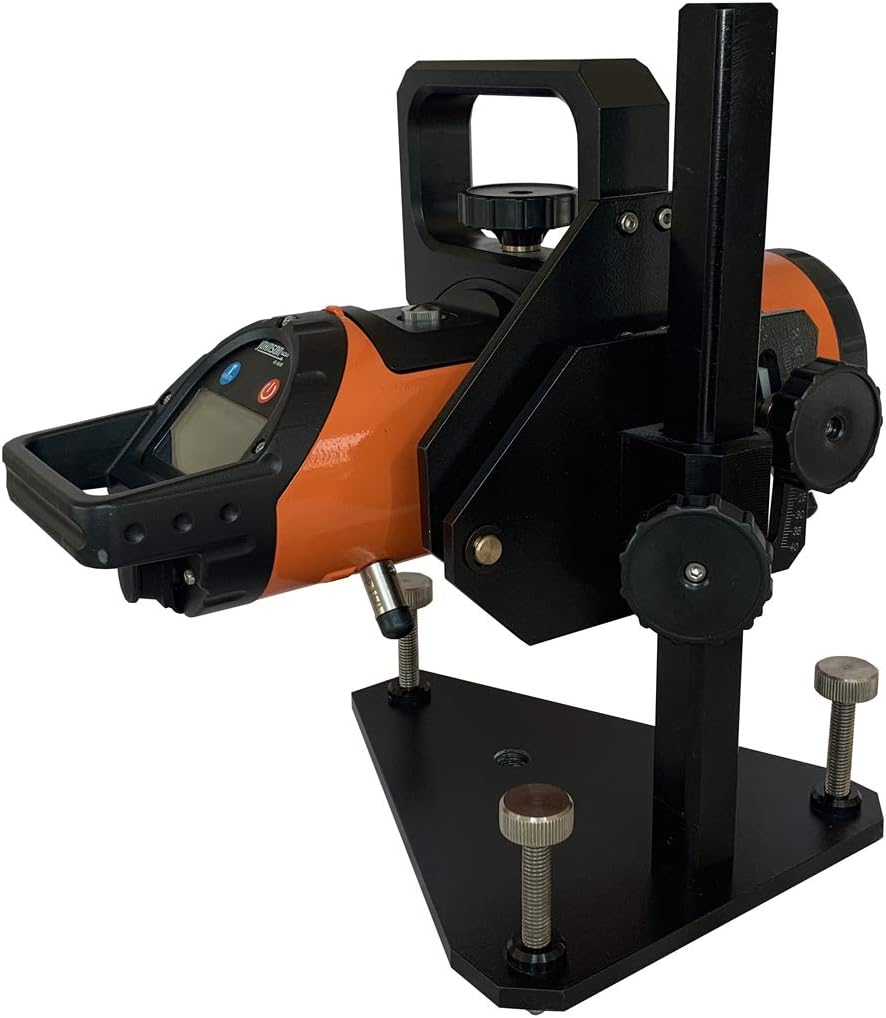
9. Pipe laser levels
A pipe laser level is designed specifically for pipe laying in plumbing, drainage, or similar.
Pipe laser levels may include specific grading modes for pipe installation.
Where to use pipe laser levels?
Pipes need leveling and plumbing for working out accurate falls for works in tunnels, sewers, manholes, trenches, and excavation works.
Features
- Narrow beam for pipes
- High accuracy of 1/16 of an inch per 100 ft
- Remote operation
- Long battery life
Drawbacks
- Needs operation expertise
- Limited for pipe laying and similar tasks
- Needs careful handling and storage
- Requires frequent calibration
Final Word
Now that you know how each laser level type works, you can choose which one to use for ground-leveling tasks, building, pipe laying, or tile laying. As you see, some laser levels are overkill for a DIYer.
A DIYer is better off with a cheaper USB-charged cross-line level if budget is a concern. Or, you can upgrade a dot laser is better for ease of use and more building functionality.
If you’re looking for a versatile laser level, invest in a reliable and accurate cross-line laser level. And for larger outdoor projects, a rotary laser level would be worth the investment.


