
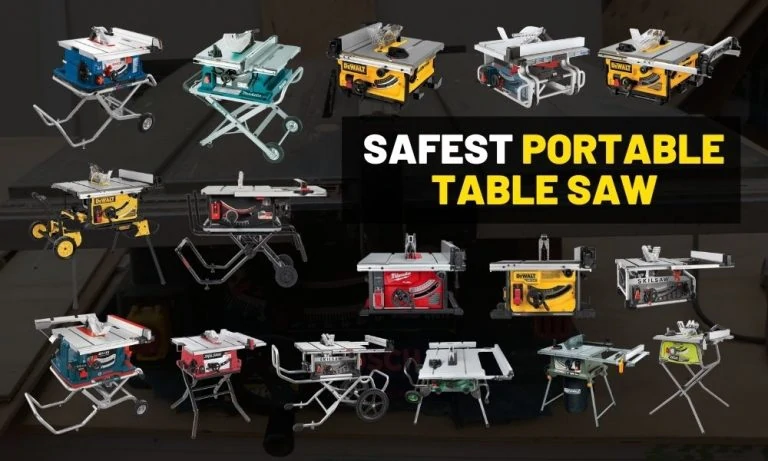
- What a safe table saw means?
- Safest portable table saws (Flesh detecting break)
- Best standard portable table saws
- Cordless table saws
- What is a portable table saw?
- Are bench saws dangerous?
- Table saw safety attributes
- Standard table saws vs. Stop saw technology
- Jobsite table saws vs. Cabinet table saws
- Cordless table saws vs. Corded
- More on Bosch vs. Stopsaw
- How StopSaws work, flesh sensors explained
- Are StopSaws worth the extra cost?
- Other tools that can rip timber
- Tips for using your portable table saw
- Table saw history
- Comparing top table saws
- The verdict: The safest table saw for your workshop
- Sawstop JSS-120a60

Last updated on March 20, 2026 2:41 am
What a safe table saw means?
According to Aaron Barnett of BangingToolbox: Bosch and Sawstop have an inbuilt flesh-detecting emergency break, making the safest portable table saws. Other table saws made by Dewalt and Makita have essential attributes like an adjustable riving knife and a sturdy modular blade guard.
A flesh-detecting emergency break is designed to instantly stop the saw blade in case of accidental skin contact. In some cases, the blade is retracted downward inside the tool if such an incident occurs.
As time goes on this feature is becoming more and more affordable on what otherwise would be the most dangerous table saw.
You will soon find out that new tool reviews aren’t the only thing that gets men excited, and that the best table doesn’t have cutlery on it but runs on a powerful motor attached to a saw blade with all the safety attributes.
Take your time to browse our review, and consider all your options online, that will help you find the best choice that you will not regret.
WARNING! (Graphic Content Below)
Avoid cutting your fingers with a table saw!
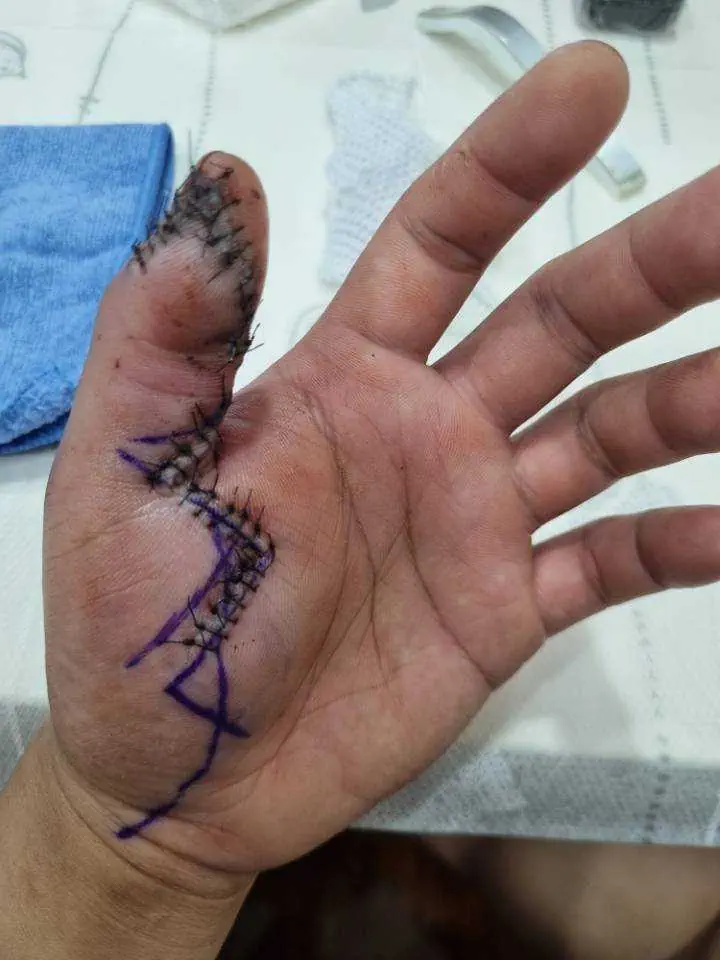
Table saws aren’t toys! One wrong move can remove your precious, hardworking fingers!
If you aren’t trained or qualified to use a table saw or unsure about buying, hold it off! Accidents happen fast, and your fingers won’t grow back!
That’s why I recommend table saws with built-in safety guards to save your hands and possible hospital trip.
Remember! Safety first! Even qualfied builders are at risk if they dont have push sticks, guards or are working fatigued.
The chippy in this photos wants to share that tablesaws with an emergancy break can stop these accidents from happening.
Safest portable table saws (Flesh detecting break)
#1 Finest value flesh detecting table saw
SawStop JSS-120A60 safe flesh detecting table saw with rolling stand

- The safest ‘jobsite’ table saw with an instant emergency brake on skin contact if human flesh is sensed on the blade.
- An easy-to-adjust and accurate fence and blade adjustment with a sliding table extension.
- Comes standard with an active dust collection blade guard.
- Armed with a T-style high/low fence that slides easily and locks firmly into place.
- The one-turn elevation feature helps you raise and lower the saw blade with a single turn.
- The new design adds two inches to the depth of the table.
- Costs more than saws without a flesh detecting break.
#2 The Bosch flesh detecting table saw
Bosch GTS1041A-09 safe flesh detecting portable table with stand

- Active response technology prevents injury with flesh sensing technology.
- System reset doesn’t cause damage to the saw blade.
- Very sturdy stand.
- Dual-activation cartridge unit.
- Easy to set fence and rail.
- Dust extraction system could be better.
- A few complaints of the saw tripping with no known incident.
Best standard portable table saws
#1 Finest value portable table saw
DEWALT DWE7491RS carpenters 10-inch portable table saw

- The contractor table cuts up to 32 ½” rip capacity through hard materials and large workpieces.
- Tool-free adjustment of guard component.
- The fence is quickly accurate and easy to adjust.
- The stand can be set up and broken down. easily.
- A quick-mount base design would have been better.
#2 Best Makita portable table saw
Makita 2705 10-inch table saw

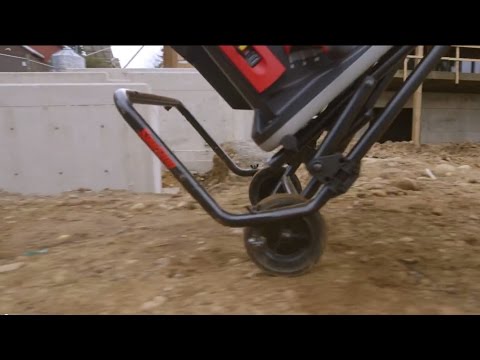
- More sturdy tool stand with wheels.
- The saw blade spins at a maximum speed of 4,800 RPM.
- Adjustable dual side guards for easy measurement.
- A modular blade smart guard system can be adjusted without tools.
- The fence can move a bit if bumped too hard.
#3 The Bosch table saw
Bosch 4100-10 10-inch blade portable table saw with folding table stand

- Space-saving design with a table extension.
- Excellent portability and easy setup/takedown.
- Soft start circuitry prevents tripping of the circuit breaker.
- Equipped with a smart guard system and anti-kickback pawls for maximum protection.
- The rolling stand could be more robust.
#4 A smaller Dewalt jobsite table saw
Dewalt DW745 10-inch table ripping saw

- Lightweight and optimized footprint enhance the portability of this unit.
- Utilizes a steel roll cage that provides drop and impact protection.
- The rack and pinion fence system ensures accuracy and ease of use.
- It can be difficult to find a dust collection attachment that fits, not hard to DIY tho.
#5 A DIY portable bench saw
Skilsaw SPT99-11 10-inch worm drive table saw with stand

- Installed with a very precise rack and pinion fence system for quick adjustments and accurate cuts.
- Securely held by a durable rolling stand.
- Includes dust port elbow for easy clean-up.
- The outfeed and left support design makes it easy to make larger cuts with the table extension.
- Locking parts are a bit flimsy.
#6 Another Dewalt portable bench saw
Dewalt DWE7480 10 inch compact table saw

Rack and pinion telescoping fence rails simplify fence adjustment.- 24 ½” capacity for a wide variety of cuts.
- Comes with onboard storage compartments.
- The included saw blade isn’t the best quality.
#7 Small portable Jobsite table saw
Bosch GTS1031 10-inch portable table saw

- Portable contractor table saw that is easy to maneuver for easy transport.
- Square lock rip fence self-aligns for accuracy and consistency with anti-kickback pawls on the saw blade.
- Stands with a rugged and durable all-steel base.
- The motor is pretty loud.
- Could use a soft start feature.
#8 The Hitachi table saw
Hitachi C10RJ 10-inch 15-amp table saw with rolling stand

- Operates on a powerful motor that spins at 4,500 RPM.
- Offers a soft start function that reduces start-up recoil.
- Bevel ranges from 0° to 45°.
- The hex bolts used in the fence tend to strip easily.
- The fence needs to be adjusted periodically.
#9 Another DIY table saw
Skilsaw SPT70WT-01 10-inch portable timber ripping saw

- Brass-gear worm drive design provides plenty of speed and torque for a small saw.
- The dual-field motor facilitates higher cutting speed and longer motor life.
- Armed with a self-aligning rip fence and a table extension for easy transport.
- Does not come with a stand.
#10 Affordable DIY table saw with stand
Skil 3410-02 10-inch portable table saw with folding stand

- The aluminum table can extend to 32 inches allowing for longer pieces.
- The steel stand is rugged and easy to set up.
- Fitted with a self-aligning rip fence for accuracy.
- Better suited for basic jobs.
#11 Table saw for homeowner
Rockwell rk7241s DIY table saw with laser

- Lightweight but capable of some heavy-duty jobs.
- A deep cutting depth and a table extension.
- A folding fence that helps produce wider cuts.
- Adjusting the blade bevel is a bit difficult.
- The vibration of the height-adjustment wheel causes the blade to move when making cuts.
- For more basic jobs.
#12 The Skil table saw
Skil TS6307-00 DIY Table Saw with Folding Stand
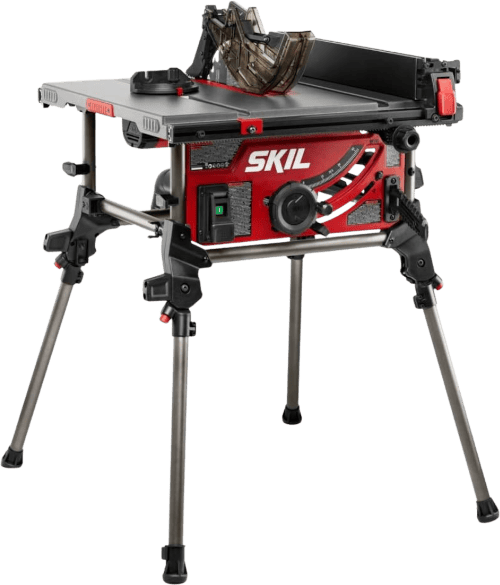
- Runs on a powerful 15-amp motor that handles even heavy-duty tasks with anti-kickback pawls.
- Large rip capacity of 25.5 inches.
- Convenient with a quick-folding stand for easy moving and transport.
- Can be too small for certain tasks.
- For the DIY market.
Cordless table saws
#1 Best cordless table saw
Milwaukee 2736-20 cordless table saw, 8-1/4-inch

- Boasts a maximum bevel adjustment of 47°.
- The guards and riving knives can be changed without tools.
- Compatible with high-capacity M18 batteries for cordless use.
- Surprisingly includes an onboard storage compartment.
- Does not come with a battery or charger.
#2 Best cordless Dewalt table saw
Dewalt DCS7485B flex volt 60v cordless table saw, 8-1/4-inch

- Changes the voltage automatically when you change tools.
- The power-loss reset feature prevents accidental re-starting.
- Boasts a 24” rip capacity.
- Decent battery life but you will still need to change periodically.
What is a portable table saw?
Table saws are the best thing used to rip or cut timber into strips at your exact set dimension, both square cut and angled cuts are easily possible.
Such work with a circular saw can be less accurate as wobble can occur doing this heavy-duty work by hand. Table saws are otherwise known as, rip saws, and bench saws.
Table saws consist of circular blades mounted on an arbor or metal shaft. They are driven by an electric motor via a system of gears or a belt or directly by the motor.
The workpiece being cut is supported by the top of the table from which the saw blade protrudes.
With most current rip saws, the up and down position of the blade varies the depth of the cut.
The higher the blade can stick out above the table, the deeper it will be able to cut into your timber.
With older designs, the table can be adjusted up or down, which determines the depth of the cut. With such saws, the blade and arbor remain in the same position.
Modern table saws have a fixed base and the blade moves up and down via an adjustable dial, also with an additional dial that will allow you to make different angled cuts by your set adjustment on the “blade angle”.
In older designs, the cutting angle was determined by the angle of the table itself.
Table saw parts
- Dust extractors. These attachments clear out dust build-up and prevent them from being ignited by friction from the blade.
- Blade elevation/tilt adjustment wheel. Blade elevation wheels let you specify the depth of the cut by allowing you to adjust the blade height. In portable table saws, this is usually combined with a tilt adjustment wheel that lets you control the angle of the cut.
- Automatic blade brake. This can greatly reduce the chances of injury when using a table saw if there is accidental skin contact with the machine’s flesh-sensing blade. This feature were built into most commercially available table saws since 2005, but even some portable DIY and trades saws now have it.
Before buying a table saw…
1. Check the durability.
A portable table saw should be durable enough to handle a wide variety of straight cuts, in thick slabs of timber as well as thinner pieces of durable wood.
The best table saws can make cross cuts in even thick material without the saw blade coming off the saw or breaking.
2. Research the brand.
Unsurprisingly, the best table saws are made by some of the biggest and best-known brands in the power tool industry: Bosch, DeWalt, and Makita.
These brands generally offer the best performance and attributes, although companies such as Festools and Skilsaw make portable table saws with exceptional value for money. Stop Saw makes the safest rip saw to use at a fair price.
3. Decide your price.
The best table saws will always cost more than the entry-level or hobbyist models.
In the case of stop saws, a high-end model could easily end up costing you double what you would pay for a standard model without the flesh-sensing attributes such as an emergency brake on human contact on the blade.
As always, I suggest that you get the best model you can afford in your budget, taking performance and safety into consideration.
4. Consider your safety.
Features such as a modular blade guard and quick shut-off buttons come standard in the best table saws. They can be very useful for preventing injuries, which are common occurrences when using portable table saws.
Look into saw stop attributes as well, which detect if the saw blade comes into contact with your hand or fingers and shuts off the blade mechanism immediately.
The best budget table saws won’t have this feature but should definitely have all the other safety attributes that all new bench saws should come with.
5. Evaluate portability.
Portability isn’t always sliding when shopping for a table saw it can also be rolling.
These saws are typically used in a fixed position, so you probably won’t have a need to move it around too much once it is in place. But if you are a tradie moving from job to job you want to have a tool that is easily moved.
If you are going to do landscaping work or work in remote locations with no power source nearby, you could look at getting a cordless table saw.

What makes a top-quality table saw?
When shopping for a portable table saw, always go for a sturdy model that can handle even heavy pieces of timber.
Although many professional users would opt for an industrial saw designed for heavy-duty usage, the best budget table saws can provide similar performance in a more compact package.
Popular brands such as Makita, Dewalt, and SawStop make superior quality portable table saws that suit tradespeople on the move from Jobsite to Jobsite.
Although if a tradesperson owns a workshop, they might opt to set up an industrial ripping saw in the workshop, with dedicated room and space for doing big and bulk ripping jobs, before getting to the renovation, or new build worksite.
Features such as easy and accurate angle adjustment and sturdy fence adjustment that doesn’t lose its “set” position during operation make a table saw easier and safer to use.
If it’s a portable tool it should be fairly small and lightweight, with a quality add-on tool stand available so you can move it to different jobs or areas of your workspace, or to bring with you to remote job locations.
But perhaps the most important factor is ripping power. If your ripping saw can cut smoothly into 3-inch slabs of wood, it will probably be good enough to handle most home and DIY cutting jobs.
With the combination of a quality table saw, and a benchtop planer you can really shape timber exactly how you want.

Are bench saws dangerous?
In a word: yes. Like all power tools, portable table saws can be dangerous [1] in the hands of an inexperienced or careless user.
In fact, portable table saws are some of the most dangerous power tools around, causing thousands of injuries every year [2], but so do ladders.
This doesn’t mean that you should avoid using portable table saws entirely.
With a bit of knowledge, extra precautions, and the use of safety attributes and equipment, it is possible to use these tools without injury, and for certain jobs.
And the correct PPE bench saws are arguably safer than doing big ripping jobs by hand with a circular saw.
Look into portable table saws with a saw stop feature that retracts the blade and stops the spinning action when it comes into contact with your fingers.
I’m going to go into more detail about this feature later on in the article. But for now, suffice to say that this feature could save you from serious injury so you should definitely look into it.
Make sure not to have any loose items, it can be a brilliant idea to have a sturdy leather shop apron on for a layer of torso protection. The apron will help stop wood dust from sticking to your clothes.
Table saw safety attributes
- Riving knife. This is a flat piece of metal that is attached to the work table, just behind the blade known as anti-kickback pawls. They prevent the cut sections of a workpiece from closing up and pinching the blade, which is a common cause of kickback, it is essential to have an adjustable riving knife.
- Fence. These help you keep the workpiece in place and allow you to make accurate cuts. In all cases, fences should be positioned parallel to the blade to avoid your work jamming.
- Guard. These help ensure safety when using a table saw. They typically have three components: a shroud that lets you see the blade without coming into contact with it; a splitter, which prevents the cut pieces from closing up and pinching the blade; and pawls that prevent kickback.
- Power switch position. These should be located for easy access and could ideally be large enough to be operated by your hand, elbow, or even knee if you need to shut off the saw quickly.
- Power cut-off switch. Get a switch that automatically turns off in case the power is disconnected or turned off elsewhere while in use. Let’s say for example the RCD blows or someone disconnects a lead by accident elsewhere on site, the power cut of feature would stop the tool from randomly turning on later, instead, electricity needs to be fixed at the source, and manually turned on again directly on the tool, so no surprises with start-up, this is such an important safety feature, as with all safety attributes these tools can come with that all highly reputed power tool brands include a power cut off from a disconnection else ware.
- Push sticks. It is a dummy piece of timber or plastic designed to hold and push your workpiece more safely into the saw cut. With a push stick, you don’t have to position your hand as close to the spinning blade. Using a push stick with a grooved V needs to be used instead of your hand at the end of each cut. This means it should always be present with the tool before use, to use at the end of your cuts. If you were to make an accidental slip while cutting the push stick will hopefully take the place of your fingers. (On a side note: making a timber push stick is a premium DIY project)
- Flesh-sensing system. These shut off the motor and stop the blade from spinning while retracting the blade if it was to come into contact with what’s sensed as flesh by the machine, this is done very quickly to help minimize major injuries using this type of tool.
- Dust collection port. Managing dust is important and so is having the best dust collection because a saw like this will generate a lot! Make sure the dust collection port is clear and operational and directed into a bag or a box to contain it.

Standard table saws vs. Stop saw technology
Standard table saws have some inherent risks, but many of them can be minimized with the use of safety attributes and equipment, safety practices, and plain old common sense.
As I explain elsewhere in this review, you can safely use table saws with a bit of care and practice, and if you know what you are doing.
But there is a way to reduce the risks of operating a table saw altogether and even eliminate them completely.
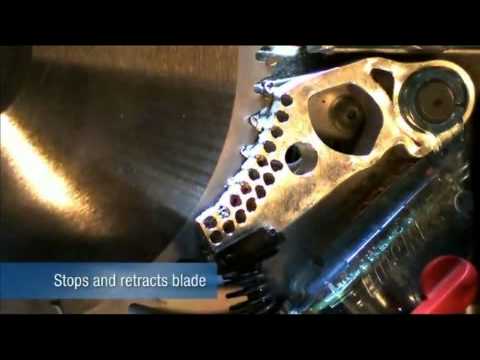
As implemented in the revolutionary SawStop, stop saw technology can make operating a table saw even safer than any safety feature included in a standard tool.
SawStop was invented by physicist Steve Gass. Introduced in 1999 SawStop [3] enabled table saws to tell when it was cutting into human flesh instead of wood.
The technology is based on the principle of electric conductivity. SawStop equipped saws have a sensor that detects the electricity that humans produce.
A brake is then applied to the blade, which causes it to retract and stop spinning, thereby preventing injury in the case of a slip.
All this takes place in a matter of milliseconds. At worst, you will only get a tiny nick on your finger before the blade pulls back.
Saws equipped with SawStop technology are more expensive than their standard counterparts, but they can prevent serious injury.
And for professional workshops, advertising the use of SawStop technology can improve the safety image and be good for business. Just remember to connect the dust collection.
Jobsite table saws vs. Cabinet table saws
The main reason to go for a portable Jobsite table saw instead of an industrial cabinet table saw or hybrid table saw (A mix between the two) is of course portability.
Industrial cabinet table saws are just too big and bulky for the average home user, hobbyist, or DIYer.
And if you need a table saw on a remote job site or out on the road, you can forget about bringing along your humongous industrial table saw.
Of course, in terms of sheer force, a commercial table saw beat the smaller portable models. Even the best portable table saws would struggle to keep up with a first-rate industrial model.
If you were to subject your Jobsite table saw to the same rigorous demands as you would a heavy-duty table saw, it will probably not last as long as a dedicated workshop industrial saw under heavy prolonged use.
That being said, most DIYers won’t ever need all the grunt that industrial hybrid table saws put out.
For most home users and even most tradesmen doing heavy-duty building work, a top-tier compact table saw is sufficient.
Besides, with portable models, you get the necessary power and performance without having to spend on a much more expensive industrial model with portable convenience.
If you do want the ultimate workshop woodworking experience using the best cabinet table saw for woodworking read our review.
If you want to know all the different saws for cutting and ripping wood read my guide here to know when to use what.
Cordless table saws vs. Corded
Those who’ve been following the site for a while know that I’m a big fan of cordless power tools.
They are usually simpler, cheaper, and more convenient to use than their corded counterparts.
And in terms of potential, the best cordless tools can hold their own against many corded models.
When it comes to Jobsite table saws though, our preferences lean slightly toward the corded versions.
Why? Because, unlike handheld power tools, table saws are designed to be used in a fixed position.
Therefore, there really isn’t much benefit to having a cordless version unless you are working outdoors or in a remote area with no electrical source nearby.
Furthermore, the jobs that you would use a table saw often require a lot of energy.
A cordless table saw would likely deplete the battery within minutes for heavy-duty work, so you would be constantly replacing and charging batteries.
When it comes to table saws, I recommend that you go with a corded model, unless you only plan on using it to do trim-related work and occasional work where portability is a top priority on a remote Jobsite.
Milwaukee 2736-20  | DEWALT DCS7485B  | |
|---|---|---|
| Verdict: | Best cordless | |
| Weight: | 113 lbs. | 90 lbs. |
| Size: | 8-1/4 inches | 8-1/4 inches |
| Battery: | 18V | 60V |
| Rip capacity: | 24-1/2 inches | 24 inches |
| Speed: | 5800 rpm | 5800 rpm |
What are the best jobsite table saws for carpenters & DIYers?
Although table saws are typically used in a fixed position, the ability to move them from site to site can be useful. Some degree of portability will make a saw more useful for professional carpenters and more experienced DIYers.
If you are going to be doing a lot of heavy-duty work, it might be better to go for an industrial rip saw that can handle pretty much any job. For all other uses, however, the DeWalt DWE7491RS provides stable and reliable performance, while the SawStop JSS-120A60 provides excellent value in a flesh-detecting model.
#1 Best Jobsite table saw
The SawStop JSS-120A60 adds a host of welcome attributes to the previous model, greatly adding to its versatility and capability.
Among these are a T-style high/low fence and an active dust collection blade guard that is now a standard feature.
In addition, the new model comes with a deeper table extended by two inches, giving you more room to handle bigger workpieces and deeper cuts.
Other attributes include the one-turn elevation control, which lets you raise and lower the blade with a single turn of the hand wheel.
And like all SawStop models, the JSS-120A60 comes with patented flesh-sensing technology that prevents injury and a dust collection port.
#1 Finest value for money Jobsite table saw
The DWE7491RS is a powerful table saw in a compact and easy-to-handle design. Powered by a 15-amp motor, it is capable of handling pretty much any cutting job, including large workpieces and dense hardwood.
Like many DeWalt power tools, the DWE7491RS is designed for ease of use.
Features such as the tool-free guard adjustment and quick and easy fence adjustments make this perfectly suited for woodworkers of all levels, even those with relatively little experience.
Even so, the DWE7491RS provides the stability and performance needed to get the toughest jobs done.
#1 Most affordable portable table saw
Most table saws are really designed for professional woodworkers, joiners, and carpenters.
If all you will be doing are small and simple ripping jobs and are still learning how to rip timber, you don’t necessarily need a table saw.
You can get away with using a Makita or Dewalt circular saw.
You could probably handle most of your cutting requirements with a circular saw and a straight edge. Of course, a rip saw will handle most tasks more quickly and more accurately.
If you are intending on getting a table saw, an honorable mention is the Skil 3410-02 10-Inch Portable Table Saw as one of the best table saws for the money for a beginner or a DIYer.
Other options are here for the Ryobi table saw range.
If you are intending on getting a table saw, the Skil 3410-02 10-Inch Portable Table Saw is one of the best table saws for the money for a beginner or DIYer.
More on Bosch vs. Stopsaw
For many years SawStop was pretty much the only name in the flesh-detecting table saw technology.
The company’s innovative sensor-based system seemed to provide a solution to the age-old problem of injuries caused by table saws.
A decade after SawStop hit the market Bosch came out with its own safety table saw, which caused quite a buzz among woodworkers.
Called the Reaxx table saw, this features a flesh-sensing system intended to prevent injuries resulting from contact with the blade.

Bosch’s new product caused quite an uproar in the industry, and SawStop saw filed a patent infringement claim [4] with the U.S. International Trade Commission (USITC).
But legal issues aside, both company’s take on flesh-sensing technology was a giant leap forward in ensuring the safety of table saw users.
SawStop’s table saw provides a rip capacity of 25.5 inches, which is just slightly higher than Bosch’s 25-inch capacity.
Both models are easy to set up and operate. But Bosch’s Reaxx comes with the advantage of a movable outfeed that provides 18 inches of extra support at the rear of the saw.
Each cartridge costs about US$100 and you won’t have to replace the blade, although I have heard complaints of the tool engaging the brake when there was no flesh on the blade, this would be frustrating.
With the SawStop on the other hand, cartridges cost $69 and are good for only one incident. You will have to replace the blade as well.
In tests conducted by third-party users, it seemed that the SawStop has the edge in terms of retracting the blade below the table and stopping it from spinning completely.
With the Reaxx, the blade immediately slides down below the table when coming into contact with flesh before gradually spinning to a halt.
Consider that the Bosch boasts a dual activation cartridge that lets you use the tool once more after it prevents an injury.
How StopSaws work, flesh sensors explained
Stopsaw sensors work via the principle of electric conduction. In basic terms, wood does not conduct electricity, but the human body does. Table saws with stop saw mechanisms have blades that carry an electrical signal.
The signal changes in response to the electricity produced by the human body.
When your hand or finger comes into contact with the blade, the built-in sensor knows that it is no longer cutting wood. It then trips the safety system.
Depending on how the system is implemented, the table saw may perform several safety actions.
In many table saws, a brake system springs into action, stopping the blade within five milliseconds and preventing further injury.
With other systems, the blade slows down and stops spinning gradually, which is often enough to prevent serious injury.
The blade may slide down beneath the work table out of the way. Additionally, the power may be shut off automatically.

Safety table saw
SawStop JSS-120A60
| Bosch GTS1041A-09 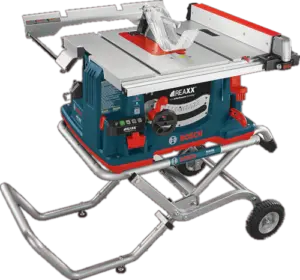 | |
|---|---|---|
| Verdict: | #1 Safest | |
| Flesh Detecting Break: | Yes | Yes |
| Weight: | 113 lbs. | 90 lbs. |
| Blade drop time: | 5 milliseconds | 60 seconds |
| Rip capacity: | 25-1/2 inches | 25 inches |
| Speed: | 4000 rpm | 3650 rpm |
Are StopSaws worth the extra cost?
Stop saws typically cost a lot more than standard table saws. Some models cost double what you would expect to pay for a table saw without a flesh-sensing feature.
But purchasing a stop saw is a clever idea if you have relatively little experience with table saws and are planning on using the tool a lot.
If you are an experienced woodworker and have the necessary safety equipment, a stop saw might not be necessary.
Consider that you will have to replace the cartridge and blade after an incident, although this is much better than dealing with a serious injury that could be prevented with an initial investment.
Considering that the alternative to replacing the cartage and possibly the blade is a serious injury, a stop saw might just be worth the extra cost.
Other tools that can rip timber
There are other tools you can use to rip timber apart from a portable table saw. However, they may not be quite as effective as a simple table saw for various reasons.
You can use a circular saw paired with a straight edge, for example. But these aren’t quite as accurate as a premium table saw and will take longer to set up and cut as well.
You might consider a track saw such as a Festool. Again these aren’t quite as quick to use as a high-grade table saw, and they take a long time to set up each cut.
Track saws require a lot of space, so if your workshop is fairly small, you might just be better off with a table saw. Here’s a detailed comparison of the two tools.
And remember never attempt to cut a curved or a circle using a table saw doing so is impossible and very dangerous.
Instead when you need to cut curves or corners in wood using an electric jigsaw tool, or for serious woodworkers have a read of my cordless jigsaw review.
Tips for using your portable table saw
1. Know that this tool is prone to kickbacks.
One of the most important things to know about table saws is kickbacks. This refers to the action of the workpiece jerking back at high speed toward the operator.
When this happens, there is a high risk of injury, either from the workpiece hitting you in the face or head, or from having your hand come in contact with the blade.
There are many reasons why kickbacks happen. There may be a knot in the wood that prevents the blade from cutting into it smoothly, or the two sides of the cut workpiece may close up and bind the blade. Some people use a miter gauge to cut miters but it is much safer and easier to do your miter cuts on a miter saw.
Here’s what you can do more with your table saw to operate it better.

2. A riving knife is the key.
All new saws use a riving knife [5] to prevent the cut pieces from coming together, thereby preventing kickback.
But the riving knife will have to be positioned correctly in order for it to work. A poorly positioned riving knife is actually a common reason why kickback occurs.
In order for it to work properly, make sure that the riving knife effectively prevents the workpiece from placing sideways pressure on the saw blade.
3. Wear safety gear.
As when working with all power tools, always wear the proper personal protective equipment when using a table saw.
At the very least, you should have hearing protection, safety goggles, or a face shield paired with a dust mask.
A dust collection port routed into a box will do wonders for diverting the sawdust to clear your working vision and lungs.
Lastly, make sure you insert the correct blade size into the saw.
Table saw history
Table saws were first developed in the United States [6], where the earliest versions appeared in 1777. The patent for the first circular saw was issued to Samuel Miller. Although Miller’s invention was a new design that paved the way for modern table saws, it was based on circular saws that were used in Holland as far back as the 16th and 17th centuries.
By 1885, circular saws that look pretty much like modern table saws were widely used. They were even featured in a W.F. & John Barnes Co. Catalog from 1885, where they were referred to as a “Hand-Powered Circular Rip Saw”.
Now the build quality is much better and even available mounted on a table for convenience and a healthy back posture while working.
Comparing top table saws
10-inch table saws
| SawStop JSS-120A60
| Bosch GTS1041A-09 | DEWALT DWE7491RS  | Makita 2705 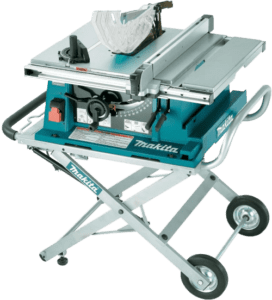 | Bosch 4100-10 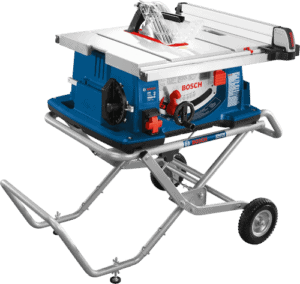 | DEWALT DW745 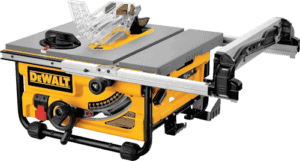 | SKILSAW SPT99-11  | DEWALT DWE7480  | Bosch GTS1031  | Hitachi C10RJ  | SKILSAW SPT70WT-01 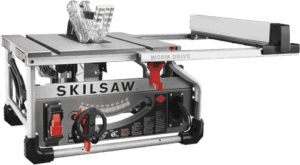 | SKIL 3410-02  | Rockwell RK7241S  | Skil TS6307-00 | |
|---|---|---|---|---|---|---|---|---|---|---|---|---|---|---|
| Verdict: | #1 Safest | #1 Finest value | Most affordable | |||||||||||
| Rip capacity/ (to the right): | 25-1/2 inches | 25 inches | 32 1/2 inches | 25 inches | 25 inches | 16 inches | 30-1/2 inches | 24 inches | 18 inches | 35 inches | 25 inches | 32 inches | 30 inches | 25.5 inches |
| Rip capacity to the left | 9-3/4 inches | 9 inches | 22 inches | 8 1/2 inches | 20 inches | 16-1/2 inches | 12 inches | 8-1/2 inches | 22 inches | 11 inches | 14 inches | |||
| Speed: | 4000 rpm | 3650 rpm | 4800 rpm | 4800 rpm | 3650 rpm | 3850 rpm | 5000 rpm | 4800 rpm | 5000 rpm | 4500 rpm | 5300 rpm | 5000 rpm | 4800 rpm | 4600 rpm |
| Dado cut max width: | 13/16 inch | 13/16 inch | 13/16 inch | 1 3/16 inch | 13/16 inch | 1/2 inch | 13/15 inch | 5/8 inch | ||||||
| Cutting depth: | 3-1/8 inch (at 0°) | 3-1/8 inch (at 90°) | 3-1/8 inches (at 90°) | 3-9/16 inches (at 90°) | 3-1/8 inches (at 90°) | 3-1/8 inches (at 90°) | 3-5/8 inches ( at 0°) | 3-1/8 inches (at 90°) | 3-1/8 inches (at 90°) | 3-1/8 inches | 3-1/2 inches (at 90°) | 3-1/2 inches (at 90°) | 3-9/16 inches (at 90°) | 3-1/2inches (at 90°) |
| Cutting depth at 45° : | 2-1/8 inch | 2-1/4 inch | 2-1/2 inches | 2-1/2 inches | 2-1/2 inches | 2-1/4 inches | 2-3/10 inches | 2-1/4 inches | 2-1/4 inches | 2-1/4 inches | 2-3/10 inches | 2-1/2 inches | 2-9/16 inches | 2-1/2 inches |
The verdict: The safest table saw for your workshop
Whatever your safety standards are the SawStop JSS-120A60 and the DeWalt DWE7491RS both provide excellent value for the money, and you pretty much can’t go wrong with either one for their build quality.
If safety is your primary concern, definitely go for the JSS-120A60, as the safest table saw which comes with the patented SawStop flesh-sensing technology.
This particular model builds on the success of previous SawStop models, adding a welcome of new attributes such as a deeper table depth.
On the other hand, if you are looking for a stable and reliable table saw that delivers consistent power and performance, the DeWalt DWE7491RS is perfectly suited for you. Capable of handling a variety of cutting jobs, this could be the only table saw you will need.
For more great recommendations continue to read our other tool reviews.
Sawstop JSS-120a60
Why own Sawstop JSS-120A60?
- The real honorable mention as saw will instantly stop if there is human contact on the blade, reducing serious injuries on the building site or during DIY projects.
- Finest value stop saw to keep you or the user extra safe.
- The stand is stable and quickly retracts and folds out smoothly.
- Easy to adjust rail and saw blade for precise cuts.
- The blade can be fully retracted down with one turn of the depth adjustment crank saving a lot of time.
- Dust control is no problem.
Drawbacks of Sawstop JSS-120A60
- None, if you are able to invest a little more for your safety.
#1 Finest value Stop saw
Frequently Asked Questions

Can you cut angles with a portable table saw
Yes, you can use a portable saw. You can use a handy miter gauge to make this possible.
Can you use a portable planer to reduce thickness of a plywood?
Yes. Though it requires some skills to set the right blade height and rip fence to make a strong joint. For these jobs, the best tool for the job is a wood router.
More information:
- The dangers of using a bench saw and safety tips can be found from, https://www.chaffinluhana.com/table-saw/
- Estimated table saw injuries, retrieved from, https://www.npr.org/2017/08/10/542474093/despite-proven-technology-attempts-to-make-table-saws-safer-drag-on
- Sawstops timeline and official website, https://www.sawstop.com/company/about
- Bosch VS StopSaw and patent infringement info can be found at, https://www.finewoodworking.com/2016/09/14/bosch-vs-sawtop
- ore information on a riving knife can be read here, https://www.woodmagazine.com/tool-reviews/tablesaws/splitter-or-riving-knife-what-s-the-difference
- History information about table saws can be read here, https://core.ac.uk/reader/74246640


