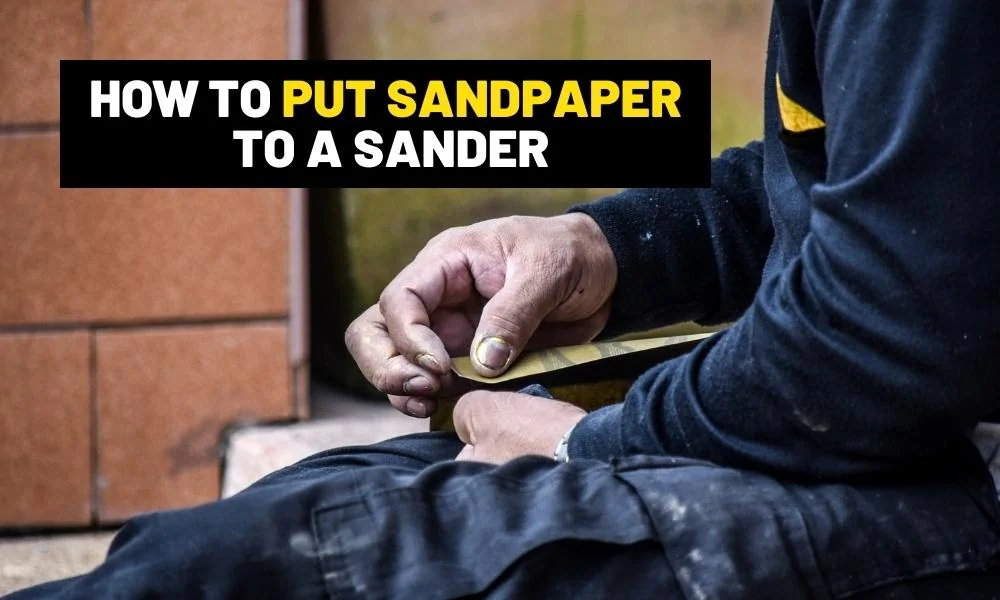
- A sanding task that only finishing sanders do
- Best corded finishing sander
- Best cordless finishing sander
- What attributes to examine on a finishing sander?
- Corded finishing sander vs. Cordless finishing sander
- Finishing sander vs. Orbital sander
- Choosing the best finishing sanders
- Tips for using finishing sanders
- Comparing corded finishing sanders
- Comparing cordless finishing sanders
- Makita B04900V

Last updated on March 20, 2026 10:05 am
A sanding task that only finishing sanders do
According to Aaron Barnett of BangingToolbox: The best finishing sander on inspection vibrates less after continuous use despite having adequate power with a range of variable speeds should be on your list.
We found that both Makita and Dewalt have good finishing sanders to look into for your in-depth research!
What makes finishing sanders the right choice is when you need an electric sander that will sand wood in the direction of the wood grain for the smoothest finish compared to tools that use a rotational motion.

Best corded finishing sander
#1 Editors choice: Finest value
For handymen and proffesionals

- The variable speed control lets us dial the oscillations-per-minute (OPM) from 4,000 to 10,000.
- The “through-the-pad” dust collection system is efficient.
- Hooks up to standard vacuum hoses for even more efficient dust collection.
- Low vibration despite having great power stats and ratings.
- A punch plate and a vacuum hose adaptor would have been welcome.
#2 Most powerful
Best for power, with low vibration

- Features flush sanding capability that lets you sand almost vertical surfaces.
- Equipped with the SheetLoc clamping system for perfect paper fitting.
- Extremely low vibration.
- This Bosch finishing sander utilizes an efficient micro-filter dust collection system.
- The lever that releases the sandpaper is a bit flimsy for us.
#3 Most ergonomic finishing sander
Makita BO3710 1/3 in, 1.7 amp Finishing sander
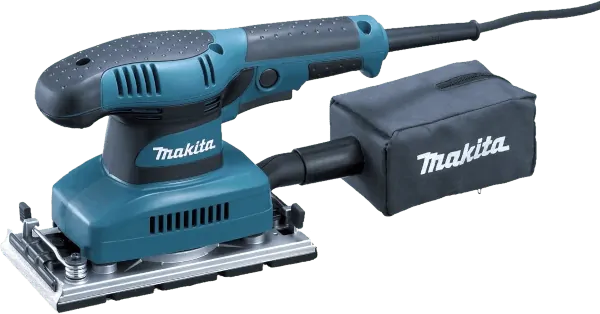
- Ergonomic handling with a rubber-coated ergonomic grip.
- Tops out at 11,000 OPM for smooth and even sanding.
- Employs a counterbalance system that reduces vibration.
- The Makita BO3710 finishing sander might be too small for some applications.
#4 A smaller 2.3 amp finishing sander
Dewalt DWE6411K 1/4 in, 2.3 amp Finishing sander
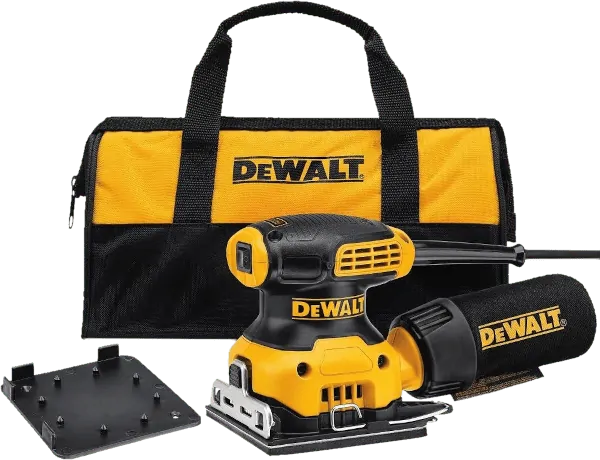
- Runs on a powerful 2.3-amp motor that goes up to 14,000 OPM.
- Employs an effective dust-port system.
- Uses washable mesh sandpaper.
- Could use an extension adapter for a standard vacuum hose.
#5 Makita lightweight finishing sander
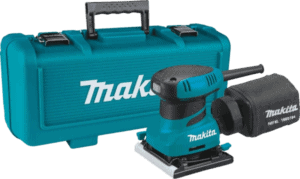
Makita B04556K, 1/4 in, 2 amp Finishing sander
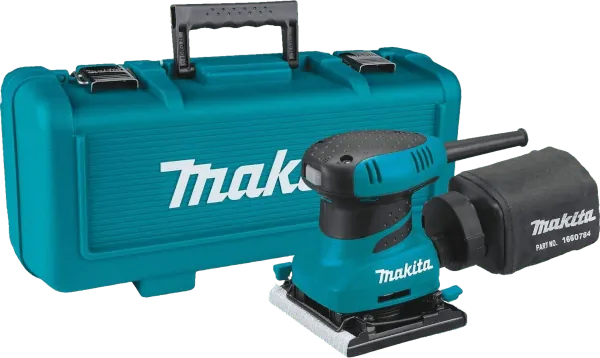
- Features precision all-ball bearing design for minimal noise and vibration.
- Contoured rubber grips for maximum comfort and control.
- Deploys a large clamping lever for quick sandpaper removal and replacement.
- The Makita finishing sander BO4556’s cord is quite short.
#6 Small bosch finishing sander
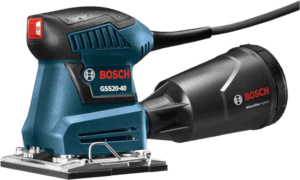
Bosch GSS20-40 1/4 in, 2 amp Finishing sander
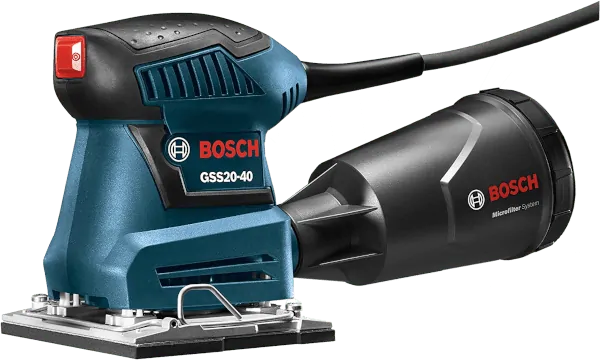
- Boasts a durable aluminum sanding plate that ensures even sanding.
- The effective dust collection system utilizes a microfilter dust canister.
- Soft grips designed for maximum functionality!
- The dust collection system could be better.
#7 A lightweight precision finishing sander
Milwaukee 6033-21 1/4 in, 3 amp Finishing sander

- Light and compact for easy handling.
- The base does not leave swirls or lines on work surfaces.
- Makes use of a simple but effective push-button paper clamp system.
- The Milwaukee finishing sander’s rear sandpaper clip could be more robust.
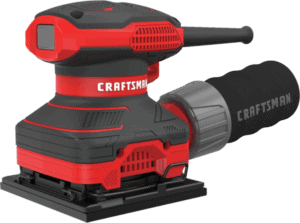
#8 Another DIY finishing sander
Craftsman CMEW230 1/4 in, 2 amp Finishing sander

- Powerful 2.0-amp motor maxes out at 13,500 OPM.
- High-performance dust collection system connects to 11/4” vacuum hoses.
- The switch is dust-sealed for protection.
- The Craftsman finishing sander leaves a few lines on work surfaces.

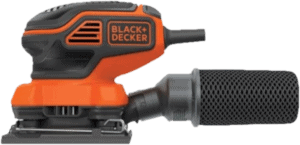
#9 A dust collection finishing sander
Black Decker BDEQS300 1/2 in, 2 amp Finishing sander
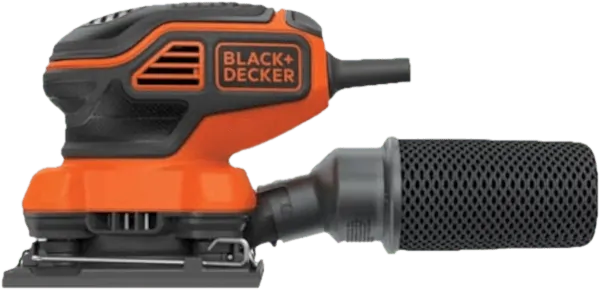
- Helps with 270° flush sanding.
- Features a tri-layer filtration system.
- Uses a soft-grip paddle switch.
- The 2.0-amp motor is powerful enough for material removal, which proves how it is recorded as the fastest finishing sander on our list.
- This Black & Decker finishing sander’s paddle switch isn’t for everyone and underperformed based on extended use.
#10 DIY pressure control finishing sander
Skil 7292-02 1/4 in, 2 amp Finishing sander
- Utilizes pressure control technology to guard against excessive pressure.
- Uses a micro-filtration system that traps fine dust particles.
- Boasts a clear-view dust canister and a built-in vacuum adapter.
- A bit difficult to hold down.

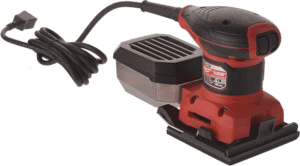
#11 Most affordable corded finishing sander
WEN 6313 1/3 in, 1.2 amp Finishing sander
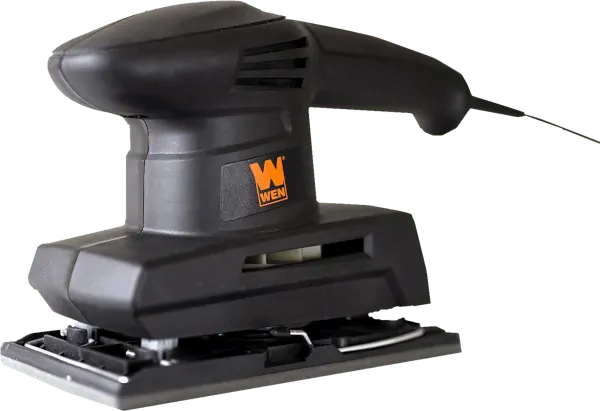
- Ideally suited for sanding large surface areas.
- Runs on a powerful 1.2 amp motor that goes up to 12,000 OPM.
- Lightweight and compact.
- Found to be pretty loud during use.
Best cordless finishing sander
#1 Best cordless finishing sander
In use we found the handle fits great in the palm
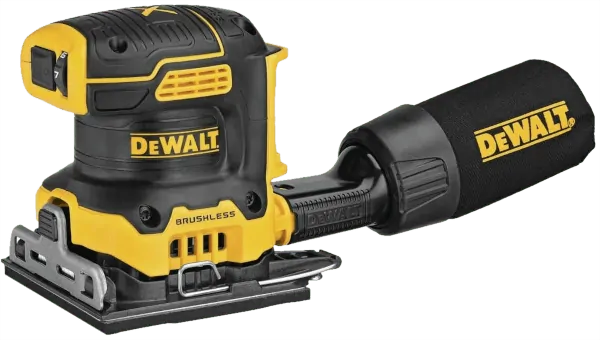
- Highlights an efficient brushless motor that provides excellent runtime.
- Variable speed control goes from 8,000 to 14,000 OPM.
- Equipped with an effective clamping system for holding sandpaper in place.
- Requires a bit of setup before you can start using the tool dust free.
#2 Finest value cordless finishing sander
For DIY use
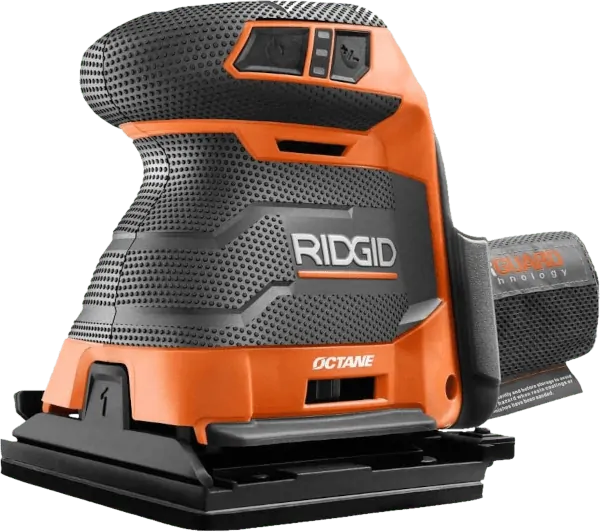
- Includes a 3-speed digital selector switch.
- The vacuum hose adaptor fits the most common hose sizes.
- Uses a redesigned sandpaper clip for a more secure hold.
#3 A single-speed cordless sander
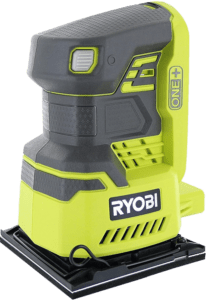
Ryobi P440 1/4 in, 18V Finishing sanders

- Easy to transport and store.
- Accommodates ¼ sheets and works with most sandpapers in home supply stores.
- Comes with a convenient lock-on switch.
- Promises 40 minutes of runtime.
- This Ryobi finish sander isn’t really suited for heavy-duty jobs.
What are finishing sanders?
A finishing sander is a powered tool that is typically used for polishing, shaping, or smoothing wooden surfaces. However, finishing sanders can be used on plastic after cutting and metal with the right sanding paper installed.
Most finishing sanders have rectangular bases on which you can attach ¼ or ½ sheets of sandpaper. The sandpaper is what comes into contact with your work surface, smoothing down rough areas.
A finishing sander can save you considerable time and money compared to doing the sanding by hand.
Finishing sanders usually provide a much finer and smoother finish than other types of sanders.
With the right finishing sander and proper technique, you can get an extremely polished appearance on almost any work surface.

Reasons to buy a finishing sander
There are many reasons to buy a finishing sander, but the main reason is that the affordable tool enables woodworkers to create a fine and polished surface on practically any workpiece.
Whether you are a furniture maker, a chippy, or a hobbyist, a finishing sander will undoubtedly find many uses in your day-to-day work.
Here are some situations for which a finishing sander will come in handy:
- Removal of rough spots. Finishing sanders can help you smooth rough spots from delicate surfaces.
- Creating polished finishes. Finishing sanders can produce finer and more polished surfaces than any other sander.
- Preparing surfaces for buffing and polishing. The best sander for refinishing furniture can prepare furniture as the final buffing and polishing, particularly if you plan to prep a surface for your joiner tool .
What attributes to examine on a finishing sander?
A finishing sander is primarily intended to make sanding work easier and more efficient.
These types of sanders give you more professional-looking results than you would be able to achieve with other types of sanders, whether manual or powered.
If you’re looking for sanders such as Makita, Bosch, Craftsman, or Porter Cable finishing sander, here are some of the most important attributes to look for when shopping for a finishing sander:

1. The ease of use.
A finishing sander should be reasonably easy to use.
Any type of sander should give you impressive-looking results even if you don’t have a lot of experience. Changing sandpapers must be reasonably quick and easy.
2. It’s power and performance.
Finishing sanders should provide just enough power to produce great-looking results.
Unlike most other power tools with which power is often preferable, finishing sanders work best with relatively light pressure.
You should, therefore, go for smoothness and low vibration rather than sheer brute power.
3. The rated and observable speed.
The ability to adjust the speed from slow to fast is essential in a finishing sander.
You need to be able to dial the speed down low for delicate surfaces and crank it up for more aggressive polishing.
4. A light touch with ergonomics.
A finishing sander should feel comfortable in your hand, without too much jerkiness or vibration.
It should be comfortable to use even for prolonged sanding sessions and allow you to position your hands for maximum comfort.
5. The comfort of the handgrips.
You need to consider the type of hand grips that come with your finishing sander.
t should be able to reduce vibration and allow you to control the tool precisely.
6. A working dust collection system.
Dust is an inevitable part of sanding whether you use a powered or manual sander.
Look for a finishing sander with a dust-catching system that is compatible with workshop vacuums.
7. Easy to activate trigger locks.
Finally, consider purchasing a sander with a trigger lock. This will let you keep the sander going even if you take your finger off the trigger. This feature helps prevent user fatigue, particularly during long sanding sessions.
Corded finishing sander vs. Cordless finishing sander
If you’ve been following my website for a while, you already know that I’m a big fan of cordless power tools. Light, convenient, and easy to use…what’s not to like?
But when DIY comes to finishing sanders, I would have to give the advantage to corded sanders.
Sanding is pretty power-intensive work, for lengthy sessions, and not many cordless options are available. Here are the relative advantages and disadvantages of corded and cordless finishing sanders.
What do you need to know about a corded finishing sander?
- Corded sanders are usually more powerful than cordless models.
- Finishing sanders are better suited for long sanding sessions.
- Electrical powered so no battery weight to deal with.
However, you should understand that:
- The electrical cord can get in the way.
- You need to work close to a power outlet or have a long extension cord.
- Found to usually be more expensive than cordless models.
What do you need to know about a cordless finishing sander?
- Convenient and portable.
- No power cords to trip over or get in the way.
- You can work anywhere, even without an outlet nearby.
- Usually easier to use than a corded finishing sander.
However, you should be aware that:
- The battery adds quite a bit of weight to the unit.
- Some cordless models are underpowered for heavy-duty work.
- You can’t work for long on a single charge, so you will need frequent recharging.
- Additional batteries can be expensive.
Who uses a finishing sander?
Finishing sanders are powerful tools that will find use in almost any workshop.
If you do a lot of woodworking, a finishing sander is a useful addition to your arsenal.
Finishing sanders are primarily used by professional woodworkers when they want to create a fine finish on the surface of furniture or get a more polished appearance.
Even DIYers and casual woodworking enthusiasts need to use finishing sanders when we need to create a smooth and polished surface.
Sanders for woodworking results in professional-looking finishes that would be difficult to achieve via manual sanding.
After using a thickness planer as I recommended here a finishing sander is a fast way to give your boards a final finish.
Finishing sander vs. Orbital sander
Orbital sanders perform practically the same function as a finishing sander. And can be used interchangeably, depending on the job.
But orbital sanders aren’t nearly as effective as finishing sanders for producing a fine, polished finish on exposed wood grain.
Orbital sanders can leave circular marks on wooden surfaces.
If you want to have as flawless a surface as possible, you would be better off with a finishing sander that sands in the direction of the wood grain, instead of in a circle.
Of course, you can start sanding with an orbital sander as a rotating motion is faster and then later you can switch to a finishing sander for the final sand and acceptable result.
In most cases, however, you could probably get the results you want solely by using a finishing sander.

Choosing the best finishing sanders
#1 Top superior quality and best value finishing sander
The Makita B04900V is easily one of the best-corded Makita finishing sanders to be found.
Driven by a powerful 2.9-amp motor it’s equipped with a variable speed control dial that ramps up the speed from 4,000 to 10,000 oscillations per minute (OPM).
This lets you adjust the speed according to the task at hand.
The B04900V utilizes a unique “through-the-pad” dust collection system that keeps the workplace clean and free of dust.
It can hook up to most standard vacuum hose sizes for a more efficient dust collection system.
I like the contoured grips and low vibration, this Makita finishing sander can be used for hours of fatigue-free operation.
#1 Premium choice finishing sander
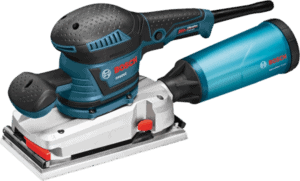
The Bosch OS50VC is the most expensive sander in this roundup, but you do get a lot for the money.
Found to have a unique flush sanding capability that lets you sand close to a vertical position on any surface, which is pretty handy for woodworking jobs.
In addition, the OS50VC is armed with an ingenious SheetLoc clamping system that ensures a perfect fit with any sandpaper.
This unit can even accept stick-on sandpaper, which is excellent for sanding on the go.
#1 Finest value small corded finishing sander
The Dewalt DWE6411K is the best value choice on the subject of cordless finishing sanders to be found. The powerful 2.3-amp motor drives the sander at 14,000 OPM, which is more than enough for most sanding applications.
The DWE6411K efficiently utilizes a locking dust-port system that lets you connect almost any standard vacuum hose for maximum dust collection efficiency.
This particular model uses mesh sandpaper, which is washable and less prone to clogging than standard sandpaper.
#1 Best low-cost corded finishing sander
The WEN 6313 may be one of the cheapest sanders in this review, but don’t let the low price fool you.
This compact and lightweight sander is as efficient as other sanders and can give some more expensive models a run for their money.
The 1.2-amp single-speed motor is reasonably powerful, topping out at 12,000 OPM.
This should be sufficient for most sanding jobs. In any case, the 6313’s lightweight and compact form factor makes it an excellent choice for anyone looking for a ‘no-frills’ sander.
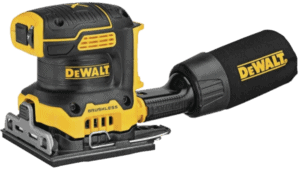
#1 Most powerful cordless finishing sander
The Dewalt DCW200B is the most powerful and most efficient cordless finishing sander you can buy. The brushless motor provides sufficient grunt for most tasks and facilitates superior runtime and maximum efficiency in a portable model.
The unit attributes a variable speed control that lets you dial down the sander to 8,000 OPM for delicate work, and ramp her up to 14,000 OPM for more aggressive results.
The DCW200B comes with a remarkably low profile that lets you get close to the surface of your workpiece, allowing for more precise sanding. Other attributes include a secure sandpaper clamp and a dust-sealed switch that ensures trouble-free operation.
#1 Low-cost cordless finishing sander
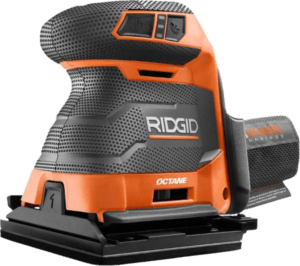
The Ridgid R86064B is a variable-speed sander that lets you go from low to medium to high at a flick of a digital switch.
This gives you a more range of speeds to tackle a wide variety of sanding jobs.
The R86064B accommodates three of the most common vacuum hose sizes available, so you can enhance the efficiency of the onboard dust collection system.
Moreover, the sander boasts an improved sandpaper clip that ensures a more secure hold.
Tips for using finishing sanders
The best finishing sanders are pretty straightforward tools and are fairly easy to use even if you don’t have prior experience. However, a firm grasp of the fundamentals will enable you to get the best results with as few mistakes as possible.
How to replace sanding sheets?
Finishing sanders can usually accommodate ¼ or ½-sized sandpaper sheets. You must replace the sandpaper when the grit has worn down.
- Remove the clamps that hold the old sandpaper in place.
- Place your sander down on the new piece of sandpaper. Adjust the position of the tool to get the most pieces from a single sheet.
- Cut the sandpaper big enough to cover the base of the sander, with a little extra to allow for clamping.
- Make sure to pull the sandpaper taut to remove any slackness that can impair performance.

Essential safety gear when using finishing sander sheets
Finishing sanders are pretty safe compared to most other power tools, but you do have to take some precautions to ensure your safety. Part of this involves wearing the proper protective gear when operating a finishing sander. At the very least, you should wear the following safety equipment:
- Goggles or safety glasses to protect your eyes from dust and debris.
- Use a dust mask or a respirator [1] to avoid breathing in dust and fine particles.
- Hearing protectors help protect your ears against the sound produced by loud sanders.
The dos and don’ts of using a finishing sander
How to use a finishing sander properly?
- Wear the proper safety gear at all times.
- Position the sander so that the electrical cords are away from the work surface.
- Secure your workpiece before you begin sanding.
- Affix the sandpaper securely to the base of the sander.
- Turn on the sander and let the motor reach full speed before lowering the base down to your workpiece.
- Empty out the dust bag frequently.
- Start with coarse sandpaper initially, and then move to medium and fine-grit sandpaper.
What you should never do with your finishing sander?
- Never work on slippery surfaces coated with dust.
- Discontinue the use of a sander with a frayed electrical cord.
- Do not use your sander without adjusting the brushes, if the motor produces too many sparks.
- Avoid over-extending yourself trying to reach a spot on the workpiece.
- Do not apply excessive pressure on the sander.
Comparing corded finishing sanders
| Makita B04900V
| Bosch OS50VC
| Makita BO3710
| Dewalt DWE6411K
| Makita B04556K
| Bosch GSS20-40
| Milwaukee 6033-21
| Craftsman CMEW230
| Black Decker
| Skil 7292-02
| WEN 6313
| |
|---|---|---|---|---|---|---|---|---|---|---|---|
| Verdict: | Top performing finishing sander | Best powerful variable speed | Best low-cost | ||||||||
| Weight | 6 lbs | 6 lbs | 3.5 lbs | 3 lbs | 2.5 lbs | 2.7 lbs | 3.68 lbs | 3.1 lbs` | 3 lbs | 3 lbs | 3 lbs |
| Sheet size | 1/4 inches | 1/2 inches | 1/3 inches | 1/4 inches | 1/4 inches | 1/4 inches | 1/4 inches | 1/4 inches | 1/2 inches | 1/4 inches | 1/3 inches |
| Speed | 4,000-10,000 opm | 8,000-10,000 opm | 11,000 opm | 14,000 opm | 14,000 opm | 12,000 opm | up to 14,000 opm | 13,500 opm | 16,000 opm | 12,000 opm | |
| Motor | 2.9 amp | 3.4 amp | 1.7 amp | 2.3 amp | 2 amp | 2 amp | 3 amp | 2 amp | 2 amp | 2 amp | 1.2 amp |





Comparing cordless finishing sanders
| Dewalt DCW200B
| Ridgid R86064B
| Ryobi P440
| |
|---|---|---|---|
| Verdict: | Top performing cordless | ||
| Weight | 2.1 lbs | 2.6 lbs | 2.3 lbs |
| Sheet size | 1/4 inches | 1/4 inches | 1/4 inches |
| Speed | 8,000-14,000 opm | up to 14,000 opm | 12,000 opm |
| Power | 20V | 18V | 18V |
Conclusion: Who finishes best?
The Makita B04900V is an absolute powerhouse of a sander, handling whatever job I throw at it without a hitch.
The variable speed control provides enough range to handle a variety of jobs, and the dust collection system is positively flawless.
This Makita finish sander features ergonomically designed grips that allow for hours of comfortable use.
The Dewalt DCW200B is about as powerful a cordless finishing sander as you could get.
Featuring a state-of-the-art efficient brushless motor that goes from 8,000 to 14,000 OPM without a hiccup.
I especially like the low profile that lets me dig in deep for precision sanding: for sanding down dark water stains or polishing metal smooth.
Are you looking for fast aggressive sanding, to prep wood before a finishing sander? Check out our review of the best industrial belt sanders!

Not the sander you need? Check this out!
Makita B04900V
Reasons to use Makita B04900V:
- Variable speed ranges from 4,000 to 10,000 oscillations per minute (OPM).
- Comes with an efficient “through-the-pad” dust collection system that we liked.
- Connects to vacuum hoses for better dust collection.
- Our 5-star rating for durability, functionality, and smoothness.
Reasons not to use Makita B04900V:
- Doesn’t include a punch plate or a vacuum hose adaptor.
#1 Best corded finishing sanders
More information:
- Definitions associated with Respiratory protection can be read at, https://www.osha.gov/laws-regs/regulations/standardnumber/1910/1910.134