

- Best metal cutting cold saw
- Best chop saw (Abrasive wheel for metal studs)
- Smaller 12-inch chop saw
- Alternative sized chop saw
- Cordless chop saw
- What chop saws do?
- The difference between cold saws and chop saws
- What sized metal cutting saw to use?
- Cold saws vs. Chop saws vs. Angle grinders
- DeWalt vs. Evolution cold cut saws
- Dewalt vs. Fein chop saws
- Choosing the best metal cutting saws
- Jobs for metal cutting chop saws
- Jobs for metal cutting cold saws
- Tips for using chop saws
- Comparing the top metal saws
- Dewalt D28730

Last updated on October 2, 2025 6:24 am
What are your choices for chop saws?
Aaron Barnett of BangingToolbox suggests: The best metal cutting chop saw is made by Dewalt, Morse, or Makita.
There are two types of metal cut-off saws. The most common is the abrasive wheel chop saw for light to medium cuts (For metal studs).
For thicker metals, a carbide-tipped tungsten-toothed “Cold Saw” doesn’t need frequent blade replacements for demanding jobs.
There are however small benefits and drawbacks to each type of metal cutting saw mentioned below.

Best metal cutting cold saw
#1 Best metal cutting cold saw
Dewalt DW872 metal cutting saw 14-inch

- Cuts a wide variety of materials with a low amount of sparks.
- The carbide-tipped blade remains consistent even after repeated use.
- Quicker performance compared to most chop saws.
- Results in clean and precise cuts with hardly any burrs.
- More expensive than an abrasiveness cut-off saw.
#2 Best carbide tipped metal saw
Morse metal-cutting chop saw 14-inch

- Low noise operation.
- Doesn’t produce heat, sparks, or burning smells.
- Actually cuts metal instead of grinding.
- Equipped with onboard storage for the blade-change wrench.
- The vise could use a quick-release function.
#3 The Fein metal cutting saw
Fein MCCS14 metal cutting saw 14-inch

- The combination of low speed and high torque results in very clean cuts.
- Cuts faster than most abrasive saws.
- Cuts at a variety of angles from 0° to 45°.
- The locking tab pinning the vise handle tends to get bent out of shape.
#4 Another cold saw
Evolution power tools metal cutting chop saw 14-inch

- Makes cleaner cuts than abrasive wheel saws.
- Cuts through a variety of materials, from plastic to wood and even steel and aluminum.
- Retains cutting depth even with repeated use.
- The base and clamp aren’t the most robust.
Best chop saw (Abrasive wheel for metal studs)
#1 Finest value chop saw
Dewalt D28730 chop saw 14-inch
- The powerful motor comes with overload protection circuitry.
- Features an ergonomic handle that helps in longer hours of comfortable use.
- Quick-lock vise lets you quickly clamp on materials of different sizes.
- Armed with a 45° pivoting fence that lets you make angled cuts quickly and accurately.
- Angles tend to change because the brace doesn’t click into place.
#2 Best Makita chop saw
Makita LW1401 cut off chop saw 14-inch
- Fitted with an adjustable spark guard that redirects sparks away from the operator.
- Comes with a convenient two-stage lock-off power button.
- Fence adjustment helps position in various cutting angles.
- Angle adjustment tends to shift a bit.
#3 The bosch cut-off saw
Bosch 3814 abrasive cut-off saw 14-inch

- The motor runs with a built-in overload protection.
- Quick-release locking vise keeps the workpiece stable.
- The adjustable fence enables different angled cuts.
- The motor gets pretty loud.
#4 The Metabo metal saw
Metabo HPT CC14SFS portable chop saw 14-inch

- Cuts through pipes, rebars, and shaped steel with minimal effort.
- Quick-lock/release vise lets you do quick material changes.
- Can make miter cuts of up to 45° in either direction.
#5 The Milwaukee chop saw
Milwaukee electric tool 6177-20 14 cut off saw 14-inch

- Always makes consistently even cuts.
- Cuts through even the hardest materials with the right blade.
- The motor is powerful and doesn’t bog down.
- Angled cuts are a bit off without adjustment.
#6 A DIY chop saw
Porter-cable PCE700 chop saw 14-inch

- Boasts a quick-release clamp.
- Comes with a cutting fence with convenient miter adjustment.
- The reliable heavy-duty steel base enhances stability.
Smaller 12-inch chop saw
#1 Small Makita chop saw
Makita LC1230 metal cutting saw 12-inch

- Cuts four times faster than most abrasive saws.
- Quick-release support fence enables you to do 0° to 45° miter cuts.
- Can cut to a maximum cutting depth of 4.5”.
- Not very effective for cutting stainless steel.
#2 Small DIY chop saw
Skilsaw SPT62MTC-01 metal cutting saw 12-inch
- Can make cuts up to 4.5”.
- Doesn’t produce sparks.
- Makes clean cuts with no need for deburring.
- Can get pretty loud.
Alternative sized chop saw
#1 Best 15 inch chop saw
Evolution EVOSAW380 steel cutting chop saw 15-inch

- Dry metal cutting action doesn’t produce heat or sparks.
- No need to use coolant to keep the workpiece cool.
- A powerful motor with a high torque gearbox that reduces the load on the motor.
- Stands with a heavy-duty cast aluminum base for industrial metal-cutting applications.
- The base wobbles a bit.
#1 Small 6-inch chop saw
Lion tools J1G-KE2-160 cut-off chop saw 6-inch

- Ideally suited for cutting small stock and small metal pieces.
- Vise jaw does an impressive job of holding square or round stock securely.
- The hinge isn’t that stable, which can cause blade drift.
Cordless chop saw
#1 Best Makita cordless chop saw
Makita xwl01z brushless cordless 14-inch cut off saw

- No need for a power outlet with this cordless Makita chop saw.
- A Quality tool that is compatible with Makita 18V batteries.
- Fitted with a heavy-duty cast aluminum base for industrial metal-cutting applications.
- Not as much power as a plugin model.
What chop saws do?
Chop saws are power tools that are used to cut through metal and other hard and dense materials. They look pretty much like standard drop saws, but they use abrasive cutting discs instead of toothed blades to do the cutting.
Chop saws are especially capable of making straight and precise cuts in a variety of metal materials.
They are commonly used by carpenters, house framers, and metal workers to make square cuts. However, chop saws can only cut at 90° angles, so they can’t be used to make a variety of angled cuts like 45° bevels.
For making angled cuts, most pros used a variant of the chop saw known as a metal cutting miter saw, or cold saw.
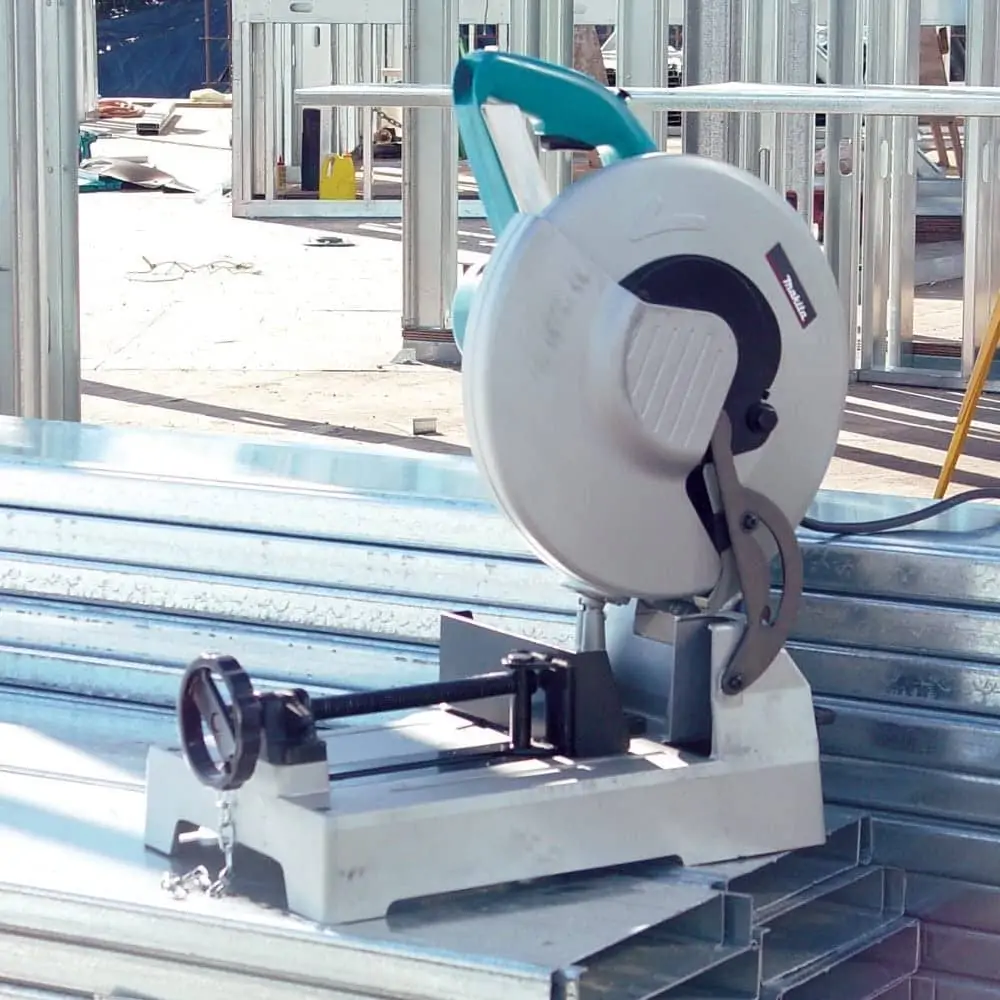
These types of saws can handle a wider range of jobs than most basic chop saws and are especially useful for making angled cuts quickly and accurately.
Chop saws and metal cutting miter saws are often lumped together as chop saws. Unlike circular saws, chop saws only swivel up and down over the workpiece and otherwise remain in a stationary position.
Although you could tilt them sideways to the metal you are cutting to achieve different angled cuts, they mostly remain in the same 90-degree position, unlike circular saws, cold saws, or angle grinders that can be moved around to cut any angle freehand.
The abrasive discs used in chop saws do an excellent job of cutting through most materials like PVCs. They come with different types of abrasive material, each suited for specific tasks.
One thing that you have to consider, however, is that the abrasive discs used in chop saws are essentially disposable. The grinding action and the heat that they produce when they come into contact with the metal cause the abrasive coating to wear away quickly, preventing them from cutting metal effectively.
When this happens, you will have to replace the cutting disc. This is not the case with cold saws.
Features to think about first
- Electronic monitoring system. Monitors the number of rotations that the chop saw makes, ensuring consistent performance even under load.
- Smooth start function. Reduces power drawn when the chop saw is turned on, preventing it from jerking.
- Brush replacement system. Facilitates the replacement of carbon brushes in the motor, helping prolong tool life.
- Belt drive. It protects the motor from overloading and reduces the risk of overheating.
Before you buy a chop saw…
1. Is it durable?
Chop saws are expected to handle heavy-duty jobs and cut through some hard materials.
Although the abrasive disks will have to be replaced periodically, the mechanism and components should be able to hold up to the demanding conditions they are subjected to.
Cold Saws should have blades fitted that can cut hard metal materials rather than blades made to cut timber.

2. Who makes the tool?
The best chop saws are made by companies such as DeWalt, Fein, Evolution, and Makita.
Tools from these manufacturers are notable for their build quality and attributes, as well as their ability to handle a wide variety of cutting tasks.
They tend to last longer than chop saws made by other manufacturers.

3. What’s the compatible blade size?
Bigger blade sizes allow you to make deeper cuts into the material, which is useful for cutting thicker metal.
Larger blades spin at slower speeds than small blades, so they produce fewer sparks than faster-spinning small blades.
4. What’s the blade type?
Tungsten blades last a lot longer than abrasive wheels.
They can cut much more material before wearing down and needing to be replaced, so you save a lot of money on replacement blades.
Although many chop saws still utilize abrasive discs, tungsten-tipped blades have pretty much taken over the pro-market.
5. Is it light enough weight to move around?
Chop saws should be heavy enough that they allow you to make cuts with sufficient pressure but not so heavy that they are difficult to move.
Chop saws for the industrial market can weigh as much as 100 pounds or more. Models intended for personal use are considerably lighter, weighing in at around 40 pounds or less.
6. Is it worth the price?
Chop saws can be quite expensive, but that doesn’t mean you should go for the cheapest model you can find.
Spending more on a quality model from the brands mentioned above will assure you of a well-built tool that will handle even demanding jobs and last a long time.
The difference between cold saws and chop saws
The main difference between cold saws and chop saws is that the latter uses toothed steel blades, while the chop saw uses abrasive wheels.
Some cold saws use coolant fluid to transfer heat from the metal to the filings produced by the cutting process.
The metal getting cut, therefore, remains relatively cool or in a “cold state.”
In contrast, chop saws grind away at the metal, producing considerable amounts of heat while it cuts.

Cold saws run at very low speeds compared to chop saws. In most cold saws, the blade spins around 1300 RPM. Chop saws typically run up to 4,000 RPMs or faster.
Interestingly enough, cold saws running at slower speeds will cut metal more efficiently than a chop saw spinning at 4,000 RPM or more.
Additionally, cold saws come in a wider range of RPM speeds and have more tooth options available with their blades.
In addition, they make cleaner, burr-free cuts than chop saws, eliminating the need for deburring after cutting.
What sized metal cutting saw to use?
Metal cutting saws come in a range of blade sizes, from 5⅜” up to 20”. There are even larger blades for industrial applications.
For DIY and most Trade metalworking, however, the blades used are smaller, with the most common sizes being 12”. DeWalt makes a range of excellent metal cutting saws, with blade sizes for 6”, 12”, 14”, and 15”.
Combined with the smaller blades, metal cutting saws spin at slower RPM speeds than the standard circular saws used for framing work.

Keep in mind that cutting metal presents a different set of challenges compared to cutting wood. Blade sizes of 7¼” or larger produces a lot of sparks when cutting metal, particularly at high speeds.
This is why most metal-cutting saws have built-in catchers or deflectors that help prevent sparks from flying around.
Metal cutting saws usually have closed housings, as opposed to the open housings more commonly seen in wood-cutting circular saws.
For portable metal-cutting jobs, consider a Makita or Dewalt 20v brushless grinder.
Cold saws vs. Chop saws vs. Angle grinders
Cold saws use toothed blades to cut metal, transferring the heat from the blade and workpiece to the chips and metal filings.
The workpiece and the blade, therefore, remain relatively cool, which preserves the life of the blade and helps in immediate handling of the workpiece.
Chop saws, on the other hand, use abrasive discs made of composite materials that grind through the metal with friction.
This process produces a great deal of heat in the material and discs, which causes the discs to wear out pretty quickly.

There are super abrasive discs that utilize diamond or cubic boron nitrides (CBN), which last a lot longer than standard abrasive discs and don’t produce as much particulate matter.
These discs are typically used for cutting concrete, asphalt, or tile, although they may be used for cutting ferrous metal.
Angle grinders can perform many of the same tasks as cold saws and chop saws, provided you fit them with the appropriate cutting disc.
With a suitable metal cutting blade, a high-grade angle grinder can even cut through fairly thick sheets of metal.
For serious metalwork, however, or if you have repetitive cuts through a wide variety of metal like steel framing, it is always better to go with a cold saw or a chop saw as you will save a lot of time.
Or at least an AC-powered Makita or DIY Craftsman angle grinder.
Angle grinder disks don’t last that long for repetitive cuts, and the cost of replacement adds up. Same with chops although the blade won’t need to be changed nearly as often due to a slightly thicker, and much bigger blade.
Cold saws, however, have a blade that will not wear out quickly as abrasive wheels do.
DeWalt vs. Evolution cold cut saws
DeWalt saws are favored for their durable build, elegant design, and unbeatable value for money. They are cheaper than most other cold saws, and their solid build quality makes them perfectly suited for simple cutting jobs to more demanding tasks.
Features such as quick-lock vises and aluminum oxide-grain wheels ensure superb performance and long tool life.
Compared to abrasive chop saws, Cold saws such as Dewalt’s Cold saw, and Evolution’s cold saw produce hardly any sparks when cutting metal.
Furthermore, the blades last for more than 1,000 uses, so you don’t have to replace them nearly as often as you would a typical chop saw.
Dewalt vs. Fein chop saws
DeWalt and Fein make some of the finest chop saws on the market.
DeWalt’s are popular choices due to their durable build quality and their bright yellow design.
Although cheaper than most cold-cut saws, DeWalt chop saws provide adequate power and performance for most cutting jobs.
Amazingly, they come with a host of useful attributes such as “quick-lock” vises for quick and easy clamping and releasing of workpieces.
Fein is known mostly for its quality cold saws, one example of which is the 14” Slugger.
The build quality of its tools is generally pretty impressive, and they likewise come with attributes such as chip trays and blade guards, all of which can be useful for pros and DIYers alike.
Fein saws are a bit more expensive than DeWalt’s and most other brands of chop saws, for that matter.
But if the quality is what you are looking for in a chop saw, Fein will definitely deliver.
Choosing the best metal cutting saws
#1 Finest value chop saw
For sheer value for money, you can’t beat the DeWalt D28730. A 14” model driven by a powerful 15-amp motor, it delivers impressive performance with no risk of overheating.
Get better control with its ergonomic “D” handle that reduces hand fatigue, allowing you to work for hours without discomfort.
The D2872 takes pride in its Quick-Lock vise that lets you secure workpieces quickly and easily, so you won’t have to worry about wobbling or misalignment.
Moreover, you get built-in overload protection and a 45° pivoting fence that lets you make a variety of angle cuts.

#1 Best performing cold saw
The DeWalt DW872 ticks all the boxes when it comes to metal-cutting saws. The 14” carbide-tipped cold saw blade cuts through a surprising variety of metals, even 5” pipe and 3” solid bar stock.
If you have to cut through struts, threaded rods, angle iron, and rebar, this one will do the job without issues.
The DW872 does most of these tasks with ease, cutting through metals much faster than most any other saw.
Additionally, you get a nice clean finish with your cuts, eliminating the need to touch up, grind, or fill in the cut edges afterward.
#2 Best quality cold saw
The Evolution EVOSAW380 is an absolute beast of a chop saw, pumping out 1800 watts of power.
The 15 amp motor, coupled with a high torque gearbox, drives a 15” blade that can cut through a variety of steel and metal materials, leaving a smooth and burr-free edge.
The EVOSAW380 is a cold-cutting saw that requires no coolant to keep the workpiece cool.
It doesn’t produce any sparks either, and the blade is good for more than 1,000 cuts before you even have to think about looking for a replacement.
If you are looking for industrial performance in a reasonably-priced chop saw, the Evolution EVOSAW380 is the only real choice.
Can a chop saw cut angles?
As versatile as chop saws can be, they aren’t really the best choice for cutting angles. Despite their size and power, chop saws are limited only to making 90° cuts.
A more effective tool for such applications is to use an angle grinder freehold. Or if you are cutting only aluminum, a miter saw with a fine-tooth blade can make crosscuts at different angles.
Most miter saws have presets for cutting at 30° or 45° or other commonly-used angles. The best models can be adjusted to make cuts at any angle.
Can you use a chop saw to cut steel studs?
You can use chop saws to cut several steel studs at a time.
With a high-quality chop saw, you could even cut up to ten steel studs in one go. However, chop saws tend to leave sharp burrs on the cut edge of the metal.
It will, therefore, require an extra step to smoothen out these burrs if you want a smooth edge with a metal file.
One option is to use a pair of tin snips or; metal scissors that won’t leave burrs on the metal cut. The main drawback of tin snips is that they can only cut one piece at a time.
It will, therefore, take you much longer to cut metal studs in large batches with tin snips as compared to cutting an entire batch with a chop saw or cold saw.
If you do decide to use tin snips, the best tool for the job is a pair of straight-cut aviation snips.

Most professionals don’t actually cut through the entire length or width of the stud, preferring to snip both sides and then scoring and bending the metal. With a bit of practice, you can make very clean cuts without any burrs using this method.
Using tin snips is definitely quieter and less messy than using a chop saw. Even without burrs, however, the cut edges can be pretty sharp, so I advise using a sturdy pair of gloves to protect your hands.
Jobs for metal cutting chop saws
Chop saws are so powerful that they are mostly used by engineers and carpenters. They can cut through even large and thick pieces of metal fast, making them excellent choices for metalworking and construction.
On many building sites, you will typically see chop saws used for making frames for houses or cutting through steel reinforcement bars.
Of course, chop saws can be useful for DIYers, particularly those that need powerful metal-cutting tools for heavy-duty jobs.
There are many corded models that are easier to use than hydraulics-powered chop saws.
If you frequently have to cut through steel studs or bars, a chop saw can be set up on a workbench to cut metal more easily than by freehand with an angle grinder.
Besides, you can cut galvanized pipes with a chop saw and other tools listed in this blog.
If you need to cut curves or circles in metal, check this guide out.
Jobs for metal cutting cold saws
The best metal-cutting cold saws have heavy-duty aluminum catchers that catch the swarf or fine metal filings produced by the blade during cutting.
They can make clean and precise cuts without burrs, so there is usually no need to smoothen out the edges afterward. You won’t have to wait for the metal to cool down after cutting as you would with abrasive saws.
And you can cut any type of metal beam as long as you can lift it onto your bench.

Large cold saws are commonly used for cutting sheet metal and are a popular choice among professional roofers. They can cut steel sheets up to 0.24” thick, and unlike abrasive chop saws, they don’t cause damage to the protective coating of steel sheets.
However, portable sheet metal cutting tools might be preferred for roofing like electric or air nibblers.
Can I cut metal with a miter saw?
Most people wouldn’t necessarily turn to a miter saw when they need to cut metal.
But they can actually do a pretty good job of cutting aluminum and even steel, provided you fit them with a fine-toothed blade.
In addition to a high teeth count, you should go for a blade that provides a triple-chip grinding action, which results in clean, burr-free edges.
You will get better results with composite blades made from aluminum oxide, which can be quite effective for cutting steel and aluminum bars.
Keep in mind that miter saws are better suited for one-offs and small batches of metal.
The blades spin much faster than standard metal-cutting saws.
So the heat that they produce makes them less suitable for cutting big batches of metal sheets or stock.
And you want to save the wear and tear of metal cutting jobs away from your miter saw used for precision finishing jobs.
Tips for using chop saws
1. Learn the proper positioning.
As with all power tools, proper positioning is essential for using your chop saw safely.
You will want to set your workbench at around waist height or just slightly lower to give you enough leverage to control the saw and operate it comfortably, rather than just using it on the ground like the worker above.

2. Make a protective barrier against the wall.
Sparks are always a concern when working with cutting or grinding power tools.
The cutting and grinding action of the wheels produces tiny shards of metal which are typically sharp and hot.
Over time, these particles could leave unsightly marks on the wall. To prevent this from happening, place a sheet of plywood against the wall behind the saw to serve as a protective barrier.

3. Wear protective gear.
Of course, you will want to protect yourself from these sparks as well. Always wear safety glasses when working with a chop saw, or better yet, use a full face shield.
You might want to cover your hands and arms with appropriate gloves and a long-sleeved shirt made of flame-retardant material.
You will generally want to wear gloves anyway, as cut metal could have sharp edges.
Always let freshly cut metal cool down sufficiently before handling it to keep from singeing yourself.
4. Finally, make sure that no one gets too close while you are working.
If someone you are working with must be close by, make sure that they are wearing protective equipment as well like ear protection and eye protection.
Comparing the top metal saws
DeWalt DW872 | Morse  | Fein MCCS14 | Evolution Rage 2 | DeWalt D28730 | Makita LW1401  | Bosch 3814 | Metabo HPT CC14SFS | Milwaukee 6177-20 | Porter cable PCE700 | Makita LC1230 | Skilsaw SPT62MTC-01  | Evolution Evosaw 380 | Lion tools J1G-KE2-160 | |
|---|---|---|---|---|---|---|---|---|---|---|---|---|---|---|
| Verdict: | #1 Top performing chop saw | Finest value chop saw | ||||||||||||
| Wheel: | 14 in | 14 in | 14 in | 14 in | 14 in | 14 in | 14 in | 14 in | 14 in | 14 in | 12 in | 12 in | 15 in | 6.5 in |
| Cutting capacity round pipe: | 5-3/6 in | 5-1/8 in | 5-1/8 in | 5-1/8 in | 5 in | 5 in | 5 in | 5 in | 5 in | 5 in | 4-1/2 in | 4-1/2 in | 5-7/8 in | |
| Cutting capacity square pipe: | 4 in | 4-3/4 in | 4-3/4 in | 4-3/4 in | 4-1/2 in | 4-11/16 in | 4 in | 5-1/8 in | 4-5/8 in | 4-1/2 in | 3.9 in | 5 in | ||
| No load speed: | 1300 rpm | 1300 rpm | 1300 rpm | 1450 rpm | 4000 rpm | 3800 rpm | 3100 rpm | 4000 rpm | 3900 rpm | 3800 rpm | 1700 rpm | 1500 rpm | 1450 rpm | 8800 rpm |
Conclusion: The top heavy-duty chop saw for metal cutting
The DeWalt D28730 is a great choice for all-around jobs and mostly heavy-duty metal-cutting tasks. The 14” carbide-tipped blade can cut through even 3” solid metal bars and threaded rods.
If you want to get more for your money, you can’t do better than the DeWalt D2872 cold saw. It cuts with a 14” blade powered by a 15 amp motor, giving you sufficient cutting power for most jobs.
Moreover, it does angle cuts thanks to its 45° pivoting fence. It handles these jobs with a constant running speed with no sparks as well, with little need for de-burring afterward.
Finally, check out the Evolution EVOSAW380 for an industrial-strength chop saw/cold saw in a convenient DIY-friendly package.
The cold-cutting action helps in quick work, and you get smooth and burr-free edges as well.

Dewalt D28730
Reasons to own a DeWalt D28730:
- Additional overload protection circuitry.
- Good ergonomics for long hours of use.
- Cheaper but robust chop saw.
My few issues with DeWalt D28730:
- Sparks.
#1 Finest value Dewalt chop saw
Frequently Asked Questions

What makes a chop saw different from a miter saw?
Chop saws are used for making crosscuts only on wood pieces. A miter saw can do bevel and miter cuts.
Can I use a chop saw as a miter saw?
No. Their functions as a tool are not interchangeable. Although some chop saws have a fence that you shift up to a 45-degree angle.
Which is better for creating precision cuts?
Miter saws are best for making precision cuts like miter, bevel and compound cuts.


