

- How your ideal compound miter saw should be?
- Best miter saw [12-inch with a stand]
- Best 12-Inch compound miter saws
- Best 10-Inch Sliding miter saws
- Best drop saw [Single-bevel]
- Sliding compound miter saw vs. Single bevel saw
- Cordless vs corded miter saws
- Dewalt vs. Makita miter saw
- Workbench or a dedicated miter saw stand?
- What is the best DIY miter saw?
- Folding stand vs. Rolling stand
- Making a first class decision on what saw to use
- So what’s with the Makita inward sliding arm?
- Should I get a 10-inch or 12-inch miter saw?
- You can also cut metal with a miter saw
- What tasks should be done with a miter saw
- Tips for operating a miter saw
- Miter saw maintenance
- Miter saw comparison
- Our chosen most reliable compound miter saw
- Dewalt DWS780 review

Last updated on March 19, 2026 1:16 pm
How your ideal compound miter saw should be?
According to Aaron Barnett of BangingToolbox: A compound miter saw with a sliding arm, a 12-inch blade, and compatibility with a portable folding or rolling stand is the staple to every chippy and DIY’ers tool kit.
Makita and Dewalt both have great options but you want to pick the tool that will last the longest without maintenance.
Pick a tool with a spring stiffness on the retractable blade that suits your needs.
Compatibility with a portable stand saves a lot of time from having to set up planks and saw-horses every time you move your working area to the next, aluminum stands are light and will fit better inside your van than a rolling stand.

Best miter saw [12-inch with a stand]
#1 Best miter saw with folding stand
Dewalt dws780 12-inch compound miter saw with folding stand

- Gearbox and belt drive design allow for a wider range of vertical cuts.
- Powerful 15-amp motor spins at up to 3,800 RPM.
- Back fence design allows for cutting angles ranging from 45° to 90°.
- The lightweight folding stand works with most brands of miter saws and is quick to set up.
#2 Best miter saw with rolling stand
Dewalt DWS780 12-inch sliding miter saw with rolling stand

- XPS cross-cut positioning system allows for a cut-line indication with no need for adjustment.
- Miter detent plate has 10 positive stops for more accurate performance.
- The stand instead has wide rubber grip wheels for fast easy mobility.
#3 The Makita miter saw with a folding stand
Makita LS1219LX 12-inch compound miter saw with folding stand

- The 2-steel rail sliding system design allows for single slide-glide operation.
- Can make 15” crosscuts at angles of up to 90°.
- The durable stand folds neatly for compact storage and has rugged wheels and a convenient side handle.
- The stand’s aluminum tubular design reduces weight considerably.
#4 The Makita miter saw with a rolling stand
Makita LS1216LX4 12-inch sliding miter saw with rolling stand

- Has a linear ball bearing system that ensures smooth and accurate cuts with no adjustment necessary.
- Has a dual sliding fence system that makes it easy to make a variety of miter and bevel cuts.
- The stand is quite heavy and maybe too large for some workshops.
Best 12-Inch compound miter saws
#1 Best sliding compound miter saw
Dewalt DWS780 sliding compound miter saw with laser, 12-inch 15-amp

Strong dropping spring for long-lasting “up-spring” when finishing cuts.- Excellent vertical cutting capacity, as well as accurate angle setup.
- Best trade quality and value 12-Inch drop saw for carpenters and DIY’ers.
- A helpful XPS cross-cut positioning system lets you know where the cut line is.
- Compatible with both a folding and rolling aluminum stand.
- The strong dropping spring takes a bit to get used to.
#2 Best compound sliding miter saw
Dewalt DWS779 sliding compound miter saw, 12-inch 15-amp

The powerful motor handles heavy-duty cutting tasks easily.- Has a maximum cutting thickness of 6.75”.
- Easy to set bevel angles.
- Quite a bit heavier than most other miter saws.
#3 The Makita sliding compound saw
Makita LS1219L sliding compound miter saw with laser, 12-inch 15-amp

- Can be set flush against the wall to take up less space.
- Has an in-front bevel lock for easier setting.
- Has a vertical cutting capacity of 6 ¾”.
- Easy to set angles.
- Makitas springs can become too soft over time.
#4 The Milwaukee compound miter saw
Milwaukee 6955-20 sliding bevel miter saw, 12-inch 15-amp

- Fine adjust control has a detent override for precise angle setting.
- Digital readout lets you set angles to 0.1° increments.
- Doesn’t come with a vacuum adapter or a quick clamp.
#5 Sliding Festool miter saw
Festool 575306 sliding bevel miter saw, 12-inch

- Has a rail forward design that reduces footprint while improving accuracy.
- Has one of the most effective dust. extraction systems in this roundup.
- Cutting capacity isn’t that impressive despite claims that it compares to 12” models.
#6 Compound Hitachi drop saw
Hitachi C12RSH2 15-amp sliding miter saw with laser, 12-inch 15-amp

- Has a compact slide system that slides the head along the fixed rails, allowing for zero clearance operation.
- Has the very effective Hitachi Laser Marker System onboard.
- Robust design.
- The slide action isn’t the smoothest.
#7 The Bosch drop saw
Bosch GCM12SD 15 amp sliding miter saw, 12-inch 15-amp

- Has an axial glide system that improves alignment and allows for wider crosscuts in a compact design.
- Smoothest cutting miter saws in this roundup.
- Too many moving parts.
- Requires a bit of adjustment to ensure accuracy.
#8 Affordable DIY miter saw
Skilsaw SPT88-01 bevel sliding miter saw, 12-inch 15-amp

- Powerful worm drive provided durability and excellent performance.
- Has an LED shadow light for accurate cuts.
- Dual-field design keeps the motor running cool even with extended use.
- The motor is a bit loud.
- More for the DIY market although it’s pretty decent quality.
Best 10-Inch Sliding miter saws
#1 Best 10 inch Makita miter saw
Makita LS1019L Sliding Compound Miter Saw with Laser, 10-Inch 15-Amp

- The linear ball-bearing system helps make very precise cuts.
- Has a vertical cutting capacity of 5 ¼”.
- Easier to move around than a 12-Inch saw.
- The downward position of the dust collection port requires positioning the saw away from the wall.
- Big is better mostly.
#2 Another Makita sliding miter saw
Makita LS1018 Compound Miter Saw, 10-Inch 13-Amp

- Allows for a first class range of cutting angles.
- Has an easily accessible rear handle bevel lock that can be adjusted to 45° in either direction.
- Comfortable lightweight portable design.
- Comes with a lot of accessories including a vise and rule, a wrench, and a dust bag.
- Tends to read out of alignment sometimes.
#3 The Metabo sliding miter saw
Metabo HPT C10FCG2 Sliding Miter Saw with Xact Cut Shadow Line, 10-Inch 15-Amp

- Lightweight and portable.
- Xact Cut indicator shows where the blade will cut
- Great miter angle range.
- Uses a tool-less laser marker for accurate cuts.
- Single bevel only.
- Limited depth
#4 The Skil compound miter saw
Skil MS6305-00 Sliding Compound Saw, 10-Inch 15-Amp

- Strong motor provides good cutting power for its size.
- Dual bevel capability with wide miter range
- Able to crosscut up to 2×12 at 90° and 2×8 at 45° for larger workpieces.
- Seems a bit top-heavy.
#5 A cheaper DIY sliding miter saw
Delta S26-263L slide miter saw with laser, 10-inch 15 amp

- Light enough to move easily from room to room.
- Has table extensions.
- The spindle lock secures the spindle even when the blade nut is removed.
- The saw starts at full power when the switch is turned on.
- Not trade quality.
Best drop saw [Single-bevel]
#1 Best single bevel drop saw
Hitachi c10fch2 single bevel miter saw with laser, 10-inch 15-amp

- Has a comfortable horizontal handle with a vibration-reducing grip.
- Has a pivoting flip fence that can be raised by as much as 4” for vertical cutting of crown molding.
- If you’re used to a sliding compound miter saw you will find a single bevel saw frustrating.
#2 The Makita single bevel drop saw
Makita single bevel miter saw, 10-inch 15-amp

- Powerful 15.0 amp motor tops out at 4,600 RPM.
- Has a dual post compound pivoting arm for maximum range of motion.
- There is quite a bit of torque during starts and stops.
#3 The Dewalt single bevel saw
Dewalt DWS715 single bevel miter saw, 12-inch 15-amp

- Has a detent override feature that allows you to set angles precisely.
- Has tall sliding fences that allow for cutting crown molding up to 5 ¼”.
- Pushing the saw arm down locks it into the ‘down’ position.
#4 The Metabo single bevel miter saw
Metabo HPT C10FCGS single bevel miter saw, 10-inch 15-amp

- Comes with a large table that supports a wider variety of workpiece sizes.
- Has a convenient vice clamping system that secures workpieces.
- The brush access feature allows for easy carbon brush change.
- Only allows bevels to the left.
- The power cord is quite short.
#5 A DIY single bevel miter saw
Skil 3821-01 single bevel compound miter saw with laser, 12-inch 15-amp

- Has nine positive stops for easy setting of commonly used angles.
- The 15.0-amp motor spins up to 4,500 RPM.
- Table extensions support long and wide workpieces.
- Produces a lot of torque at startup.
What are compound miter saws?
A miter saw is a type of saw that is typically used for making crosscuts and miter cuts in framing, and finishing timber. The downward motion is the reason why miter saws are often referred to as “drop saws”.
Miter saws are pretty versatile tools that can handle a wide variety of tasks, from making crown molding and picture frames to door frames and window casings, and a lot more.
They can also make regular board cuts and can be used for flooring and remodeling work, as well as trimming.
Compound miter saws are versatile, allowing woodworkers to cut bevels and miters, and even both simultaneously.
A similar tool fitted with abrasive attachments is instead known as “chop saws”.

Important parts on a miter saw
- Blade and guard. These components work together when making cuts. As you lower the blade to the workpiece, the guard slides back to expose the cutting edge. It then slides to cover the blade as you release the cutting mechanism.
- Fence. This is the part that you push the workpiece against when making cuts, ensuring that the resulting edge is straight and even.
- Handle and switch. The switch is conveniently located on the top of the handle so that you can easily push it to start the blade spinning then lower it down to the workpiece via the handle.
- Miter gauge. This has angle stops that allow you to make cuts at different angles. The best miter saws let you make straight cuts to 90° angles and various other angles in between.
They are specialized tools that can make cuts at different various angles. Although the blade is lowered to the workpiece, it can also pivot to either side by way of the swing mount. This sideward movement is what enables miter saws to make angled cuts. here’s how you can make perfect 45 degree angled cuts.
Before you buy; what is important?
1. The saw’s durability.
our miter saw should be able to handle a high volume of cutting jobs and remain in perfect working condition.
Cutting through a variety of different materials–particularly hardwoods and metals–can put tremendous strain on the blade mechanism, the motor, and the other components of your saw.
Make sure the model you go for can withstand rugged use.
2. The reputation of the brand.
DeWalt and Makita make the best miter saws on the market.
You can generally expect reliable performance from these brands, along with attributes and capabilities that enable you to work more efficiently and get better results.
Although saws from other manufacturers may work just fine for occasional use, it is better to go for a miter saw from a reputable manufacturer.

3. Your required motor size and power output.
High-amp motors are essential when shopping for a miter saw.
A higher amp rating will give you more cutting power, allowing you to work more quickly and more efficiently, with consistently superior quality results.
A low-powered saw or a blunt blade can leave burn marks on timber, and not cut perfectly square.
4. Large blade size for deep cuts.
Always choose the right size of the blade for the work you are planning to do.
Most miter saws have 10” or 12” blades, which should cover you for most tasks.
If you frequently have to make long cuts, going for a tool that takes a larger diameter blade is advisable.
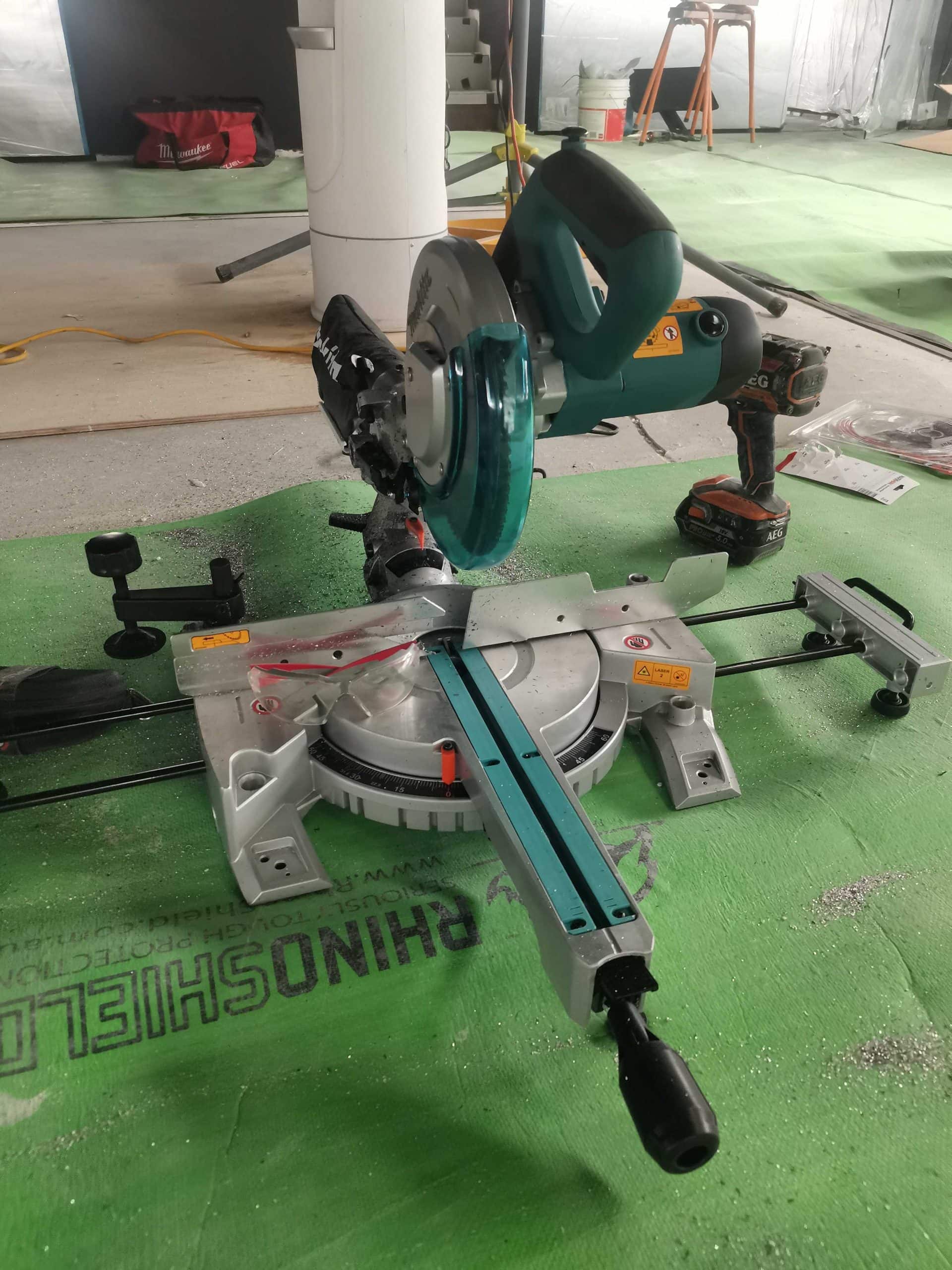
5. Auto angle cuts with positive stops.
Look for a miter saw that has positive stops, which are set points that allow you to make angled cuts quickly.
These settings can save you a lot of set-up time when cutting angles, make sure you have a quick lock at 45° and 22.5° at least.
It is also a first class idea to look into saws with thumb-activated stops that let you make quick miter adjustments when necessary.
6. A respectable price for results.
As always, I advise you to go for the best miter saw in your price range.
Opting for a higher quality model is always better than buying a cheap miter saw, as the added cost will reward you with better performance and a more durable tool that will last you longer.
Sliding compound miter saw vs. Single bevel saw
Sliding compound miter saws are the most important tool that keeps a building site running fast and smooth, due to this tool’s low required-effort for fast and accurate cuts on even tricky angles.
But the most basic miter saws are single-bevel designs that allow you to cut only in one direction. Although this may seem adequate for many DIY jobs, you will find that you will quickly outgrow the capabilities of a single-bevel saw.
It can be incredibly frustrating to be limited to making cuts in only a single direction and then have to flip the workpiece over to cut the other way if the blades to small for the cut.

A much better option is a sliding compound miter saw, which allows you to freely cut different angles.
The best compound miter saws also allow you to make much wider cuts with a greater degree of accuracy as reported by many other users in sliding miter saw reviews.
Even if you only plan on using your miter saw for DIY work, I strongly recommend that you go for the best sliding compound miter saw you can find instead of only a single-bevel model that can limit you in the future.
Cordless vs corded miter saws
Like many power tools, miter saws come in corded and cordless versions.
Either type can be useful for DIY and professional use, although you might prefer one or the other depending on how often you need a miter saw and what you will use it for.
If you frequently need to cut a lot of material, a corded model is almost always the better option.
It is a lot more convenient to have unlimited access to power with a miter saw if you rely on it constantly, instead of having to stop and change batteries or recharge your tool every time the charge runs down.
Of course, corded miter saws are better suited for situations where you have access to a power outlet and you don’t have to move your tool to different locations frequently.
If you have to do a lot of cutting in remote job sites where there is no power source nearby, you will have to go for a cordless model.
Cordless miter saws are also better suited for small jobs and landscaping work, which doesn’t really require you to have your saw constantly running. The lighter weight and portability of a cordless miter saw also make it a better choice if you frequently have to travel to different job sites.

Dewalt vs. Makita miter saw
DeWalt and Makita are among the most reputable power tool manufacturers in the business.
You’ve probably noticed that most of the power tools reviewed on this site are made by these two companies.
Both companies are known for high-performance tools that provide excellent attributes and functionality, with the durability to go the distance.
Although DeWalt and Makita tools are a bit more expensive than tools made by other manufacturers, they also provide excellent value for money considering their quality.
You generally can’t go wrong with a miter saw from either of the two brands, but DeWalt saws have a slight advantage in terms of the range of board widths they allow you to cut.
They also run a lot smoother than saws from many competing brands and are a lot quieter besides.

Keep in mind that the springs used in DeWalt saws are quite tight, so pushing the blade down will require a bit of effort. However, this gives you better control over the cut once you get used to it.
Makitas generally have softer springs and are easier to control right out of the box.
However, the springs can weaken over time, and they won’t spring back as readily.
You might be able to prevent his from happening by clearing out the dust and debris from the mechanism, but keep in mind that you will likely have to deal with this problem sooner or later if you go for a Makita drop saw.
Workbench or a dedicated miter saw stand?
You can make do with just a DIY workbench in a pinch if that is all you have.
If you don’t plan on doing a lot of cutting work, a scaffold plank and two sawhorses should let you get the job done without any added expense.
At some point, however, you may want to look into purchasing a dedicated miter saw stand, which will make your work a lot easier.
Dedicated stands are more convenient to transport and store, and they will reduce the amount of time it takes to set up your rig.

What is the best DIY miter saw?
If you are looking for a miter saw strictly for DIY use, any one of the models reviewed here should do the job just fine.
If you are planning on using your saw only occasionally and want to spend the least amount of money possible, the models lower down the list provide excellent value for money.
If the cheapest DIY sliding miter saw is what you are after, you could have a read of my dedicated ryobi miter saw review.
You can’t go wrong with a sliding compound miter saw even for DIY use. The convenience of being able to cut at different angles is worth the added cost, over a single bevel saw.
The compound and a sliding mechanism will let you cut more accurately by pushing rather than dropping the blade on your cut. And the sliding arm lets you also cut wider boards.
Folding stand vs. Rolling stand
One of our top picks in this review–the DeWalt DWS780–comes with your choice of a folding stand or a rolling stand.
Each has its benefits and drawbacks, and you could certainly do a first class job with either one.
Folding stands have the advantage of being lighter and more compact, which makes it easier to fit into a car or a van.
They also won’t take up much space when folded down, which makes them a better choice for storage and portability considerations.
On the other hand, rolling stands are better suited for situations wherein you can’t have your cutting rig permanently set up in one spot.
Rolling stands have wheels that make it easy for you to move them around from one area of a room to another if necessary.
Of course, rolling stands tend to be heavier and bulkier than folding stands, so they aren’t really suited for working in remote locations.

Making a first class decision on what saw to use
There are quite a few excellent miter saws available on the market, the best of which are featured in this review. But these models stand out in particular: the DeWalt DWS780 and the Makita LS1219LX.
The DeWalt DWS780 is available in two kits: one with a folding stand and one with a rolling stand.
#1 Best miter saw with a folding stand
The DeWalt DWS780 12-Inch compound miter saw with a folding stand is an excellent choice for pros and DIYers who prefer a system that remains in one spot.
The saw combines a state-of-the-art gearbox and belt drive design that allows for a much wider range of vertical cutting actions.
The Dewalt DWS780 with a folding stand has a convenient XPS cross-cut positioning system that provides a helpful cut-line indicator without the need for adjustment. The 15-amp motor is one of the most powerful in its class, maxing out at 3,800 RPM.
The folding stand is a heavy-duty model that supports workpieces up to 16’ wide, weighing as much as 500 pounds. Despite its carrying capacity, it is remarkably lightweight due to the aluminum construction.
#1 Best miter saw with a rolling stand
The rolling stand that comes with the DeWalt DWS780 with Rolling Stand is equally impressive, with wide rubber wheels that provide excellent grip and performance.
It supports workpieces up to 8’ wide, weighing as much as 300 pounds.
It also has a three-position pneumatic system that allows you to raise and lower the surface as needed.
#1 Best Makita miter saw with a folding stand
The Makita LS1219LX 12-inch compound miter saw with a folding stand offers a high-capacity solution for accurate cutting.
It has a 2-rail sliding system that lets you place it right up against the wall so it won’t take up too much floor space in your workshop.
The unique direct-drive gearbox and guard system allows for a first class range of vertical cuts, and it even lets you make crosscuts at 90° angles in pieces up to 15” wide.
The stand that comes with the kit supports up to 500 pounds. It weighs a very modest 65 pounds and can easily be moved to different areas of the worksite.
And with a large aluminum base, you have a solid foundation for more efficient cutting work.
So what’s with the Makita inward sliding arm?
Sliding compound miter saws provide you with all the benefits of a compound miter saw plus a few others besides.
These saws have sliding mechanisms similar to the radial arms found in other saws, allowing you to move the blade back and forth along a rail as needed.
This lets you cut boards that are wider than the blade’s diameter, giving you more versatility to handle a wider variety of tasks.
The Makita LS1219L has a sliding mechanism opposite to most other saws, which lets you set it up flush against a wall.
Although the sliding component does block your line of sight somewhat, you might appreciate having that extra bit of space to work with. Unlike what the older model allows for.

Should I get a 10-inch or 12-inch miter saw?
Miter saw blades come in a range of sizes, with 10” and 12” blades being the most common.
If you are doing mostly finishing work, a first class 10” should be all you need for most of your projects.
They are light and easy to handle and can perform basic tasks with good results.
However, if you are doing a lot of framing or more heavy-duty work, a 12” blade is the better option.
The larger diameter allows for longer cuts, and they can handle finishing work just as well as a 10” blade.

You can also cut metal with a miter saw
You can cut some types of metal with a miter saw, provided you use the proper blade.
The best miter saws can cut through aluminum, and even brass and bronze fairly easily if you use a blade designed for non-ferrous metals.
These blades use carbide material for cutting into metal and are especially effective when used with a lubricant.
Of course, the range of materials you can cut with a miter saw is fairly limited.
If you frequently have to cut through harder metals, a metal cutting chop saw is a better option.

What tasks should be done with a miter saw
Miter saws can handle an impressively wide range of cutting jobs, from regular board cuts to compound angle cuts and everything in between.
They are especially useful for making angled, miter cuts, which would be difficult or even impossible with many other types of saws.
Miter saws are excellent choices for general DIY work such as flooring and remodeling.
They are also handy for trim work and finishing, which makes them perfectly suited for carpenters and carpenters that need to work on architraves.
The flexibility of a first class miter saw allows workers to cut architraves around windows and doorways, which most other tools would struggle to accomplish with the same speed and accuracy.
Miter saws can also be used to cut baseboards or cladding systems for a house or a shed.
These tools are especially useful for framing work, which typically requires cutting wood at different angles.
Miter saws are particularly suited for tasks wherein you need to cut different pieces in precisely the same way or to the same length.
One other task for which miter saws are perfectly suited for timber cladding, which involves creating a more visually impressive exterior for houses or buildings.
Also known as weatherboarding, timber cladding requires that the timber be cut to specific lengths and angles, which is what miter saws are particularly good at.
Finally, you can use your miter saw for decking, which often involves making straight as well as angled cuts.
With a first class miter saw, you can create pretty impressive designs that combine different cuts that are set perfectly flush against the deck posts and frame.
You can even use your table saw to its maximum capacities with this ultimate table saw using hacks.
When it comes to uses, it’s really different from a circular saw or a track saw.
Tips for operating a miter saw
Using a miter saw seems pretty easy. After all, all you have to do is lower the blade mechanism to the workpiece, right? But there are a few tricks to make drop saws quicker and easier to use.
Knowing how to control the blade and maneuver your workpiece will enable you to consistently get excellent cuts.
1. Bulk cutting boards
If you have multiple cuts of timber to do at the exact same length you can mark the end of the timber on the workbench before your first cut with your pencil.
You can clamp a block of wood to this line and you can then push every next piece of timber up against this guide to ensure a clean and accurate cut time and time again without having to measure every cut individually.
You can then take this a step further by using a wood clamp, to clamp a piece of timber to create a stop edge. Now you don’t even need to align your piece up with a pencil line.
Simply push each new board against the timber stop edge, and make cut-after-cut the exact same length.
Get some info on adjustable clamps here.
2. Check blade alignment with your mark
When measuring, you can test your blade placement before committing to a cut.
You might want to lower the blade onto the material with the motor off so you can see if the blade is aligned properly.
If you are confident that you have your workpiece positioned correctly, you can turn on the motor and make the cut.
If necessary, move your wood from side to side to line the blade up with your mark. You can then start cutting.
3. Accurate cut line marking tip
For more accuracy keep the blade on the same side of the line as the piece you will discard after the cut.
Mark and cut to keep the pencil line. Pencils get blunt when cutting framing continuously, when you cut to keep your line it doesn’t matter the thickness of your pencil line.
Use a scribbling back and forth motion, to bring your line out slowly to the spot your measuring.
Basically mark to cut on the end edge of your line not the center of your line for faster and more accurate cutting.
4. Other tools to use in conjunction with a miter saw
Everyone should have a portable power saw but a miter saw is needed for bulk cutting jobs and when more accuracy is required.
A final tip miter saws can only make crosscuts, for ripping timber along the grain you should look at getting the best portable table saw you should read my review here.
Miter saw maintenance
It can be tempting to put silicone or CRC spray on the moving parts if they get stiff, however it may be a quick fix today, tomorrow dust will stick and clog it up, even more.
To re-lubricate the sliding arm you can instead use graphite dust, it is dry and it does not cause dust to stick to it.
If you don’t have graphite dust readily available, you can have a go at making some with your pencil.
History on miter saws
The electric miter saw was invented in 1964 by ED Niehaus [1], who worked as a tool designer for the Rockwell Company. From the earliest version, Niehaus’ invention had many attributes that are still commonly seen in modern miter saws, such as the radial arc spring action, blade brakes, and even a dust collector.
Because the design was never patented by Rockwell, several manufacturers soon came out with their own miter saws, many with notable design improvements.
Miter saw comparison
Compound and sliding miter saws
DeWalt DWS780  | Makita LS1019L  | DeWalt DWS779  | Makita LS1219L  | Milwaukee 6955-20  | Festool 575306  | Hitachi C12RSH2  | Bosch GCM12SD  | Skilsaw SPT88-01  | Makita LS1018  | Metabo HPT C10FSHC  | Hitachi C10FSHPS  | Delta S26-263L  | |
|---|---|---|---|---|---|---|---|---|---|---|---|---|---|
| Verdict: | #1 Top corded miter saw | Best 10-inch | |||||||||||
| Sizes: | 12 in | 10 in | 12 in | 12 in | 12 in | 12 in | 12 in | 12 in | 12 in | 10 in | 10 in | 10 in | 10 in |
| Crosscut capacity at 90°: | 2 in x 8 in | 4 in x 12 in | 2 in x 14 in | 2 in x 14 in | 3-15/32 in x 12 in | 4 to 3/16 in x 12 in | 4 in x 14 in | 4 in x 14 in | 3-5/8 in x 12 in | 2 in. x 14 in | 3-11/32 in x 12-9/32 in | 12 in | |
| Crown molding (nested): | 7-1/2 in | 6-5/8 in | 7-1/2 in | 8 in | 6-5/8 in | 6-5/8 in | 7-1/2 in | 6 in | 5-1/2 in | 6-5/8 in | 7-1/2 in | 6-5/8 in | |
| Motor: | 15 amps | 15 amps | 15 amps | 15 amps | 15 amps | 13 amps | 15 amps | 15 amps | 15 amps | 13 amps | 15 amps | 12 amps | 15 amps |
| No load speed: | 3800 rpm | 3200 rpm | 3800 rpm | 3200 rpm | 3200 rpm | 1400 - 3400 rpm | 4000 rpm | 3800 rpm | 4000 rpm | 4300 rpm | 3200 rpm | 3800 rpm | 5500 rpm |
Single bevel miter saw
Hitachi C10FCH2  | Makita LS1040  | DeWalt DWS715  | Metabo HPT C10FCGS  | Skil 3821-01  | |
|---|---|---|---|---|---|
| Verdict: | Best single bevel | ||||
| Sizes: | 10 in | 10 in | 12 in | 10 in | 12 in |
| Motor: | 15 amps | 15 amps | 15 amps | 15 amps | 15 amps |
| Cutting capacity : | 5-21/32 in (max cutting width) | 2-3/4 in x 5-1/8 in (miter at 90°) | 2 in x 8 in (crosscut at 90°) | 4 in x 6 in (crosscut at 90°) | |
| No load speed: | 5000 rpm | 4600 rpm | 4000 rpm | 5000 rpm | 4500 rpm |
12-inch miter saws with stand
DeWalt DWS780 Compound  | DeWalt DWS780 sliding  | Makita LS1219LX Compound  | Makita LS1216LX4  | |
|---|---|---|---|---|
| Verdict: | Best 12 inch with stand | |||
| Crosscut capacity at 90°: | 2 in x 16 in | 2 in x 16 in | 2 in. x 14 in | 2 in. x 15 in |
| Crosscut capacity at 45°: | 2 in x 12 in | 2 in x 12 in | 2 in. x 10 in | |
| No load speed : | 3800 rpm | 3800 rpm | 3200 rpm | 3200 rpm |
| Stand: | Folding | Rolling | Folding | Rolling |
| Stand length | 32 inches | 32.5 inches | 46.5 inches | 44 inches |
Our chosen most reliable compound miter saw
The accuracy and speed miter saws have to cut fast square and angled-cuts are what keeps a building site moving smoothly.
Although some older saws might have difficulty setting angles accurately and quickly and can affect the pace of a project.
And you pretty much can’t go wrong with the DeWalt DWS780, whether you opt for the folding stand or the rolling stand.
The increased vertical cutting capacity, the innovative design, and the powerful motor make it a great choice for DIY work as well as more heavy-duty tasks.
As the folding and rolling stands support an impressive amount of weight, and even large workpieces.
The Makita LS1219LX is also a great choice as well, combining high capacity and accurate performance in an efficient and compact system.
There stand supports a very impressive 500 pounds and the saw has a powerful 15.0 amp motor, so you can expect this system to keep up with your most demanding days as well.

Dewalt DWS780 review
Pros:
- Top-quality Dewalt miter saw with durable long-lasting springs.
- The lightweight folding stand fits inside vehicle more easily than a rolling stand.
- Long extending support arms.
Cons:
- For workshops, you might prefer a rolling stand.
#1 Best miter saw with a folding stand
More information:
- Miter saw motor history can be read at, https://www.jlconline.com/tools/power-tools/hall-of-fame-2002_o


