
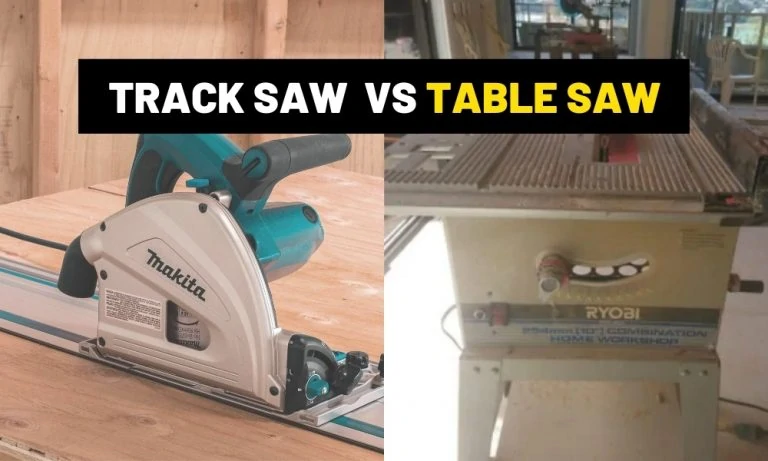
- What is a track saw?
- What is a table saw?
- How is using a track saw different?
- How is using a table saw different?
- On portability
- On safety
- On performance
- Which is better for cutting sheets?
- Which is better for cabinet making?
- Which is better for making repetitive rip cuts?
- Which is better for making long beveled angled cuts?
- Which is better for making crosscuts?
- So which is better overall?
Last updated on March 22, 2026 1:45 am
What is a track saw?
According to Aaron Barnett of BangingToolbox: A track saw is a hand-held circular saw with a rectangular rail (track) that lets it slide to create precise, linear cuts.
Some track saw variants can even do plunge cuts, hence also giving these the name ‘Plunge Saws’.
With their unobstructed tracks, these saws are ideal for making very accurate rip, cross, and angled cuts.
This is essential for sheet lining and wall claddings that need to be cut from saw stools.
What is a table saw?
A table saw is a large and powerful woodworking tool. Designed for heavier use and applications, they’re compatible with larger circular blades which protrude from the top of the table.
Table saws are often mounted on an arbor and are powered by very capable electric motors. The table provides additional support for workpieces, increasing efficiency, precision, and consistency for cutting even thick timber.


When to use what?
If you are caught in the middle of choosing between a track saw and table saw, here are the best applications of each:
A track saw
Certain applications and situations make a track saw the better option over a table saw, especially when it comes to mobility and space. Consider the following:
- Better for working in small, tight, or limited spaces.
- Offers more accuracy than a circular saw as it eliminates the need for more manual clamps, finding a straightedge, and managing blade guards on delicate work.
- For when you primarily do straight and angled cuts.
- For when you want to cleanly and efficiently cut boards that would otherwise be too much of a hassle to cut lifting onto a table saw.
- If you want a tool with easy assembly, dust control, accuracy, and portability.
A table saw
Table saws are innately more capable since they’re larger and have bigger motors, over track saws, these are better considering you are ripping timber boards rather than sheets:
- You have a space that’s big enough to allow for seamless operation (no material jamming, blocking, etc.).
- You’re after speed. Averaging 3000 – 5000RPM, table saws cut fast and some more safely than others.
- You’re after precision and accuracy compared to a circular saw. The table allows you to press material against the fence, increasing control.
- It has higher cutting versatility because it can mount larger blades than a track saw.
- It’s better for ripping and cutting larger and thicker materials such as logs and boards.
How is using a track saw different?
When cutting with a track saw, follow these steps:
- Mark and plan your cut.
- Pick the correct blade type for the material you are cutting.
- Orient the rail to line up with your marks.
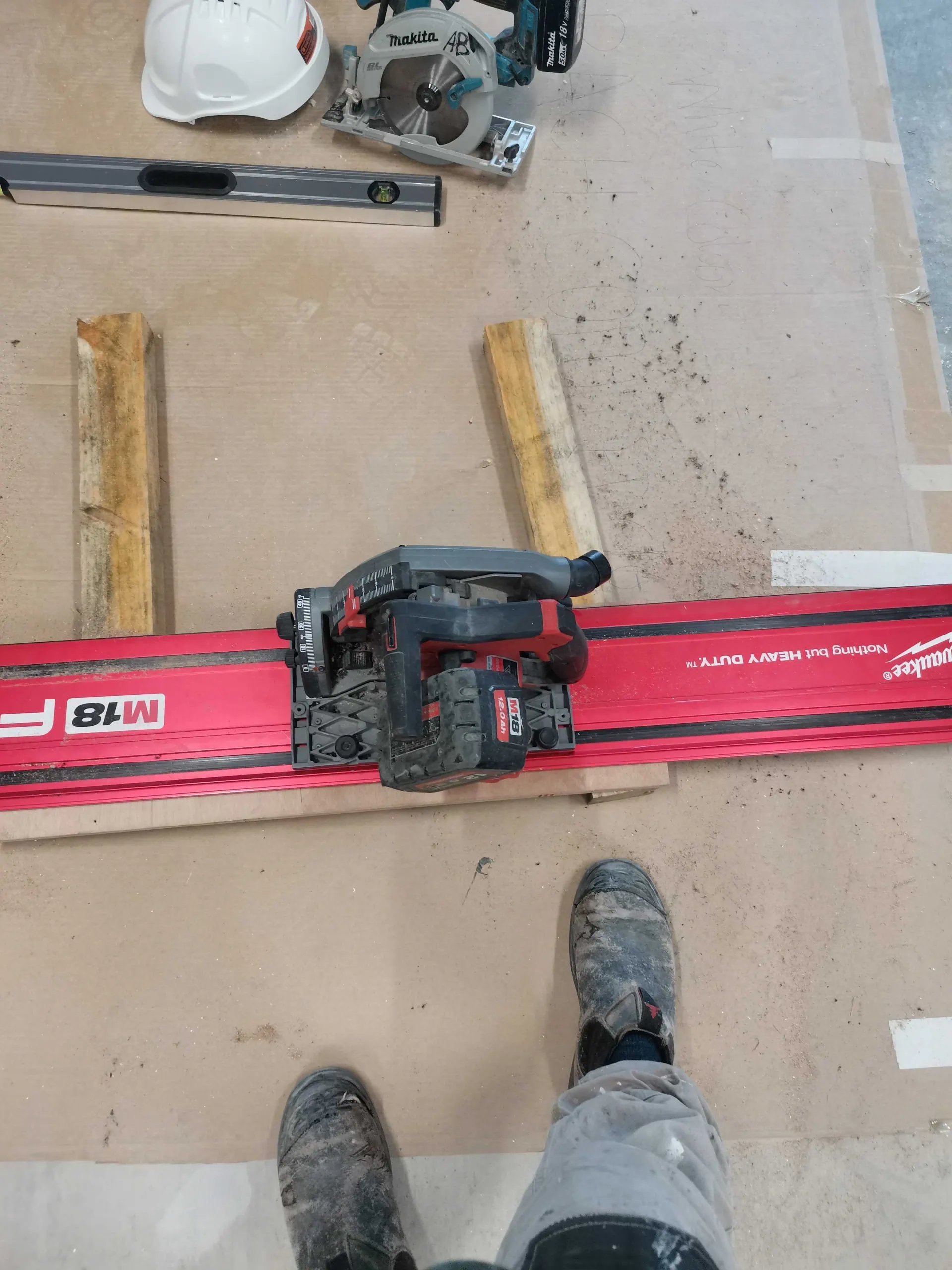
- Mount the track saw rail and the saw on top of it.
- Adjust and check the alignment of the riving knife. This is the safety feature that protects against kickbacks and falls.
- Adjust the cutting depth so the blade’s teeth just stick below the thickness of what you are cutting. It’s advised not to cut wood less than ⅛” thickness. Too thick or too little cutting depth can also damage the blade.
- Press the plunge release to expose the blade from its housing.
- Then press the power trigger and allow the blade to wind up. As the motor turns on so will the dust extraction system automatically.
- Begin cutting when the blade hits full speed by keeping the saw mounted on the guide rail.
- Make sure to never reverse a cut and go backward.
How is using a table saw different?
When cutting with a table saw, follow these steps:
- Make sure that the saw is unplugged.
- Select the correct blade (TPI) and size based on your project requirements.
- Set the appropriate blade height depending on your workpiece. This will be so that the teeth just come up above the workpiece and not too high.
- Adjust the miter gauge and/or the angle of the table for angled cuts.
- Check the alignment of the riving knife. A feature that protects against kickbacks and falls.
- Properly position the cutting fence to make sure that your cut is unobstructed and properly lined.
- Plugin and turn on the saw. Ensure that the material is not yet touching the blade before powering the saw.
- Cut and feed your piece into the saw, tracing along with your marked cut. Be sure to use the saws’ built-in guides and rulers to maintain accuracy.
- Make sure you never reverse your cut or go backward.
On portability
#1 A track saw
Track saws are smaller and lightweight, thus are more portable and easy to handle. They also take up less space for use and in storage, making them easier to bring and move around.
The rails can sometimes break down into two or smaller pieces which allow for better transport but a long rail can be difficult to move sometimes.
Overall, the design of track saws focuses on convenience and efficiency, reducing fatigue without losing out on performance.

#2 A table saw
While there are stands that can fold, table saws are not all built as portable.
They’re larger and cumbersome and can be stressful to set up without portable stands.
Working at remote locations would also require you to have a vehicle capable of fitting the stand and all its components, anything outside of a van can be unsuitable.

Which is more portable?
So between a table saw vs track saw, the track saw clearly wins in terms of portability.
On safety
#1 A track saw
The primary safety feature of a track saw is that they also have an adjustable riving knife and the fact that it houses the blade when not in use.
The design itself of a track saw revolves around providing safer operation, especially for beginners.
The rail also functions as a stabilizer and sort of guard, preventing slips and ricochets.
#2 A table saw
Table saws have a bad early history full of accidents. The protruding blade and the fact that you have to feed in the material when cutting requires more skill and care from the average user.
Modern table saws are built way safer, with various mechanisms such as blade guards, emergency brake sensors [1], and anti-kickback pawls.
However, the sheer power and the fact that a fast-moving serrated blade is exposed when working presents a constant risk even for experienced professionals.
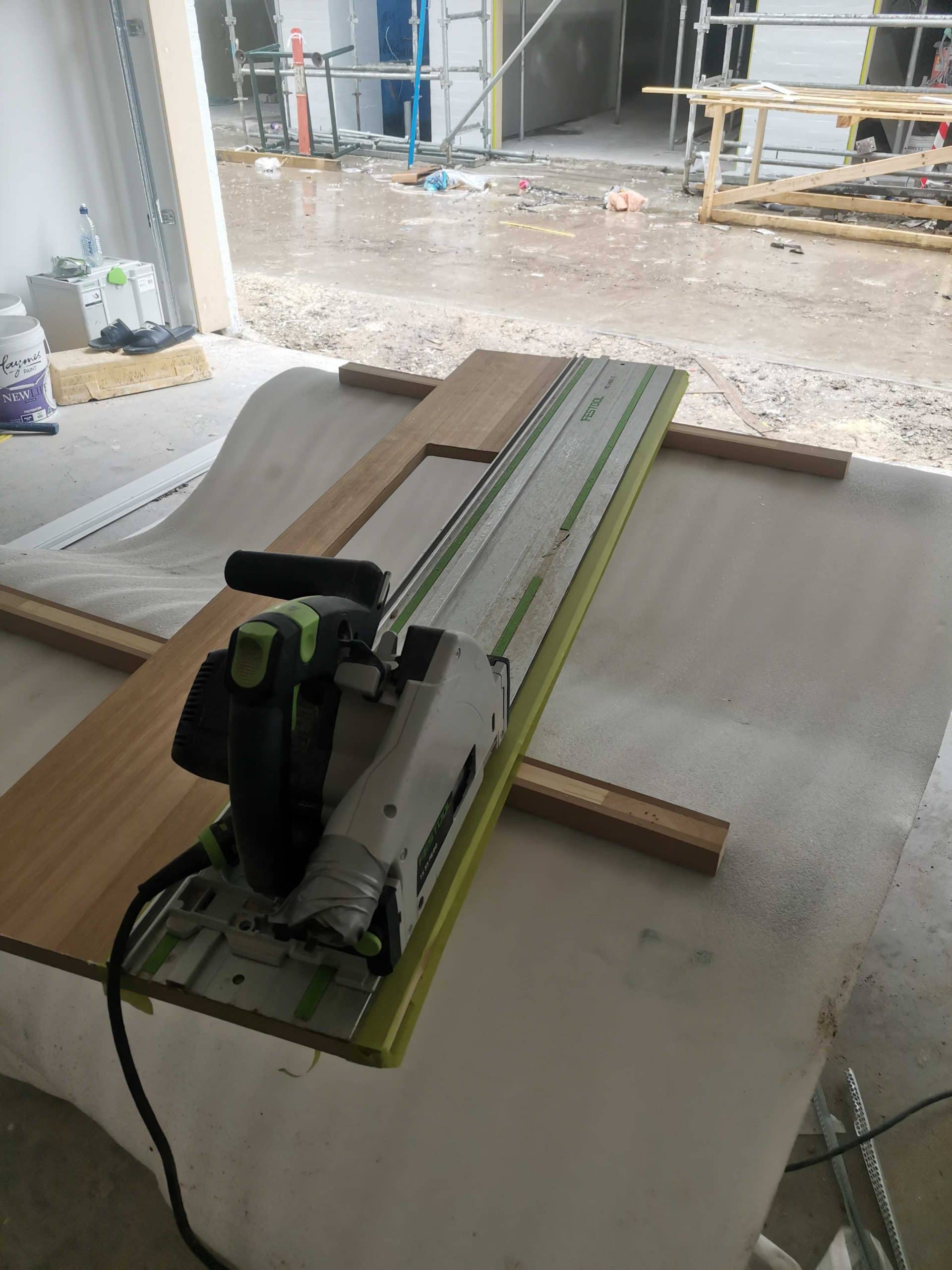
Which is safer to use?
So what’s better a table saw or a track saw in terms of safety?
The track saw takes general safety, but this isn’t to say that a table saw is not safe – they just require an added level of caution to safely operate.
Or an added investment for a safe flesh detecting emergency brake variant.

On performance
#1 A table saw
Table saws were built to take on larger and tougher material feed at a faster more aggressive speed.
Focusing more on performance rather than portability, table saws are fitted with stronger motors, typically 2HP at the very least, capable of chugging out blade RPMs in the range of tens of thousands.
Table saws need the added power to keep their larger blades cutting fast and efficiently on dense wood rather than sheets.
#2 A track saw
Track saws, although smaller, actually pack quite the punch. In fact, modern track saws have shown to dish out almost the same amount of power as table saws.
One example is the Makita SP6000J whose 12-amp motor can reach RPMs of up to 5200.
While they can also have interchangeable blades, most don’t go beyond 6-½” as the saw’s frame can’t handle anything bigger.
Which is more powerful?
Table saw without a doubt.
Which is better for cutting sheets?
#1 A track saw
Being able to do long and straight cuts with ease is a track saw’s specialty.
You can effortlessly cut sheet goods, like 4×8 plywood, to size without having to take up too much space and with only one user. Sheet sizes are already rather space-consuming, making them the harder element to move around.
Maneuvering the tool instead of the pieces themselves increases productivity without needing too much compromise.
Not to mention the higher viability of performing custom cuts for fabrication purposes.
Even includes its ability to cut fiber cement sheets and laminate with the right blade installed.
This makes track saws much more accurate, and faster and only requires a single person to operate.
#2 A table saw
While you can certainly cut sheets using a table saw, it’s often not recommended if you have a limited workspace.
Cutting sheets with a table saw requires a floor area that’s almost three times the size of the sheet to be able to allow for smooth infeed and outfeed.
However, despite this small drawback, sheet goods are cut faster but less precisely on a table saw given its higher blade versatility and output.
Because the sheet needs to be lifted there needs to be 2 or 3 people to lift and stabilize the sheet when being cut on a table saw.
Lastly, table saws are also limited to only cutting wood and aluminum, and not man-made fiber cement boards.
Best for sheet cutting
A track saw is better for cutting down thinner sheet material into smaller sections, while a table saw is better for production-scale cutting and for general cutting of larger, thicker thinner wooded lengths.
Which is better for cabinet making?
Let’s compare a table saw vs a track saw for cabinet making.
#1 A table saw
Since cabinets are usually composed of multiple compartments made from identical workpieces, a table saw is perfectly suited for cabinet and wood furniture making in general.
Setup time between each cut is basically nonexistent and cutting scales well along with the size and complexity of the cabinet.
The various guides and attributes of a table saw also allows it to make cuts that just aren’t practical with a track saw, such as dadoes and slots.
#2 A track saw
With the help of the rail [2], it’s easy to cut large wooden panels for cabinets.
A track saw will produce smooth and clean cuts with little-to-no chipping which helps in reducing post-process work.
An irregularly shaped cabinet is also more doable given how easily adjustable track saw operation can be (angle cuts more or less than 45 and 90°).
One downside is longer work times when building larger cabinets with smaller wooden compartments.
For cabinet making
A track saw can be better for much smaller and simpler and/or irregularly-shaped cabinets.
So between a track saw and a table saw, the table saw is better for making cabinets. And more specifically a specialized cabinet table saw.

Which is better for making repetitive rip cuts?
#1 A table saw
Ripping is one of the core functions of a table saw. That leads to track saw vs table saw for ripping trim function not a question. It can do almost any kind of rip cut given the intrinsic qualities of its toolkit.
With the accuracy of a table saw’s assembly along with its various quality-control components, wide, narrow, and even repetitive ripping is a small game for these workshop workhorses.
#2 A track saw
You’d need to mark all the pieces you’ll be rip-cutting with this one by one.
It can stack up hours and even days to complete a large batch.
Cutting down boards before ripping adds up to work time even more.
For making rip cuts
Unanimously the table saw. Though you can be patient and use a track saw for smaller ripping projects.

Which is better for making long beveled angled cuts?
#1 A table saw
A table saw handles mitering and other measured cuts better. The built-in guides and rules make it easier to maintain cutting dimensions, while the table’s added stability also increases control.
Tables saws might be bulky, but they’re surprisingly accurate and precise, able to make impossibly narrow cuts for their size.
#2 A track saw
When it comes to angled cuts, track saws have an edge. The easily adjustable and free-angle rail allows you to cut in a 360° plane.
Adding more rail pieces also lets you take on longer material and perform straight, clean, and accurate cuts [3] with ease. You can miter free-hand, but it’s better to use tracks, squares to the set bevel on the tool.
For mitering and measured cuts
A track saw is for mainly angled cuts and a table saw is better for straight bevel and other joinery cuts.
Which is better for making crosscuts?
A track saw (Depends)
Cutting longboards or 2x4s needs you to cut perpendicular to the material.
While it’s certainly doable, the rail’s limited surface will also limit the length of the cut and is likely to dip or sag during operation.
You’ll need to exert a bit more effort when using one of these for cross-cutting.
It’s not really viable over a circular saw.
A table saw (Depends)
A table saw’s higher power output, larger blade, and ideal working surface makes quick work of even the thickest of wood stocks.
The table also gives additional support to secure the workpiece. To make cross-cuts however with a table saw you need a table saw that you can lift and drop the blade with your foot on a pulley.
Feeding the blade into the material supported by a back fence. Coupled with using a sled, you can make squared crosscuts. But it is better to use a miter saw.
For cross-cutting
A table saw crosscuts even thicker material like a hot knife through butter. But less efficiently than a miter saw and not all table saws are set up to do it.
So which is better overall?
Well, it really depends on the need. Both tools are great and can be better than the other depending on what you intend to do and certain conditions are met.
They’re both power saws and are pretty darn good ones at that. Track saws for easily cutting sheet material accurately to size. Otherwise, a table saw is the ideal long-term investment for ripping large timber lengths to size.
In the end, it’s really case-to-case, so we’re hoping that at least one of these makes the cut to be part of your tool collection.
And if you are not sure what saw to use for your project, you’ll probably find it here.
More information:
- On skin detection on table saws, About us page, https://www.sawstop.com/company/about
- Build your own track saw for straight, accurate cuts, published on https://www.popularmechanics.com/home/tools/how-to/a21719/build-your-own-track-saw-for-straight-accurate-cuts/
- Tool-review: Rail-guided saws, published on https://www.woodmagazine.com/woodworking-tools/reviews/more/rail-guided-saws


