- What is a cement board and where to use it?
- Things to consider before cutting cement board
- Tools for cutting cement board
- 1. Using backer boards knife
- 2. Using a circular saw
- 3. Using a tile saw
- 4. Using an angle grinder
- 5. Using an electric shear
- 6. Using a turbo drill attachment
- 7. Using a D-cut fiber cement cutter
- 8. Using a hand guillotine
- 9. Using a hole saw attachment
- What is the best tool and method to cut fiber cement boards?
- How to safely cut fiber cement?
- All it takes is the right cement board cutter.
Last updated on March 22, 2026 2:54 am
What is a cement board and where to use it?
According to Aaron Barnett of BangingToolbox: A cement board is a mixture of cement and cellulose fibers that are formed into thick sheets similar size to drywall and plywood except for heavier, long-lasting, and fire retardant.
They usually come in the standard 4 x 8(ft) size and are commonly used as flooring, wall paneling, and backing for tiles. Cement boards perform well in areas that are prone to water exposure, such as bathrooms and kitchens, because of their inherent resistance to water damage and the formation of mold and mildew.
Things to consider before cutting cement board
- Tools available. Your cutting method largely depends on the tools you have at your disposal. You can use tools from dedicated cutters, corded and cordless track saws, as well as drills with specific attachments.
- Blade type. When using saws, not all blades are suited for cement boards. A carbide-tipped blade [1] with a low tooth count is almost always used as it’s strong and does not expel a lot of dust when cutting with a dust extractor.
- Precision. Straight cuts can be done by most tools while curved cuts would have to be done with thin blades. Cutting circles will require special tips or attachments on a jigsaw tool.
- Time and speed. Power tools will get the job done faster than manual or hand-operated tools but may come at the cost of a lower-quality cut due to lower control.
- Cement board quantity. Depending on the volume needed to be cut, you may be better off using a track saw or stacking sheets for producing fast and consistent cuts on multiple boards at once.

Tools for cutting cement board
1. Backerboard scoring knife
A scoring knife is used to “score” or cut small grooves across certain lengths of material. The easiest way how to cut cement backer board with one of these is to actually score along the area you wish to cut and then snap the sheet along the scored lines.
These work well mainly for straight and linear cuts that don’t need to be paint-smooth, without the hassle of dust or the need for power tools.

2. Circular saw
You can cut cement boards with a circular saw so long as you’re using a carbide-tipped fiber cement cutting blade with a low teeth count.
Toothed blades will blunt and have the tendency to get bogged down and rip chucks out.
Ideal for making straight cuts, just don’t use a new saw.
3. Tile saw
A wet saw, which is a type of tile-cutting saw, is surprisingly effective on a cement board.
The abrasive blade bathed in water produces clean and dustless cuts faster than cuts produced by a jigsaw or a circular saw.
Cuts similarly to a circular saw, but with a longer-lasting blade, and a more dust-free operation.
Slightly more tedious to use on wider boards.

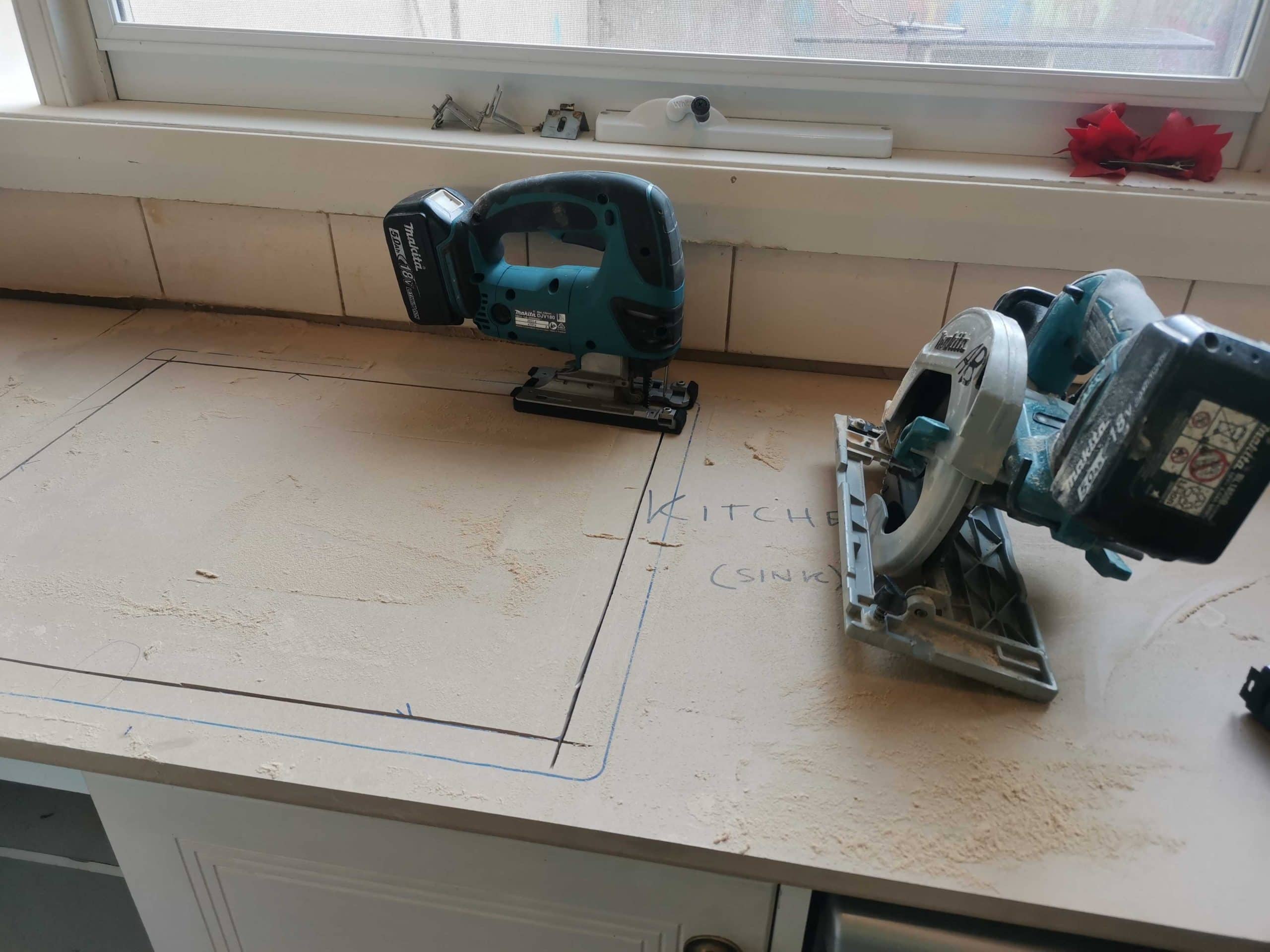
4. Jigsaw
A jigsaw is one alternative to a circular saw. Arm it with a metal-cutting or carbide-grit jigsaw blade to cut cement board and you’re good to go.
It cuts slower than a circular saw, but leaves smoother edges and expels very little debris.
Use for small straight cuts, and for making curved cuts. Blades can dull quickly so only use them for curved cuts, or checkouts.
5. Angle grinder
Another alternative to a circular saw is an angle grinder. For best results, go with a diamond cutting wheel, but do take care since this tool is harder to control and produces heaps of dust.
Better for cutting straight, edges, and corners if you know how to use it properly.
6. Dremel rotary tool
Cutting cement board with a dremel is basically a miniature angle grinder. It’s easier to control and expels only a small amount of dust. With a carbide cutting wheel, it works remarkably well on a cement board.
Cuts similarly to an angle grinder, but cleaner and at a smaller scale for tiny checkouts.
7. Fiber cement shear drill attachment
Fiber cement shear attachments are specially designed cutting accessories that are compatible with power drills. The hardened carbon-steel blades are tailored to cut cement siding and transform your drill into mechanical cement backer board scissors.
Ideal for cutting straight, but can also be used for precise arcs and curves.

8. Electric fiber cement cutter
These are technically circular saws armed by default with carbide-tipped blades that are dedicated mainly to cutting fiber cement and similar material. They also come with a handy dust-collection system.
Cuts similarly to circular saws, but can do plunge cuts easier. Better for cutting cement sheets with and protecting your circular saw from this type of work.
9. D-cut fiber cement cutter
These are dedicated tools for cutting cement siding. With an adjustable, swinging cutting head, the D-cut can cut at a maximum pitch of 4/12 with no dust, noise, and power requirements.
Great for making straight cuts and angle cuts up to 70°.
10. Hand fiber cement sheet cutter guillotine
More portable versions of standard fiber cement cutters. Fiber cement guillotines or hand shears are specialized cement siding cutters mainly for working with smaller pieces (up to 8mm).
Good for dust and power-free straight and square cuts on the go when portability is desired.

11. Track saw
A track saw also comes with an adjustable aluminum track that helps guide the saw and keeps it straight throughout a cut.
The blade cover has a dust exhaust port which you connect to the vacuum to keep the dust from accumulating around your workspace.
Best used for creating clean and accurate straight cuts on cement board. With its ability to angle the blade as well, you can also create bevel cuts for corners.
As well as stacking and cutting multiple sheets at the same time with ultimate precision.
12. Hole saw attachment
Using a brushless cordless drill is the recommended way of cutting with a hole saw attachment.
This is useful when you need to create holes for vents, pipes, and conduits to pass through.
For cutting interior squares, you would need to use a jigsaw or reciprocating saw to cut out the corners after working with the hole saw.
Great for cutting out perfectly circular and square holes.
1. Using backer boards knife
Use the score and snap method for thinner boards. Mark and lay down the workpiece on a flat, even surface. Get rid of nearby objects that might damage the board.
How to score and snap cement boards with a backer boards knife?
- Identify which side of the board is the ‘good side. This is the side that should be facing up as you lay the board down. Mark where you’ll score along.
- Use the scoring knife to trace along the lines and create small grooves.
- Repeat the cuts about 2 – 3 times.
- Place the board against your knee and apply increasing pressure until the board snaps.
- Cut the now-exposed connecting mesh with a utility knife. You can smoothen out the edges with either an angle grinder, sandpaper or a rotary tool.
2. Using a circular saw
Need to cut thicker sheets of cement board? No worries, just use a circular saw. It’s a much faster and better way of cutting cement boards than with a knife.
Make sure to plug in your saw into a stable power supply and wear proper protection beforehand.
Cutting cement board with circular saw
- Place the board on a flat, elevated surface such as a table or a workbench and position it such that the blade can pass through the board without causing damage to the surface beneath using dunnage (Temporary blocks of wood).
- Mark out your cut.
- Start your saw and wait for it to get up to speed.
- Cut through the entire length of the cutting line until finished.

3. Using a tile saw
You’ll need to set up the saw on a flat, even surface that’s preferably near a water and power source. Take extra caution to ensure that the hoses that connect to the saw and the power cord won’t come in contact with each other. Be sure to wear all the necessary protective equipment.
How to use a tile saw to cut cement backer boards?
- Arm the appropriately-rated tile-cutting or carbide blade.
- Measure and mark the workpiece.
- Turn on the saw and allow water to fully saturate the blade before making the cut. Make sure that the water keeps running throughout the entire duration of the cut.
- Slowly guide the piece into the blade and allow it to chew through.
- Follow your scoring lines and make sure to work accurately for clean, precise results.
- Empty water in the collection bin continually as it will accumulate debris and make it difficult for you to see.
4. Using an angle grinder
If you’re going to use an angle grinder to cut cement board, then be fully prepared for a dust storm. Make sure to be working in a spacious area, preferably outside, where it’ll be harder for the dust to accumulate.
Wear full hand and face protective equipment. Be sure to be using a carbide-grit or diamond cutting wheel.
How to use an angle grinder to cut cement boards?
- Make sure to clamp down and fully secure the workpiece. Mark on the underside of the board so that it’s visible.
- Rev up the grinder and make sure it hits full speed before starting your cut.
- Align with the marks and make sure to come in at a completely straight angle. Cutting even at a slightly tilted angle might cause skewness.
- Proceed and work slowly to maintain accuracy and straightness as the tool can be difficult to control.
- Stop only once you reach the edge. Do another pass as needed, otherwise, you can try and snap the board if it was thinned enough but not cut by the blade.


5. Using an electric shear
In contrast to an angle grinder, using an electric shear creates little-to-no dust when cutting. This removes the need for a respirator – handy for when you don’t have one.
There are some downsides though as the shears can only cut thin sheets of cement board up to ⅜ inches and you waste some materials as the shears take out thin strips when cutting.
How to use an electric shear to cut cement boards?
- Mark out your cut.
- Begin your cut at the edge of the board.
- Slowly go through your cutting line. If you’re going for a perfectly straight cut, use a square or a thick piece of straight metal as a guide.
- Clean up the strip of cement board produced by the shears.
6. Using a turbo drill attachment
Using a shear attachment removes the need to purchase a totally separate tool. Compatible with most power drills and impact drivers, a turbo shear attachment gives you the same off-hand cutting efficiency with a little more oomph.
It’s a viable option for straight and even curve-cutting thicker cement boards.
How to use a turbo drill attachment?
- Mark your cut. Unless you’re positive that you can handle holding down the piece yourself, clamp it down to avoid wavy and skewed cuts.
- Always begin cuts at the edges. Follow the scoring lines.
- Work both the piece and the tool for curved and angled cuts.
- Clean by sanding up edges after cutting.

7. Using a D-cut fiber cement cutter
A fiber cement cutter is a first class option to efficiently cut numerous cement boards. Dustless, noiseless, and manually operated, working with one of these is as easy and simple as using an office paper cutter.
Measure and mark your pieces to make cutting even faster.
How to use a D-cut fiber cement shear cutter?
- Identify if you’ll be doing a straight or angled cut as the tool attributes 2 separate, equal-length blades for either one.
- Set the pitch, up to a maximum of 4½, for angled cuts.
- Place the workpiece and extend the support arms just until they allow it to lay flush against the guide bar.
- Grab and push down on the lever to cut.
- Use the swing holding bar to further hold down the piece if you plan on doing several more cuts on a shorter piece.
8. Using a hand guillotine
For another dust-free way of making straight cuts on backer boards, you can use a hand guillotine shear. Place the hand guillotine on top of a smooth, flat, and solid surface and secure it to your liking.
You don’t need a respirator but you will still need to wear your favorite job site T-shirt.
Cutting with a hand guillotine
- Mark out your cutting line on the board surface.
- Place your board on the cutting table of the guillotine.
- Align the cutting line to the blade slot.
- Press firmly on the board and pull down the blade to start the cut.
- Slide the blade along the cutting table to advance through your cutting line until finished.

9. Using a hole saw attachment
A hole saw is great if you need to cut a clean, perfectly circular hole. This can be done before or even after the backer board has been mounted.
When you cut before mounting, make sure to lift the board up so that the drill attachment does not damage the surface underneath once it goes through the board.
Cut holes using a hole saw attachment
- Mark the center of the circular hole on the board surface.
- Fit the appropriate hole saw attachment to the drill that corresponds to your desired hole size.
- Place the center tip of the hole saw attachment to the center marking. Make sure that the hole saw is perfectly square with the board.
- Start drilling and push the drill in carefully. Maintain a tight grip as you may get a lot of resistance. Withdraw the hole saw every five seconds to lessen the chance of binding.

What is the best tool and method to cut fiber cement boards?
What
Out of all the tools mentioned, while all are perfectly usable, the best way to cut cement board is with a track saw.
A track saw allows you to work with both speed and precision, combining the power and versatility of a circular saw with the control and accuracy of both the reciprocating saw and the jigsaw.
Outside the need for power tools or large-scale work, a scoring or utility knife will suffice.
Why
In terms of cost-efficiency, a track saw gets you the effectiveness of several other cement board cutting tools combined for a slightly higher individual tool cost.
It’s surprisingly portable and the rail provides both ample protection and additional support when cutting even without clamping the piece down.
Unless you absolutely need to, the simple score and snap are enough for most small, personal projects.
No need to spend much on anything other than a first class scoring or utility knife for projects that won’t be seen with the naked eye. Saves you money and also works a couple of muscles.
How to safely cut fiber cement?
- Wear the appropriate respirator for the job. Cutting cement boards expels 50% of silica dust [2]. Breathing in this kind of dust can be dangerous and can lead to several respiratory illnesses.
- Wear proper eye protection to keep dust away from your eyes which can lead to eye irritation and even blindness in very severe cases.
- Have a vacuum with an attached HEPA filter around at all times. Always clean the workspace thoroughly after cutting.
All it takes is the right cement board cutter.
A cement board can be a very durable and aesthetic option for both wall paneling and flooring. With higher heat, corrosion, and warping resistance, it’s no wonder why more people are opting to spend on the slightly more expensive cement boards over other cladding options.
With that being said, certain applications do require you to cut cement boards – which in itself is also a tad bit harder. Luckily, so long as you have a cutting tool like a track saw, you’ll be able to work your cement boards into shape with the proper knowledge and technique.
A cost-free solution is an electric shear drill attachment. Now, who says scissors can’t beat rock – or, in this case, cement.
More information:
- Cutting fiber cement siding, an article from https://www.chippyonline.com/products/exteriors/cutting-fiber-cement-siding_o
- Reducing hazardous dust exposure when cutting fiber cement siding, published on https://www.cdc.gov/niosh/docs/wp-solutions/2015-185/pdfs/2015-185.pdf