- Key Takeaways
- Are you often exposed to silica dust or asbestos?
- What is asbestos?
- What is silica dust?
- What do they have in common?
- The dangers of asbestos
- The dangers of silica dust
- Permissible exposure limits
- Where to find silica dust?
- Where to find asbestos fibers?
- Occupation at risk of exposure to asbestos
- Occupation at risk of exposure to silica dust
- Is silica the new asbestos?
Last updated on March 24, 2026 12:10 am
According to Aaron Barnett of BangingToolbox: I have done specific training on both asbestos and silica dust before writing this article.
Key Takeaways
- Asbestos and silica dust are both harmful to the lungs.
- Asbestos is a chemical that cannot be seen with the naked eye.
- They both remain harmless until they are broken down from their solid form.
- Their particulates get trapped deep in the lungs and cause fibrosis or scarred tissues.
- Asbestosis and silicosis are both incurable diseases brought on by long-term exposure to these substances.
- Asbestos still exists in old structures and is used in many industrial products today.
- Silica is highly present in construction sites.
- Asbestos dust can be detected in the air in many cities walking down the street on a normal windy day.
- The building health risks are increased to over 90% in conjunction with smoking.
- From a scientific perspective, the asbestos risk is low if you are a nonsmoker, but high quantities of silica dust can accumulate from repetitive exposure if not protected.
Are you often exposed to silica dust or asbestos?
Imagine feeling healthy while working in physically demanding jobs like construction or automotive.
It is quite heartbreaking to discover a few years after that you have contracted a life-threatening illness from being exposed to small dust particles that you handle every day.
Silica dust has been dubbed the “new asbestos” because it endangers workers by targeting and weakening their respiratory system.
With all the evidence, studies, and thousands of diseases linked to asbestos, it’s no wonder why people compare silica dust to the hazardous material that killed thousands of people.
While governments and bigger companies are doing their best to impose standards and conduct training in handling these materials, many workers in smaller industries are still clueless about the materials they are being exposed to.
In this article, we will show what silica dust and asbestos are and how each one poses a danger to humans.
Construction workers are not the only people exposed to harmful dust; everyone within a city is exposed, and even those working in offices may be breathing in asbestos.
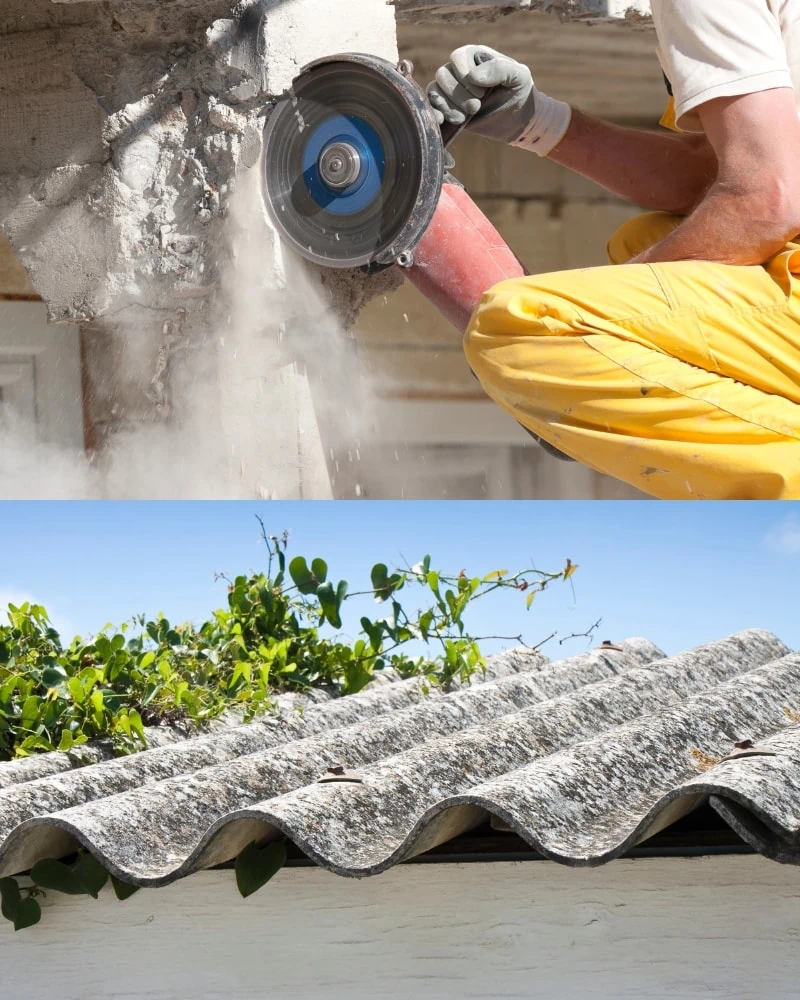
Almost everyone is exposed to asbestos.
Super Six Corrugated Cement Sheets (Containing Asbestos) exist on many commercial building roofs, leaching asbestos into the outside air throughout cities on a windy day. Old concrete water pipes may likewise contain asbestos.
Old pipe lagging, leftover building dust, and asbestos-containing insulation can leech asbestos into old buildings and offices.
What is asbestos?
Asbestos is a naturally occurring mineral (A chemical, not a dust) found commonly in thin, strong fibrous materials that can resist heat, chemicals, electricity, and corrosion.
Because of this property, many industrial and construction companies use this material to strengthen their products.
You will often find this material on thermal insulation and adhesives in construction, like linoleum, floor tiles, and roofing shingles.
Asbestos is used for heat and fire protection properties and has controversially saved lives in the event of fires.
In addition to that, you can find this fiber on heat-resistant automotive products such as brakes, gaskets, transmission parts, and clutches today.

What is silica dust?
Silica dust is a fine particulate from silicon dioxide, a naturally occurring mineral commonly found in rocks, granite, sand, and quartz.
You may find this mineral in man-made materials used in construction, like mortar, cement, brick, and concrete.
The vitreous and transparent material is used in building materials for its strength and durability.
Its crystalline form blends easily with construction material and water to make a more workable or malleable material good for shaping and molding.
It has excellent binding properties that enhance a newly formed product’s durability.

What do they have in common?
- In their solid form, asbestos and silica dust are completely harmless. But once they break down from various processes, their tiny bits become harmful.
- They are similar in the manner in which they become airborne. For example, when asbestos breaks down from disturbances such as repairs, wear and tear, and demolition, the fibers release and later become airborne in its microscopic state. The same goes for silica. After being disturbed by activities like grinding, drilling, sandblasting, cutting, or sanding, the crystalline silica floats in the air.
- Those fibers or dust within a diameter of 10 micrometers become respirable and become dangerous for one’s health.
- Both stay in the air, depending on the ventilation, temperature, or humidity.
- Long-term exposure can result in disease even decades later. Those workers with prolonged asbestos exposure can develop asbestosis, while those with extended exposure to silica dust can develop silicosis.
- Both major diseases can affect the lung condition and reduce its capacity. You can observe it from their similar symptoms, such as hard coughing, chest pain, fatigue, and shortness of breath.
- Both of them are fatal.

The dangers of asbestos
While there has been a worldwide ban on asbestos, at least ten countries like the US still use it, and found in different industrial products.
Because of this, about 1.3 million workers in the US are still exposed to asbestos today [1].
Some new cars still contain asbestos in the interior fabrics.
One of the most prevalent non-cancerous diseases is asbestosis. This chronic lung disease develops when the tiny asbestos fibers are inhaled and go to the lungs.
The small air sacs called alveoli take in these particles.
The immune system reaction fails to clear up these particles since asbestos is inherently resistant to digestion.
For this reason, these trapped asbestos fibers get trapped deep into the lungs until they fill up with these microscopic fibers.
The event causes fibrosis and scarring.

Diseases associated with asbestos
Aside from asbestosis, many diseases have been linked to inhalation of asbestos as a chemical rather than just dust.
- Mesothelioma
- Laryngeal cancer
- Lung cancer
- Ovarian cancer
- Asbestosis
- Atelectasis
- Pleuritis
- Pleural plaques
- Pleural effusions
The chemical cannot be seen as visible dust, and water will not stop it from becoming airborne. An appropriate mask is needed.

The dangers of silica dust
Silica is safe until it turns into an airborne particle. It is safe in its solid state.
But when you start grinding or cutting concrete or drilling into the rocks, those particles that turn into dust become respirable crystalline silica (RCS), and the state silica becomes hazardous.
Silicosis forms when the person inhales the RCS. The microscopic silica becomes trapped deep in the alveoli or air sacs.
The immune responds by trying to clear the particles. Collagen would form around the particle and cause fibrosis or tissue scarring.
Diseases associated with silica dust
Aside from silicosis, silica dust can cause other diseases, such as lung cancer, chronic obstructive pulmonary disease, and kidney disease.
Both silicosis and asbestosis are incurable diseases. You can manage these diseases, depending on the fibrosis level. There are no treatments developed for both of these diseases to date.
Meanwhile, silicosis could lead to tuberculosis, and even a small percentage could lead to heart failure.
Permissible exposure limits
Permissible Exposure Limits are limits and regulations set by the government to protect workers from exposure to harmful substances like asbestos and silica.
These limits are given following the 8-hour Time Weighted Average.
In the USA, employers should ensure that workers can only be exposed to silica dust within a concentration of 50 µg/m³ on an 8-hour shift per day [2].
For asbestos, employers should not expose workers to asbestos airborne concentrations of more than 0.1 fiber per cubic centimeter on an 8-hour shift per day [3].

Where to find silica dust?
Silica dust is prevalent in many occupational settings.
In construction settings, you can find it in concrete, mortar, sand, and stones when undergoing drilling, cutting, grinding, demolishing, or sweeping concrete dust when cleaning the site.
In mining operations, you can find it in minerals or rocks like quartz, sandstone, granite, or slate.
In manufacturing facilities, you can find silica in glass, cement, or ceramics production.
Silica dust is present in many operations, such as abrasive blasting, stonecutting, and masonry.

Where to find asbestos fibers?
Meanwhile, asbestos is found in older buildings.
Those structures built around the 1940s to 1980s may have asbestos in their attics, walls, floor tiles and adhesives, roofings and sidings, pipe insulations, popcorn ceilings, drywall joint compounds, and electrical insulations.
Moreover, shipbuilding and naval vessels for insulation and fireproofing used asbestos.
Asbestos was used in automotive parts such as clutches, brake linings, and gaskets before the 1970s.
These fibers may still be present in old infrastructures like water and sewage pipes.
Additionally, you may find asbestos in respective disposal sites or in environments where asbestos has settled or deteriorated.

Occupation at risk of exposure to asbestos
People who worked with materials or products containing asbestos are at risk of asbestos exposure:
- Auto mechanics
- Boilermakers
- Construction workers
- Electricians
- Firefighters
- Industrial workers
- Insulators
- Miners
- Millers
- Plumbers
- Power plant workers
- Shipyard workers

Occupation at risk of exposure to silica dust
All workers who use power tools for cutting, grinding, and drilling into silica dust-containing materials are at risk of silica dust exposure without an effective mask.
If you blast or excavate granite, sandstone, or clay, you are at risk of silica dust exposure.
- Abrasive blasting operators
- Agricultural workers handling certain pesticides and diatomaceous earth
- Construction workers
- Ceramic and pottery workers
- Concrete and cement product manufacturing workers
- Demolition workers
- Drillers and miners in hydraulic fracturing (fracking) operations
- Glass manufacturing workers
- Masons and bricklayers
- Miners
- Production workers of glass products, ceramics,
- Quarry workers
- Roofers
- Sandblasters
- Shipyard workers
- Stonecutters and stonemasons
- Tunnel workers

Is silica the new asbestos?
Silica is not the new asbestos. But it shares similar risks and dangers for anyone exposed. Both of them are occupational hazards.
And they both require stringent safety measures, standards, and regulations.
The two materials are safe when undisturbed but can be fatal in an airborne state.

However, silica dust demands more attention, studies, and research because asbestos has already been proven dangerous and fatal with much evidence.
Silica dust is still being linked to lung diseases, but enough records do prove the risk.
While many companies are slowly removing asbestos in buildings, infrastructures, and establishments, silica dust is becoming a notorious silent killer in many workplaces.
Here is what you can do as a worker or employer in an environment with silica potentially transforming into airborne dust.
- Shift to wet cutting from dry cutting.
- Make use of a workplace vacuum instead of a broom.
- Always provide room and time for ventilation.
- Utilize dust filtration systems.
It is easy to protect yourself from Silica. It’s obvious if there is dust in the air, and you only need to wear appropriate Respiratory Protection.
Main contractors should have a strict policy to kick subcontractors off building sites that do not wear dust protection or use water to control dust.

The least you can do is reduce the impacts of grinding objects with silica dust.
Any worker can always get exposed to silica dust. You must invest in a reliable respirator rather than using a simple dust mask.
As an employer exposing workers to these substances, you must equip them with the protection they need.
Nothing beats having a first line of defense against the risks of silica and asbestos in the workplace.

More information:
- Asbestos facts statistics report by https://www.asbestos.com/asbestos/statistics-facts/
- Standards on Respirable crystalline silica by https://www.osha.gov/laws-regs/regulations/standardnumber/1926/1926.1153
- OSHA Fact sheet about Asbestos by https://www.osha.gov/sites/default/files/publications/OSHA3507.pdf