

Last updated on November 21, 2023 3:19 am
Need to cut metal siding?
Aaron Barnett of BangingToolbox suggests: Metal siding can be challenging to cut. For metal sidings, cutting any piece with the wrong tool can lead to cutting errors or damage to the cladding.
Moreover, you’d face the risks of cutting the material roughly and even causing a sharp safety hazard.
Aside from damaging the tool being used, your material can warp or bend with the wrong tool.
You have to deal with the material’s thickness as a large metal sheet could be difficult to handle when cutting and maneuvering if done in the wrong way.
For this reason, we created a simple guideline that even DIYers can follow.

Step 1. Get the right tool for the job.
The right tool for the cutting task will help you cut metal sidings smoothly.
You can avoid damaging the material or creating uneven cuts, leading to material waste. Of course, you cannot afford to waste sheets of metal sidings.
Also, you need a tool that does the job. I’ve seen some DIY sites recommending the wrong tools for metal siding.
You do not only risk damaging the parts of your tool but also its integrity on the job site.
So in this list, we have enumerated the most appropriate tool to cut metal sidings for your wall cladding system.

1. Aviation & tin snips
When it comes to cutting thin metal sheets, you can never go wrong with aviation & tin snips if they are built for serious metal cutting.
Handheld tinsnips can be manufactured in a wide array of qualities, and what I think is the best is the most appropriate for shearing into metal sidings by hand.
A phenomenal aviation cutter design is intended for manually cutting thin metal sheets like steel sidings without warping or bending or the blades spreading apart in a lateral direction.
Spreading would avoid future cuts as, just like scissors, the jaws need to be tight together to perform a smooth result.
In layman’s terms, our recommended snips utilize two blades hinged together by a pivot, much like scissors. When the operator squeezes the handles, these sharp blades meet on the metal sheet to cut the material apart.

2. Nibbler
A nibbler is a specialized tool with uniqueness and personality that stands out in any man’s toolbox. Designed for cutting thin metal sheets – just like sidings.
Our nibbler tool chews into metal sheets smoothly and precisely with the punch-and-die mechanism.
With minimal distortion and outstanding maneuverability, a nibbler can leave smooth cuts without needing to deburr the edges. But expect a trail of filings.
More importantly, a nibbler cutting tool can cut following any shape of different forms of metal sheets.
Although working with a nibbler machine could be messy, the metal chips are usually manageable with a strong magnet at the end of a stick.
A nibbler works for fast and precise cuts and shapes in metal sheets and can cut any metal siding

3. Power shears
Power shears are motorized metal-cutting scissors. A powerful shear will be like having a pet crocodile by your side. Except he can either be air or electric-powered.
Like scissors or an untamed jaw, the cutter has a pair of snips/ blades that slice through any metal sheet while only steering the direction of a lightweight, portable machine.
One type of electric shear uses two cutters on both sides to cut. This blade leaves swirling kerf, making metal waste more manageable than tools producing metal chips or dust.
If you need to cut long straight cuts in metal sidings, use power shears.

4. Sliding miter saw
If you must cut lap sidings, use a sliding metal saw with a ferrous blade. The ferrous blade lets you cut heavy-duty metal sheets.
The chop saw uses a circular abrasive blade mounted on a pivoting arm.
You can set this pivoting arm with the right angle or rotate the arm or your workpiece with backing support for even more precise cutting.
You can move the blade back and forth to make longer cuts, even if the metal sidings are wide. If you need to make angled and beveled cuts, this power metal cutter will do the job precisely.

5. Jigsaw
If you need a lightweight handheld tool to cut metal sidings, use a jigsaw with a metal-cutting blade.
Use a bi-metal blade for metal-cutting purposes, and you will cut accurate cuts with a jigsaw with practice.
The reciprocating blade moves upward and downward to cut checkouts or grooves in metal sidings.

Step 2. Prepare your workstation.
What do you need?
- Marker
- Tape measure
- Clamps
- Straight edge
Make sure you have a stable, flat, and clean surface to place wider sheets of metal sidings.
Remove any clutter above your workbench, and make sure the metal pieces lay nice and flat.
Also, wear your protective gear, such as gloves, safety goggles, and hearing protection.
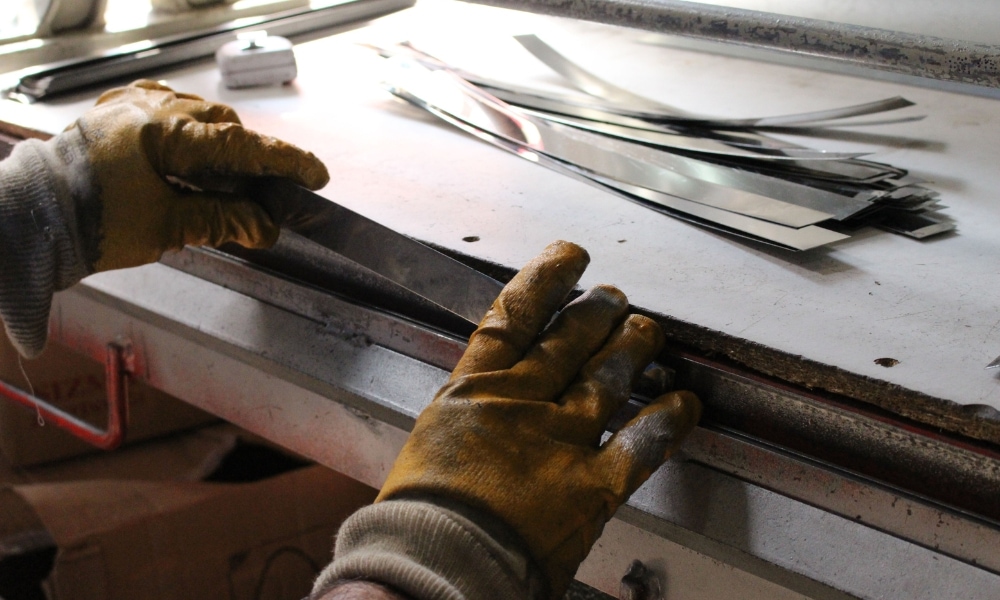
Step 3. Secure your workpiece.
Avoid wasting any workpiece with stubborn cuts because of an unstable surface and unsecured workpiece.
Use strong metal clamps or a vise grip to keep the metal siding in place.

Step 4. Start marking.
Using a measuring tape and a pencil, draw or mark a cutting line as a guide. This step will help your metal cutting tool follow.
For straight cuts, you can use a straight edge to mark a straight line and work as a guide. From here, you can start positioning your tool on the starting edge.
Step 5. Make the cut.
Once you have positioned your tool on the edge of the material and you’re using a power tool, set it to the required speed.
Start slow and increase the speed gradually. Doing this allows you to estimate your control over the tool before cutting.
Follow the guide marks you set until you complete each cut. Deburr any edges when needed.

Step 6. Clean your area.
Turn off your power saw and store it properly.
Make sure to wear protection for your hands before collecting metal shaving.
Clear metal chips, shavings, or dust with a brush, a vacuum, or a shop vac.
Do not use a vacuum not designed to collect metal chips.

Final Word
Cutting metal sidings should be easy when you choose the right tool. Some people use circular saws, but using this could be harder to control and may affect your final cut.
Additionally, circular saws are designed and used for cutting wood, not metal. Make sure to use an appropriate metal-cutting blade and use a slower speed if you do.
The most appropriate tools for cutting sidings are tin snips, power shears, and an electric nibbler. These tools cut through metal sidings seamlessly.


