

Last updated on March 23, 2026 3:11 am
Need to cut straight lines on metal?
Aaron Barnett of BangingToolbox suggests: For anyone who uses their nibblers for creating intricate shapes and patterns in metal, using the tool to make straight lines could be a challenge.
For the most part, the nibblers cutting heads make it hard to follow a straight line unless you draw the line on the metal sheet first.
A nibbler has limited cutting depth depending on the model of your tool.
If you are going to cut through thicker metals, you may have to make several passes, which can affect the straightness of your cutting.
Also, cutting a straight line with a nibbler is slower than cutting complex curves, shapes, or patterns.
For this reason, electric shears are much preferred for a straight-cutting job. But what if you only need to make a few straight cuts and you do not have shears or tin snips to cut with?
Here’s where you need to learn to make straight cuts with a nibbler.

How do you prepare a straight-cutting job with a nibbler?
Here’s what you need to prepare before creating straight cuts with a nibbler tool:
- Electric nibbler
- A straight edge and pen or a chalk line
- Metal clamps
- Safety gloves
- Safety goggles
When you have gathered your tools, prepare your workbench next. Make sure the surface is clean and clear from obstructions.
How to cut straight lines with a nibbler?
Step 1 Secure the metal sheet in position.
Place your metal sheet in a secure position on your work table. Align the sheet perfectly on the workbench.
Secure it with your metal clamps. And if possible, use two of them on both edges. Tighten the clamps with the screws.
Tighten the clamping mechanism so that you can hold the metal sheets securely. However, do not over-tighten the thread as they may leave traces or indents of the clamps that could deform the metal sheet.
Step 2 Secure the straight edge on the workbench.
A straight-edge guide can be used for marking and cutting straight lines.
Place the straightedge like a hollow aluminum section in the desired position where you need a straight line cut.
Secure with metal clamps so that it would refuse to move out of place while you are cutting.

Step 3 Position the nibbler.
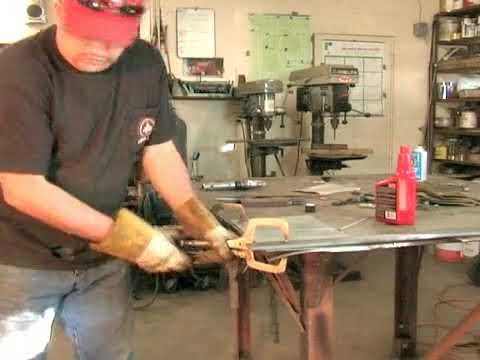
Before working with your nibbler tool, wear your protective gear.
Position the tip of your nibbler on the edge of the metal sheet. Make sure to align it on the cutting path.
Your dominant should be able to control the power switch and set the cutting speed. Use your non-dominant hand to guide the nibbler tool and follow the straight line.
By either following the line you marked or by following against the straight edge.
Step 4 Set the cutting speed.
The cutting speed and thickness of your metal sheet will affect your cut’s quality.
For thick metal sheets, you will need a slower cutting speed. For thin metal sheets, you will need a faster cutting speed.
Remember that when cutting straight lines with a nibbler, you have to gain control and balance to avoid having a jagged cut.
If you’re new to cutting straight lines with a nibbler, start with a slower speed, then gradually increase the pace when you are comfortable.
Step 5 Start cutting.
Now that your nibbler is in the right position and at the right speed for your skill level, you can start cutting from the edge of the sheet metal.
Glide the nibbler tool along, following the guide from the straight-edge tool. Keep the nibbler’s head perpendicular to the metal sheet.
Apply even pressure and glide with a slow and steady motion. This control will help you avoid jagged cuts and keep your cut straight.
Step 5 Deburr the cut.
You can use a deburring tool, like a file or sandpaper, to smoothen the edges of your cut in a straight line.
However, most nibbler tools do not leave behind a sharp edge that requires deburring.
Step 6 Clean up.
By this time, micro metal chips must have scattered all over your workstation.
Turn off your nibbler and remove metal chips stuck on the blade or gears. You can use a brush to collect the metal shavings, a shop vac, or a vacuum designed for collecting metal chips.
Collect the metal filings into a container and dispose of them properly.
Make sure to wear gloves to protect your hands from sharp metal chips.
You can also use a strong earth magnet on the end of a stick to collect and remove the metal chips.

Tips for cutting straight lines with a nibbler
- Try practicing cutting a straight line with a metal scrap.
- Use a guide. If you don’t have a straight edge, a chalk line would do for free-hand cutting.
- Use the right nibbler that can cut through the thickness (gauge) of the metal sheet you are working on.
- Use and maintain sharp cutting blades.
- Always turn your nibbler off when not cutting.
- Don’t forget to wear safety gear. You can also use ear protection when cutting with nibblers.
- Make sure your area is well-lit.
- Have spear-sharp nibbler blades ready to go
Lastly: Consider an Alternative Tool
Alternatively, you can use metal shears or a metal shear impact drill attachment for cutting corrugated metal in a fast straight line.


