- Aim for that smooth polished finish
- Ways to sand metal
- Power sanders for sanding down metal
- Metalworking jobs that need sanding
- Phases of sanding metal before painting
- How to select sandpaper used for sanding metal?
- How to sand down metal using power sanders?
- Best sanders to use
- How to sand down metal using a sanding block?
- How to sand down metal using an angle grinder?
- How to sand down metal using a bench grinder?
- Wet sanding and how to do it?
- How to clean metal after you sand it?
- How to polish metal?
- Safety tips for sanding metal
- You can bring back its natural shine.
Last updated on June 2, 2022 11:04 pm
Aim for that smooth polished finish
Aaron Barnett of BangingToolbox suggests: Sanding down metal is a simple and efficient way to smoothen metallic surfaces as a method of restoring a metal’s faded appearance or removing rust. Nothing beats the aesthetic appeal of pristine-looking and stunningly shiny metal; a clean gorgeous appearance blends in with almost any motif and as a well finished-surface on metal.
No metalwork skill-set is complete without at least a basic understanding of the tools and fundamentals for sanding down. This guide is all about providing you with everything there is to know about how to sand down metal.
Find out how to strip back any type of metal even sand metal doors, sand metal chairs, or even how to sand a car to bare metal.
Ways to sand metal
You can sand metal in pretty much the same way that you sand wood, which is either manually or by using power tools.
Depending on the scale and requirements of your project, it might be more beneficial to sand using one way over the other or by using both methods.
Mostly, you’ll likely be using power tools for higher efficiency and for more consistent results.

Power sanders for sanding down metal
There are many kinds of available power sanders to use, each with its own unique set of characteristics to produce different results. There are certain phases to sanding and using a specific kind of sander for each one will help you arrive at the best possible outcome.
Orbital sander
Orbital sanders are small, often palm-sized sanders that you use if you want to have an ultra-smooth surface in a relatively quick time-frame.
Despite their size, orbital sanders allow you to cover even large areas and produce an almost flawless surface that’s primed for finishing.
Belt sander
Regarded as the most aggressive hand-held sanding tool, belt sanders are powerful enough to shape the material and are best to use for initial sanding, able to quickly sand-back even the roughest of surfaces.
Given their capacity, they’re fairly easy to handle and can also strip off excess material fast.
Finger/file sander
A finger or file sander is an excellent sander to used for detail work as it can easily reach areas that are otherwise impossible to get to with conventional or larger sanders.
Armed with a narrow belt, you use this kind of sander to smoothen in tight spaces and corners such as between rails and trimming.

Finishing sander
You can use a finishing sander to polish, shape, and smoothen surfaces to achieve results closely similar to an orbital sander.
Instead of using an orbital motion, a finishing sander uses a back-and-forth motion to arrive at an ultra-fine finish that’s lighter and more appropriate than what you get with an orbital sander.
Oscillating tool
An oscillating tool is like an upgraded detail-sander as it can easily reach tight areas as well as cut material to allow for better and easier refinements.
True to its name as the ‘multi-tool’, an oscillating tool is a first class alternative multi-purpose sander as you can equip different sanding disk heads for all kinds of sanding jobs.
Bench grinder
A bench grinder is a very capable tool that’s specifically designed to grind metal. Although it’s not sanding it’s useful for more aggressive sanding and polishing tougher and harder materials.
This makes it good for sanding metal as the interchangeable wheel attachment allows you to take various sanding approaches with even differently-sized metals, albeit with a little practice and finesse.
Angle grinder
Though originally meant for grinding, you can use an angle grinder with the correct head attachment to sand wood and metal.
Able to work fast, angle grinders are good for either a second pass for polishing new projects or as initial grind for restoration/recycling project to sand rusty metal and humps with a brush.
(Make sure to wear goggles).
Metalworking jobs that need sanding
- Manufacturing – Processing raw materials for use in other industries and applications requires sanding as a necessary step prior to treatment to ensure that all pieces pass quality checks and meet standards.
- Construction – Structural pieces and metal used in interior design are often sanded and /or polished for both appearance and in preparation for fabrication, strengthening, and painting.
- Automotive – Vehicle work, repairs, and customization often call for metal to be sanded-down in order to meet specifications and for better aesthetic functionality.
- Metal art & sculpting – Metal used as art pieces need to be presentable so as to express a level of creativity and wonder. Metal sculptures and logos of big companies are sanded-down so they appear shiny and lustrous. Here are some copper art projects you might want to try.
Phases of sanding metal before painting
So you want to know how to sand and prepare metal for repainting? Here’s how.
Cleaning
Over time, due to weather and countless chemical reactions, foreign material build-up on metal becomes thick and adheres itself to the surface.
When you know how to sand paint off metal, remember that cleaning comes prior to sanding. Use cleaning solutions and mineral spirits to loosen and knock off any tacky surface.
Initial sanding
Removing withered coating and paint as well as other small blemishes is the goal with initial sanding.
As a first-pass, this phase is geared more towards evening out the surface to facilitate better paint adhesion.
Finishing pass
After a thorough initial sanding, you can follow up with an additional pass or two to arrive at your finished sanding.
At this point, the goal is to remove imperfections such as rust to help re-strengthen the piece and prepare the surface for repair and priming.
How to select sandpaper used for sanding metal?
Now you know how to sand metal for painting, it’s time to find out how to choose sanding sheets for metal polishing.
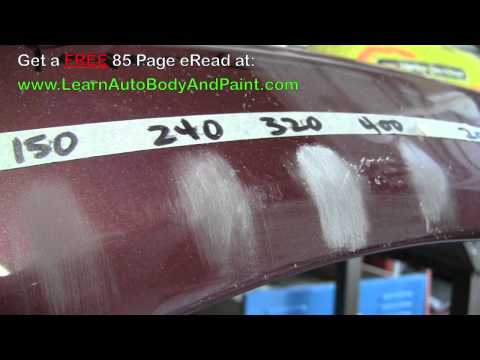
When sanding metal, it’s important to select which grit sandpaper to use, depending on the need, as it will determine the results you’ll get.
Since metal scratches are harder to remove than from wood, follow the guidelines below to determine the best coarse level [1]:
Grit 36 – 100
- For removing finishes such as paint.
- For shaping and leveling.
- For removing rust and other imperfections.
Grit 100 – 180
- For removing scratches.
- For smoothing.
- For pre-finish prep.
Grit 180 – 320
- For achieving fine to ultra-fine, almost glass-like finishes.
- For scuffing between coats.

How to sand down metal using power sanders?
Power sanders are definitely faster to use when compared to hand-tools. There are many kinds of power sanders as we’ve mentioned earlier, so we’ll take a look instead at the general steps on how to use them.
- Select the appropriate sandpaper.
- Select the appropriate sanding head attachment (if applicable).
- Clean the abrasive surface and remove any dust/debris.
- Select and designate your starting point/s.
- Move the sander in straight and controlled strokes depending on how fine you want the finish to be and on the size of the material.
- Repeat for 2 to 3 passes until you are satisfied with the results.
Best sanders to use
- Belt sander – Strongest sander type; best for initial sanding/removing material.
- Orbital sander – Strong and portable sanders for ultra-smooth surfaces.
- Oscillating tool – Multi-purpose tool with a sanding head attachment for either detail-sanding and/or general sanding.
- File sander – For getting into tight areas that need fast stock removal.
How to sand down metal using a sanding block?
Think of sanding blocks as a bed for your sandpaper. It lets you sand more vigorously using just your own sweat and allows for more pressure and control because of the back surface.
- Select the appropriate sandpaper (preferably grits 80 – 240).
- “Wrap” the sanding block using the sandpaper positioning it at the top then folding it to the bottom.
- Firm the folded sandpaper and crease and edges.
- Begin sanding. Use either straight or circular strokes or a combination of the two, but in separate passes.
- Re-fold sandpaper once it becomes loose and worn.
How to sand down metal using an angle grinder?
An angle grinder can be used as a sander with the correct head attachment. It’s recommended to use a flap disc which comes in 40, 60, 80, and 120-grit and is specifically designed for use with an angle grinder. The flap disc is notable for effortlessly removing large quantities of material making it viable for shaping as well.
- Select the appropriate grit sanding head attachment.
- Select and designate your starting point/s.
- Gently make contact with the angle grinder and lightly stroke it along the surface.
- Move-in straight strokes.
- Do additional passes until you are satisfied with the results.

How to sand down metal using a bench grinder?
A bench grinder is a must-have workshop tool, especially if you’re working with metal.
A bench grinder can cut, sharpen, polish, and buff metals.
- Select the appropriate grit sanding wheel; choose an appropriately sized one as well to make things easier.
- Fully secure both the bench grinder and the grinding wheel.
- Dully dress the grinding wheel to be rid of any particle clogging that might ruin results.
- Switch on the grinder. Ready and hold your piece against it while maintaining full visibility and in the orientation, you want (vertical or horizontal).
- Gently make contact with the grinding wheel and move the piece along in single strokes.
- Make additional passes until you are satisfied with the results.
Wet sanding and how to do it?
Wet sanding is used if you want to achieve a really glossy finish.
As opposed to dry sanding that uses a circular sanding motion, wet sanding makes use of straight strokes and water as a lubricant to help you arrive at smoother finishes.
Not all sandpaper can be used with wet sanding. As such, it’s recommended to use grits between 500 – 1500 with the appropriate rating and is specified for the use with water.
To know how to wet sand metal, follow these steps:
- Ideally done after dry sanding.
- Select your sandpaper and soak it in water.
- Select an orientation and starting point.
- Move-in straight strokes, alternating directions between passes.
- Do not apply too much pressure so as to focus on scratch removal.
- Dip the sandpaper back in a container of water periodically.
How to clean metal after you sand it?
Immediately after sanding, you can use a damp cloth to wipe away small debris or a cleaning solution to lighten the scratches left behind.
When repairing metal with small holes and dents, you can sand it down using a degreaser mixed with mineral spirits.
Once smoothed out and restored, run it down with rust converters and prime the surface in preparation for a painted finish.
How to polish metal?
1. Bench grinder
Because a bench grinder is highly versatile.
You can use it to pretty much do anything that’s related to working with metal, including polishing thanks to an attachment of a polishing wheel.

- Choose the appropriate wheel; both type, and size.
- Apply a polishing compound (mix of abrasive filler and greasy wax).
- Move your piece towards the edge of the wheel, angling it downwards.
- Lightly move the piece along the angle and don’t forget to reapply compound as it wears off.
- Move the piece towards the wheel for a bright and shiny finish. Otherwise, move it against the wheel for a smoother one.
2. Angle grinder
Think of an angle grinder as a portable bench grinder. In this case, you can make use of the tool’s high output to polish.
- Choose a polishing head attachment.
- Variable speed angle grinders have it much easier here. Select a working RPM between 1500 – 3000.
- Approach the piece at the desired angle.
- Apply polishing wax to the polishing head while in operation.
- Without too much pressure, move the grinder along, making light back-and-forth strokes.
- Make additional passes as you see fit.
- Change to a lighter polishing head for a final polish.
Find out more about these hand-held grinding tools .
Safety tips for sanding metal
- Always wear the appropriate protective gear as you will be working with power tools and stay clear of any
potentially flammable materials [2]. - Always keep your immediate work area clear of debris and other objects, especially those that might catch fire because of sparks.
- Maintain tools as needed.
- Always wear safety goggles when sanding metal, especially with power tools.
You can bring back its natural shine.
Sanding down metal is a great practice that adds both to metal’s appearance like steel, stainless steel, aluminum, copper and brass as well as its integrity.
Knowing how to sand metal smooth helps in prolonging the life and value as you can basically still recycle even old and worn-out pieces, overall reducing cost and saving on material resources.
Whether done by hand or with power tools, sanding down metal remains to be an integral part of metalwork and adds flair and craftsmanship to your projects.
More information:
- Sandpaper coarse level, published on https://www.nainc.org/blog/sandpaper-selection-grit-guide-for-auto-body-work/
- Flammable materials are dangerous, published on https://www.osha.gov/laws-regs/regulations/standardnumber/1926/1926.152