Last updated on March 23, 2026 9:21 am
Cannot decide between line or dot laser levels?
According to Aaron Barnett of BangingToolbox: Aside from outdoor rotary laser levels, the two other leveling tools used mostly by carpenters are the line and dot laser levels.
For DIYérs not yet familiar with all the types of leveling tools, it’s no surprise you cannot decide between them.
For devices with a seemingly similar appearance, it could be difficult to differentiate which laser level is a line laser and which is a dot laser level.
It would be startling if you can not yet identify which one is suitable for your project and building requirements. The only way to differentiate is to know about the key differences in attributes, operation, and functionality.
So if you’re ready to know more, here’s a simple guide.

What is a line laser level?
Line laser levels produce straight, plumb, or level reference lines to a target.
These reference lines help users align and position building materials and objects for various applications in building, construction, and DIY tasks.
With a 180° laser beam projection, the tool can emit horizontal or vertical planes. Some line laser levels can even project them both at the same time at a full 360° rotation.

Why should you use a line laser level?
- Can project a continuous line
- Line laser beams provide greater leveling accuracy
- Accurate by ½ to ⅛ of an inch per fifty feet
- 0.4 mw to 1 mw lower laser power output
- Can be used for multiple applications
- Self-leveling
A few drawbacks of using line laser level
- Reduced visibility over long distances
- Needs a flat surface for mounting
- The pendulum is extra sensitive to knocks
What is a dot laser level?
A dot laser level projects individual dots on the target or point-to-point reference marks.
The dot laser level can project a level or at 90° angles using multiple points.
This leveling tool uses three to five dots to show square, level, or plumb lines and is more accurate for setting plumb lines.
Dot laser levels can be manual leveling however modern laser levels are self-leveling.

Reasons to own a dot laser level
- Precise point-to-point reference
- Generates 90° angle points
- Accuracy by ⅛ of an inch per 50 to 100 feet
- Suitable for indoor and outdoor use
- More affordable than line laser levels
A few downsides of a dot laser level
- Limited coverage
- Can only project dots
Sub types
Line Laser Levels
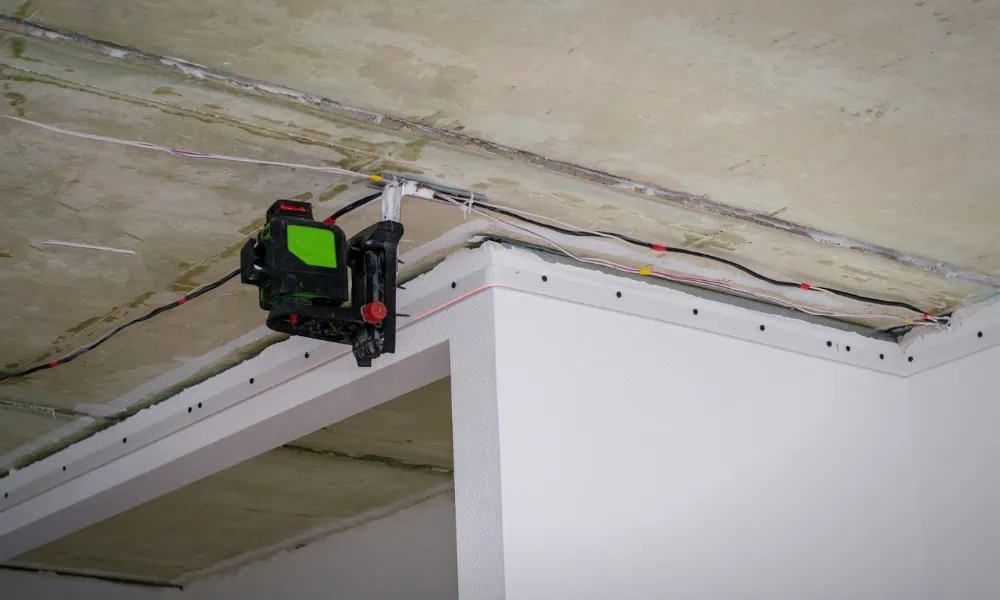
A line laser level can either be basic or a cross-line. The basic laser level line can project horizontal and vertical beams.
With laser line functionality, you can perform simple to advanced leveling tasks such as aligning shelves and cabinets and wall decors, tile installation, and switch and outlet installation.
Meanwhile, cross-line laser levels can project both vertical and horizontal lines at the same time.
Cross line functionality allows the tool to show a cross pattern instead of a horizontal or vertical line only.
For complex tasks requiring alignment in multiple directions, a cross-line is more advisable.
Dot Laser Levels
For dot laser levels, there are two types commonly used: the three-dot and five-dot laser levels.
A three-dot laser level can project three reference dots simultaneously. The dots project configurations or arrangements with three reference points.
Expect two or three horizontal dots with the other two up and above, forming a T-shape, or three dots projecting a triangular pattern.
Meanwhile, five dots laser level emits five reference dots simultaneously.
If you want to set out plan view and square rooms and walls, a five-dot laser level will deliver better than a crossline laser level or a three-dot laser level.
A 5-dot laser level will project accurate dots in a square or rectangular pattern. And a verticle up-and-down dot will plumb walls and doors faster and more accurately than a cross line laser level.

Applications
Line Laser levels
In general, line laser levels suit well for tasks requiring a quick visual guide over accuracy.
Line laser levels are best used for aligning tasks needing a straight and continuous alignment.
Leveling tasks can include wall cladding and wall linings, hanging shelves, installing cabinets, or aligning tiles or installing grid ceilings.
When you want to mark reference lines for layout work, you can use a line laser level.
For tasks that require precise straightening, of wall framing, you can do it with a line laser level with an off-set measurement.
Check our guide to using a laser level.

Dot Laser levels
On the other hand, dot laser levels work best for leveling tasks that require a precise point-to-point reference to set up and down plumb marks.
For hanging decorations at precise points or for marking accurate drill points for downlights, a dot laser level is more useful for these tasks.
For triangular patterns, angles, or aligning objects within a space, you will need the preciseness of a dot laser level.
Also, a dot laser level helps with spot-checking to verify the perfect level or alignment of points accurately.

Accuracy and precision
When it comes to accuracy and precision, both line and dot laser levels offer a unique level of precision.
Line laser levels can project continuous lines to achieve straight and level alignments.
Line laser levels have an accuracy of ½ to ⅛ of an inch for 50 feet or 1/16 of an inch for 100 feet, but they dont take into account the up-and-down straightness of a wall surface, like a dot.
For dot laser levels, the laser utilizes dots or points to measure level or plumb accuracy from end to end at all angles.
Although they may not be as wide as line lasers for continuous lines, they are suitable for aligning objects or setting individual points requiring pinpoint accuracy. You can use a chalk line for pinging your lines between points.
Dot laser levels have an accuracy of ⅛ of an inch per 50 to 100 feet.
We’ve got a comprehensive guide here if you want to check your laser level’s accuracy.

Visibility & Range
Line laser levels
When it comes to visibility, green line laser levels have greater visibility outdoors. And for dimly lit places, the red laser beam emitted by their diodes can be especially bright to see.
You can easily distinguish a laser line from a laser dot.
Laser level lines can cover an extended range of up to 300 feet, making the tool suitable for even large indoor leveling projects.
However, ambient light can affect projection during travel, especially for longer distances.

Dot Laser Levels
When it comes to dot laser levels, which may seem to have limited visibility the more condensed dots are actually more visible in ambient light.
Because it only emits a dot, a dot laser level has less chance to scatter during its travel, unlike a line laser level.
For this reason, a dot laser level can easily be seen in an outdoor environment. Additionally, the projected dot still has limited coverage outdoors and can be visible for up to 65 feet.
Here are our expert tips for using a laser level in daylight.

Ease of use
When it comes to ease of use, cross-line lasers and dot levels share almost the same level of convenience.
When using a manual laser and dot laser levels, you must adjust the screws or knobs to level or align beams or dots. For self-leveling laser and dot levels, you only have to place the tool on a flat surface and turn the device on while unlocking the self-leveling function.
The only difference is you will have to wait longer for line laser levels to stabilize the beam projection. Dot laser levels usually project the dot immediately after turning the tool on.
However, aligning objects precisely with a line laser level is much easier because you do not have to check individual dots to see if it is plumb or level. Instead you can check for level reference in a wider area.
Final thoughts
In the end, both types of laser levels excel in what they do.
Laser levels provide a visual guide to use as critical building reference lines, while dot laser levels provide accurate reference points for setting out frames.
For transferring reference points on floors, walls, or ceilings, and aligning windows or doors, go for a dot laser level.
For mounting shelves and kitchen cabinets, indoor plumbing, aligning grid ceilings and plasterboard, and tile installation, go for line laser levels.
My tip is to get a 5-point laser level, that utilizes both dots and a cross line in a single tool, making the best laser level for carpenters to use with both types of laser levels in a single tool!
If you still can’t find the right type of laser level for you, check my favorite two laser levels for carpenters here.