

Last updated on March 23, 2026 11:43 pm
A look back on the early use of levels…
According to Aaron Barnett of BangingToolbox: The use of primitive levels has been a practice since the times of ancient Egypt, Greek, and the Romans.
Egyptians were known to be the first surveyors. When the annual flooding ruined their boundary marks, they had to re-establish property ownership.
Imagine how they built their pyramids with impressive precision and accuracy.
Thanks to their early measuring tools. We can enjoy most of the newly developed measuring and leveling equipment today.
If you want to know how the use of the level developed from ancient times until today, read on.
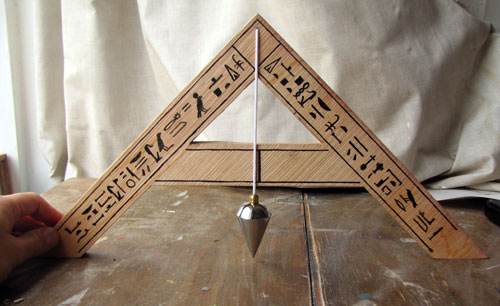
Image source: Timetrips.co.UK
Behind the name
Let’s start the hostory of levels with its name.
According to Webster, the word level comes from the French and Middle English word, livel.
Livel is an alteration of the word libellum, a Latin word derived from the word libra, which means weight or balance.

The Use of Primitive Levels
The earliest documented use of levels dates back to 1100 B.C [1]. In these times, the ancient Egyptians used plummets or plumb bobs when they were building their pyramids.
The first plumb bobs looked not much different than the ones we use today. The plumb bob is composed of a weight hanging on a string.
In the early use of plumb bobs, the Egyptians tied the other end on the center top of wooden boards or A-frame.
The weight usually has a pointed tip that indicates the center of gravity. On the frame, a marking signifies if the string is plumb or straight down.
Romans used another type of plumb bob device called groma, which they used for laying out fields and planning the towns.
The right-angled pole, with hanging plumb bobs on hanging cross-woods is set out in the ground vertically until one side lines up.
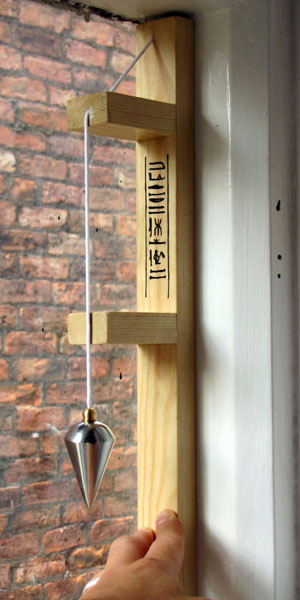
Image source: Timetrips.co.UK
Meanwhile, the Greeks filled containers with water.
On top of these containers are holes that show if the walls they created are vertical. This tool has been the concept of many spirit bubble levels known today.
In the first century B.C., a Roman architect named Vitruvius introduced chorobates.
It is a dual-functional level in a plank about six meters or 20 feet long. It has a groove filled with water that works like the spirit level.
Both ends of the plank have legs that hold plumb bobs each. When the plumb lines match the carved notches on the legs, it means it is level.

The Evolution of Levels
In the the1600s, the newly improved levels emerged.
In 1630, astronomer Giovanni Riccioli introduced the water level. It consists of two cylinders joined by a tube.
It works with the concept of water showing two points are level horizontally when you fill the tubes with water.
In 1629, another water level type works almost the same concept as the first one. However, they replaced the glass tubes with a leather hose. They filled with water into the tubes.
When both ends show the same height, it means it is level. One exciting feature of the hose levels is they can fit into awkward places and still provide a level output. You can put it in wall partitions or holes, and the device will show a level.
It was in 1661 when the French scientist and inventor, Melchisédech Thevenot, introduced the first spirit level that we use today.
The Thevenot level was a rectangular wooden frame with a transparent straight glass tube filled or partially filled with liquid. The liquid filled was initially water but was later replaced with alcohol or spirit.
But because he noticed he can improve its accuracy, he replaced it with a curved tube that reduced the unnecessary movement of the bubble.
Sometime in 1771, another version of the spirit level was introduced. The circular or Bulle’s eye level uses a circular flat glass instead of a cylindrical vial that creates a bubble.
The bubble goes to the highest point of the vial (at the center) if the surface is level. The bubble moves away from the center when it is not level.

The Commercial Age of Levels
The commercial age of leveling started in the late 1900s when manufacturing companies started producing handy pocket levels.
It was also in this stage where the line levels are used to check foundation straightness.
It was in 1973 when a major leap began in leveling and surveying field.
After introducing construction lasers to the world in 1968, Spectra introduced the first-ever self-leveling laser level.
The rise of modern electronic levels became unstoppable in the 1980s when manufacturers released battery-powered levels.
The early electronic levels feature sensors and microchips that can detect if the surface is plumb or level.
These levels have electronic displays that show the direction of adjustment required.
The digital levels introduced in 1989 can measure percent slope, degree angles, simulated bubbles, and pitch.

Laser Levels Today
We’ve come down to the recent phase in the history of leveling.
Modern laser levels now offer more advanced attributes. Laser levels today are built to withstand drops and impacts. They have locking attributes to keep the pendulum in place when not in use.
Today, you can integrate your laser level with laser-level mobile apps for remote control access and real-time leveling.
Today, the used to be spirit level has grown to be many different level types that can be used for specific leveling functions.
Also, the laser level family has grown big.
From the manual laser levels to the combination of dot and line levels to cross-line levels to rotary laser levels, there’s a specific laser level that can make your leveling jobs easier.
If you want to know, here are the laser levels that carpenters use today.

More information:
- A brief history on the level, a publication from https://www.concreteconstruction.net/_view-object?id=00000154-2552-db06-a1fe-775a14100000


