

Last updated on March 23, 2026 10:23 pm
Need to level and mark ceiling reference points?
Aaron Barnett of BangingToolbox suggests: Whether you install lighting fixtures, ceiling fans, vents, panels, or decorations in a ceiling, you want to ensure that everything is properly spaced and aligned.
However, marking a ceiling could challenge your patience and skills as a DIYer or a professional with the wrong equipment.
If this project is something you still haven’t done in the past, we’ve got you.
We prepared an easy-to-follow guideline that would make you use a laser level to mark a ceiling position like a pro.
Want to know how to mark a “datum” point from a laser level to integrate slopes and curves from a set level line?
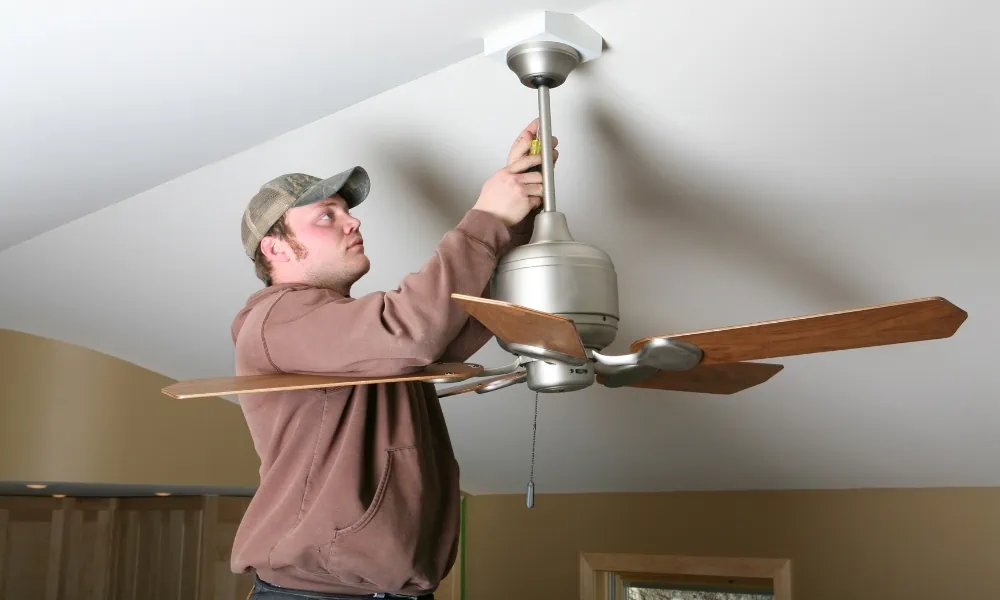
The challenges of marking the ceiling with a laser level
Marking the locations or heights for a ceiling seems straightforward. But you must know what you are getting into when you create marks on the ceiling using a laser level.
Just think about bending your neck backward. If you are in this position, you’ll have a hard time marking the ceiling and judging the level of your markings.
You need a safe way to elevate your height. Think about the ceiling height. You will need a ladder or a scaffold to reach a comfortable height.
Also, working in a wide space could limit the visibility of the laser, especially in well-lit areas. Although you are indoors, the ambient light could make it difficult to see the beams with a low-quality tool.
And do not forget the possible obstructions and interference when projecting a laser beam around an entire room.
For this reason, you need to equip yourself with the right tool and techniques to mark your ceiling level in the correct position.

Which laser level to use for marking a height up to the ceiling?
You can use a line laser level or a cross-laser level for leveling, but the best one for this job is a 5-point builders laser level.
A 360-degree cross-line laser level will project a full horizontal and vertical beam simultaneously and result in a smooth marking of heights.
If you don’t have a cross-line laser level, you can use a combination builders laser level.

What do you need?
- Pencil
- Painter’s tape
- Ladder or a scaffold
- Tripod or a ceiling mount
- Laser Level
- Laser measure
Step-by-step to mark a ceiling using a laser level
If your tools are ready, it’s time to start taking and marking the points on the ceiling.
Step 1. Measure and mark the points on the floor first.
You can mark all the points you want to project to the ceiling first on the floor by using painter’s tape on your floor; you can mark the position.
From the floor, you can use your laser level to plumb those marks up to the ceiling.
To ensure you will level from a center position, measure the area of the entire ceiling.
You can use a laser measure with area mode, to take the length and width of the ceiling. These measurements will help you find the center point.
From these measurements, you can make a grid on a piece of paper using the correct scale. Use graphing paper like a blueprint and determine the positions of your panels, lighting fixtures, or vents you want to install.

Step 2. Plan your ceiling grid.
Whether you use graphing paper or draw a grid on blank paper, you can plan where the panels or fixtures will go into the ceiling.
Using your measurements, scale them down and apply a standard ratio of one foot for every ¼ or ½ inch on the grid.
Assign locations of the fixtures or panels on your drawing, applying equidistant spaces or measurements. Mark these spots and mark their actual locations on the floor to later project to the ceiling.
Now that you have a guide on where to mark the ceilings, you can start marking.

Step 3 Set up your laser level on full beam mode.
Place your laser level on a stable surface like the tripod or on the base stand.
Place the laser level where it can project the center point upwards if you have a dot laser level or a builders laser level.
If you have a cross-line laser level, turn the device on and set it to project a vertical and horizontal beam at the same time, this will create a cross point that will act as a plumb line.
Use your laser measure to check the distance of the center point from the wall. If your wall is not plumb, it will now show. It is more important to be parallel with the ceiling-to-wall junction.
The center point is half of the measurement of length and width, where the two lines intersect. Mark the center point as your reference point.
Check if your laser level is level and plumb and not flashing. Flashing beams indicate that the laser hasn’t self-leveléd.

Step 4 Shoot the laser beams.
Starting from one corner to another, you need a beam that projects a parallel line to the wall and a vertical one that marks the center point of your mark.
Let the laser level sit on one spot, ideally on the farthest point where it can cover a larger area.
Place the device until you have marked the spots you have identified from your blueprint, and move the laser position as you need to.
Check the distance measurements with your laser measure as well, in case you have walls that are not parallel to each other.

Step 5 Mark the ceilings.
Make your first marks with a pencil on painter’s tape. Choose a tape you can easily remove this stops you from putting unwanted marks on the ceiling.
You can use a ruler and a square to ensure you draw a straight line. Position your marking tool directly beneath or at the intersection of projected lines, depending on your requirements.
Use the laser level to check the alignment. Adjust as needed. Apply enough pressure to produce a visible pencil mark.
Step 6 Keep marking until done.
Go to your next reference point as stated in your design. Check distance. Place your marking tool, align it, create the mark, and check alignment.
Repeat this process for all the reference points. Check the distance with your laser measure and alignment with a laser level.
And give one last look at this side of the wall to see if everything is aligned and marked in the proper position. Make the necessary adjustments before drilling any holes.
Step 7 Mark the other side to finish the remaining marking points.
After marking all reference points, project your laser beam on the opposite end of the wall to mark reference points not covered by your laser level’s first projection.
Cross-line laser levels may not cover the other side. Repeat the process of checking distance, leveling, and marking until all points have been marked.
Inspect all the marks you’ve made. Check the distance with your laser measure and alignment with a laser level. Perform necessary adjustments.

Here are more tips
Now that everything is marked, you can start installing fixtures, panels, lights, or vents in their respective places.
You can do this task better if you have two extra eyes to check your work. That means you can work with a helper while working, so he or she can tell you if you’re going out of line.
Leaning your head backward may disrupt your focus.
Make sure to use a stable platform. Your ladder should be balanced to ensure you are working safely.
For every mark, check the lines or marks you’ve made. This measure prevents repeating the entire process after all marks have been made.
Before starting any work, check your laser level for accuracy. And for faster and more accurate markings, use a reliable laser level and a functional laser distance meter for this type of work.


