
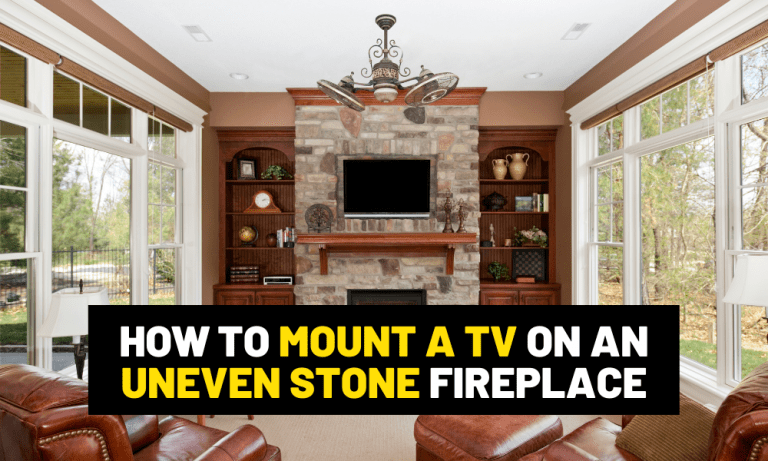
- Quick questions
- Why homeowners prefer mounting above a fireplace?
- Whats difficult about mounting a TV on an uneven stone fireplace?
- Why should you mount your TV on a stone wall fireplace?
- Factors to consider before mounting a TV on an uneven stone fireplace
- What do you need to prepare before installing a TV on an uneven stone fireplace?
- How to mount a TV on an uneven stone fireplace?
- Wiring Tips
- Are you better to mount your TV on a normal wall instead?
- Here’s a little wrap up.
Last updated on March 22, 2026 10:48 am
Quick questions

What can I use to make the TV mount hold on to the uneven surface?
Steel washers can work as packers ao you can fasten your TV mount on the uneven stone fireplace.
What can I use to flatten the surface?
You can flatten protruding stones with a cordless angle grinder.
What else should I consider before mounting my TV on an uneven stone fireplace?
Check the strength of your stone type, the electrical locations, and heat from the fireplace.
Why homeowners prefer mounting above a fireplace?
Aaron Barnett of BangingToolbox suggests: Nothing screams cozy like watching your favorite TV show next to a crackling hot fire. And mounting that TV above the fire on the brick or stone surface is the way to do it.
However, sometimes the stone surface is uneven requiring some know-how for secure installation? From a design viewpoint, a fireplace tv mount is a sight to behold when done correctly.
While many of our past clients and the homeowners we advise prefer their TVs on cabinets or on mounted on timber walls.
Erecting yours on the drop-down above the fireplace can drive everyone’s attention to just one focal point in the living room and that’s what you want.
It may seem like your TV may fall off from the stone or burn from all the heat, but with these safe, easy-to-do steps, you can transform your living room sofas and vocal point all into one direction.
Keep reading for a guide to installing a TV mount on an uneven stone or brick wall.

Whats difficult about mounting a TV on an uneven stone fireplace?
The most commonly used stone material used above fireplaces is slate, a not-so-hard rock material.
The stone breaks easily and cannot support a mounted TV if done poorly.
For TV wall mounting on an uneven surface, some stones protrude further than others and require some stone chiseling or grinding work to create a uniform surface.
Packers can also be used.

Solution
- Use steel washers as packers on the stone to create a flat surface for mounting.
- Use a cold chisel or an angle grinder to smoothen down protruding points.
- Use a combination of both these methods to find a flat surface without doing too much packing or grinding, but find a middle ground with both methods.
Find out more on this below.

Why should you mount your TV on a stone wall fireplace?
1. Aesthetics
Mounted TVs look sleeker and blend well with uneven fireplace stone texture, giving you more room space and a centralized focal point.
Mounting comes with the option of hiding hanging cable wires which leaves your room more modern and tidy.
2. Great focal point
A fireplace is the focal point of many living rooms.
Mounting your TV above the fireplace draws more attention to the fireplace because this means that you’re centralising an entertainment focal point.

3. Save space
Normally, TVs stay on top of furniture like cabinets, tables, or TV stands which take up floor space. By mounting your TV, you will open up that previously occupied floor space for other things.
If you use a fireplace pull-down mount you can lift the TV down when needed, and up out of the way when only watching the fireplace.
4. Family gathering
When you mount your TV on an uneven stone fireplace, you can create more floor space for your family to interact with each other, throw a party, and dance without fear of stumbling over a TV sitting on a cabinet.
Factors to consider before mounting a TV on an uneven stone fireplace
1. Type of stone
Since TV mounting involves drilling into stone, it’s important to consider the type of stone so that you can know how to drill different densities of rock.
Some stones are too soft and drilling and can just crumble. But not like an apple crumble.
2. Electricity location
If the power source is far from the fireplace wall, you may need to have new power points installed. You need your power source as close as possible to the TV.
3. Power tools available
Depending on how fast you want your work done, you will need a power drill with a hammer function to drill through the layer of rock, a Dyna drill will work better.

4. Fixings
There are various mounting systems available for mounting tv on uneven stone fireplaces.
However, selecting a mounting system designed to suit your TV’s weight ensures that the unit stays anchored to the fireplace wall by using long and over-engineered fixings.
5. Heat from the fireplace
The temperature of the wall where your TV will soon stand tall should not be less than specified on the technical specifications and does not become too hot when the fire is going.
You can light the fire to test that the area doesn’t become too hot. Excess heat causes irreparable damage to a TV and can become a fire hazard. To monitor the temperature, tape a thermometer to the fireplace wall.
What do you need to prepare before installing a TV on an uneven stone fireplace?
- Long screws, epoxy, threaded rod, or masonry screws
- Masonry drill
- Tape and stud finder
- Hammer
- A wrench and socket set
- Mounting bracket
- Screwdriver and cordless drill

How to mount a TV on an uneven stone fireplace?
1. Identify the desired spot
Watch out for fireplace heat. The first thing to do is to mark the exact location for the mounting bracket after determining that the spot does not get too hot by using the method above.
Also, consider viewing angle, sofa location, and sun exposure to find the desired height, you don’t want to mount your TV and then realize you have to strain your neck to get a better view.
Using a drop-down TV mount bracket above a fireplace is the solution for this.
- To ensure you get the correct spot, use a tape measure on the wall to mark out your TV location and size.
- Place the mounting bracket on the identified spot and mark the points where you will drill holes for the anchors.

2. Fixing unevenness on the stone wall
If the location where you are going to mount your TV on rocks or slates is uneven, then you want to flatten the surface as much as possible.
You also need a solid fixing point in all the corner locations that will hold the mounting bracket to the wall and will have a screw or bolt.
When you have marked the holes for drilling and fixing Dyna bolts or threaded steel rods, use a straight edge like a level, to make sure there are no bumps in the middle.
Use a cold chisel or angle grinder to remove any bumps.
Lastly, I find leveling the surface easier by packing a corner to remove bumps.
As packers, you can use steel washers, between the tv mounting bracket and the stone wall.
3. Drill a hole in or through the stone into solid fixing behind.
Using a masonry drill, drill the required holes in the corners for the position of the TV mount.
Depending on the solidness of the face surface, you may need to drill deeper to get fixing into solid concrete behind the slate, or into timber, and wall framing behind.
Ensure that the hole has the exact right diameter for the concrete anchor.

If the hole for the anchors does not match the right diameter, drill again in a new spot until you get a fitting size for the method of connection you are after.
If the stone is not stable, or thin, you want to drill through the stone so that you can use longer anchors into the timber framing or concrete behind the stone.
Locating the exact position of timber framing is important by using the correct type of stud finder that can locate the studs.
First, decide if you are going to glue in a threaded rod to then mount the TV bracket with dome head nuts.
Or use wedge-type concrete anchors like Dyna bolts or a coach screw into the timber behind the stone. Here are the 3 options for mounting.
For timber framing behind a stone wall.
Drill a hole to allow a coach screw to slide through the stone, then use the appropriate sized drill bit to predrill a hole into the timber framing.
Use a timber drill bit the size of the solid part of a coach screw, not the thread, the threaded part needs to screw into the timber.
For fixing straight into concrete behind a loose stone surface.
Use a threaded rod as a fixing option, as the steel normally comes in 1.2-meter lengths and can be cut to the size you need with an angle grinder.
You can custom-make bolts cheaper and much longer than standard bolts on the shelf.
The thicker the gauge the more horizontal support the threaded rod will hold.
The greater the distance from the concrete to the TV mounting bracket the more horizontal load there needs to be support for.
First, drill a pilot hole through the slate or loose stone. Then drill a hole 0.15 inches or 4 mm wider than the threaded rod you will use, make sure to blow any dust out of the hole so that glue can stick to the wall of the hole.
The larger-sized hole guarantees that plenty of epoxy glue can spread around all sides of the hole for a solid grip.

For fixing straight into a masonry wall.
Drill the required depth and width for the wedge-type concrete anchor that came with your TV fireplace mount. Dyna bolts work best if you have a solid fixing point from the face surface.
4. Attach the concrete anchor or threaded rods.
If you are using a wedge-type expansion anchor use a hammer to insert and tap the anchors into the drilled holes through the mounting plate. Then tighten the ends up so that the fastener is tight and firm.
For threaded rods ensure the anchor is firm by applying epoxy glue to the shaft and into the hole. Allow the epoxy to dry in the masonry before putting any pressure on the fixing.
This means, first, drill and glue the thread rods before attaching the mounting plate.
Once the glue is dry you can then attach the mounting plate to the wall and connect dome head nuts on the end
If you use a threaded rod you need to cut the end off at the right length using an angle grinder or hacksaw, after the glue is dry.
The producing length left should only be enough to fit a dome head nut on the end so that minimal interference is achieved. You don’t want the bolt to get in the way of your TV mounting plate, however, you want enough room for the but to be tightened up firmly.
File off any sharp edges using a hand file.
5. Connect the wall mounting bracket
If you used a threaded rod you can now, sit on the mounting plate and connect dome head nuts, to hold everything in place.
If you used a wedge-type anchor or coach screw the mounting plate should already be fixed onto the wall.

6. Connect the TV side mounting plate
Additionally, a second mounting plate needs to be connected to the back of your TV via the VESA pattern [1], or a compatible screw hole on your TV.
After joining the mount to the TV by securing the bolts to the TV’s metal frame, attach it to the mounting bracket on the wall. The mount will clip onto the mounting bracket on the wall.
Detach your TV from the stand by removing the screws.
Screw the new bracket to the back of the TV.
7. Connect both the wall plate and TV plate
- Simply sit the TV plate onto the wall plate, to sit on when lifted and positioned.
- Find the locking mechanism and activate it to stop the TV from lifting up and off the wall plate, Most fireplace TV mounts will have an adequate locking mechanism.
Wiring Tips
- Connect the wiring to your TV before mounting it to the wall if you’re dealing with a standard fixed wall mount. Most TV inputs are on their back and could be difficult to access once the TV is up on the wall unless there is a drop-down position or an extendable arm.
- Use surface-mounted channels to hide the cables that connect your TV to the components. Make sure the cables match the same color as your walls you can also paint the cables black.
- Some people paint the surface of mounted cables the same color as the wall to conceal the cables to better and hide the mess.
- I think you’re better to run the cables through the walls or in a cable concealing channel or tray [2].

Are you better to mount your TV on a normal wall instead?
By mounting your TV on the wall or away from your fireplace, you will create two focal points within the same room.
Naturally, a fireplace is the focal point of every living room. With a TV mounted on a wall, a room can lose a single point of central focus.
Imagine trying to balance between enjoying some fireplace warmth and a reality show because they are on different walls.
With your TV on your fireplace wall, you can have your cake and eat it too.
Another option is to mount your TV with an automatic ceiling TV bracket. Still, the focal point will be divided.

Here’s a little wrap up.
This is a simple do-it-yourself process you can do without the help of a professional. However, getting a helping hand when attaching your TV to the mounting bracket on the wall will be needed from a friend.
To finalize we recommend that you use the wedge-type anchor that comes with your pop-down tv wall mount. However, depending on your wall or if you have drywall, you might need to use alternative fixings.
Buying and gluing threaded galvanized rods will give you deeper fixing options.
If a solid concrete wall is located behind a thin layer of slate or loose rock, a threaded rod can be the cheapest and longest method of fixing behind a wide layer of loose materials.
Masonry glue (Construction epoxy glue is stronger than wedge-type anchors). If you need to reach the timber frame wall behind slate you need to find long heavy-duty coach screws.

More information:
- VESA Standard for mounting TVs, the official website of VESA https://vesa.org/
- Run TV cables above a fireplace, a guide from https://www.instructables.com/Run-TV-Cables-Above-a-Fireplace/


