- Why not use nails or screws in drywall?
- How to pick the right drywall anchor?
- What tools do you use for drywall anchors?
- How to install an expansion anchor?
- How to use a self-drilling drywall anchor?
- How to install a hollow-wall drywall anchor?
- How to use a toggle drywall anchor?
- Any other way to install hardware on drywall?
- Maximize your drywall with dedicated anchors!
Last updated on July 3, 2025 1:23 am
What are drywall anchors and the mechanics?
Aaron Barnett of BangingToolbox suggests: The best way to mount any items on the wall (especially heavy pieces of artwork) is to find the wall studs’ exact location and determine the support spacing.
However, this is not so important when mounting lighter objects such as mirrors and picture frames.
Drywall anchors however allow you to mount objects anywhere on a drywall panel with screws even where there is no wall stud.
The methods below provide a strong mounting point on drywall through the use of expanding toggle arms on the back of plasterboard and wider plastic threads that hold regular screws.

Why not use nails or screws in drywall?
Unlike wood, drywall tends to crumble easily and does not hold fasteners that well.
With most drywall being ½ inch thick, nails would simply pull out with minimal force if fasteners are on parts of the drywall without studs behind.
The threads of screws are also too small to provide a firm grip. This creates a high pressure around the mounting area, causing the drywall to crumble and pulling out the screw.
Drywall anchors prevent this by distributing the load over a larger surface area.
Here’s how you can understand nails and screws better.

What are the types of drywall anchors?
To learn how to use a drywall anchor, here are the types you should know:
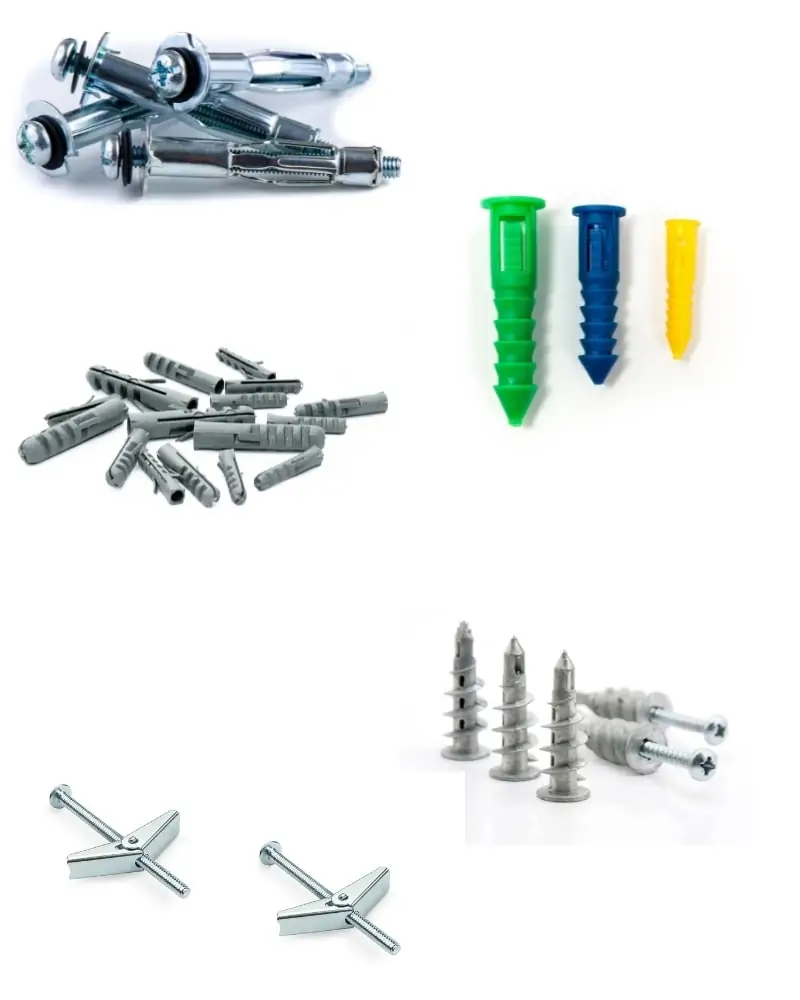
1. Expansion anchors
The most common type of drywall anchor, expansion anchors, are made out of plastic.
The middle will split longitudinally from the tip which expands as a screw is driven into the plastic [1].
Each end splits with grooves and spikes to help the sides bite into the drywall better.
While the most common, they’re also the weakest of the options. Only capable of holding 10 to 20 pounds (4.5-9.0 kg).
Expansion anchors like these are typically included with small shelf sets and can be used for light to medium-weight picture frames.

2. Self-drilling/ threaded anchors
Threaded anchors look like large plastic screws and are easier to install than expansion anchors.
Instead of an expanding tip, the increased surface area is provided by wide threads.
These do not hold that much more weight than expansion anchors and are probably only good for an additional 5 to 10 pounds.

3. Hollow wall anchors
Also called Molly bolts, hollow wall anchors consist of an expanding metal sleeve and a long machine screw.
As the screw is tightened, the sleeve is compressed and expands radially.
This provides an increased surface area and allows for heavy-duty mounting of up to 50 pounds.
The sleeve has a collar at the rear with teeth or spikes that bite into the wall surface and prevent the anchor from falling into the hole during the expansion process.
Because of how the mechanism works, make sure to get the right-sized anchor made for the thickness of your drywall (typically ½ inches) for a tight and secure fit.

4. Toggle bolts
Metal toggle bolts
This type of anchor is the traditional way of mounting on hollow walls and can also be used for ceilings.
These are the strongest anchor type [2], capable of safely holding up to 80-pound (36 kg) loads. This makes toggle bolts great for bike racks, large wood art, large flatscreen TVs, and the like.
Metal toggle bolts consist of a screw and a spring-loaded wing assembly that braces against the wall.
This differs from the other wall anchors that would only be installed during the mounting process.
They’re not reusable as removing the screw will cause the wings to fall into the hollow cavity within the wall.
Plastic winged drywall anchors
While not capable of sustaining as much load as metal toggle bolts (only up to 40 pounds), plastic winged drywall anchors can be installed prior to mounting.
Some winged drywall anchors are reusable, allowing you to remount other objects later without the wings falling off or getting stuck.
Plastic anchors can be installed like normal expansion anchors by folding the wings forward during insertion.
How to pick the right drywall anchor?
The main factor when choosing which drywall anchor to use is the load weight. Refer to the stated load capacities above for each type of anchor.
Another thing to consider is whether screws will be used for mounting on walls or ceilings. For the latter, only metal toggle bolts can safely hold any weight.
Aside from load capacities, do remember that the strength of wall anchors largely depends on the strength of the walls and the linings.
So make sure that walls are in good condition and are capable of taking the load you have.
What tools do you use for drywall anchors?
To install drywall anchors, you need to prepare the following:
- Hammer
- Power drill
- Drill bit set (with screw bits)
How to install an expansion anchor?
- Mark the spot where you want your anchor inserted.
- Using a drill, create a pilot hole. The hole should be roughly the same diameter as the anchor you’ll be using.
- Insert the expansion anchor into the pilot hole. The hardware should be a tight fit. Gently hammer the anchor into the hole until the end is flush with the wall. Avoid applying too much force as the plastic can deform.
- To install drywall anchor screws, lastly, insert and drive the appropriate screw to let the tip expand and bite into the drywall. If you are mounting shelves, do this step first before the actual mounting process.

How to use a self-drilling drywall anchor?
Here’s how to use a threaded drywall anchor.
- Mark the spot where you want your anchor inserted.
- Drill a hole small enough so that only the tip can fit through.
- Grab your power drill once again, this time with a Phillips screw bit, and insert the end into the anchor.
- Drive the anchor as you would with a normal screw until the end is flush with the wall.
- No, you can drive a normal metal screw into this anchor.

How to install a hollow-wall drywall anchor?
- Mark the spot where you want your anchor inserted.
- Drill your pilot hole. This should be large enough to fit the metal sleeve but not the collar.
- Insert the anchor into the hole and strike the end down with your Eastwing hammer until flush. If the collars have teeth, make sure that these dig in.
- Remove the screw completely from the anchor.
- Reinstall the screw during the mounting process. Use a power drill to drive the screw. You will feel a bit of resistance, but that will be just the metal sleeve compressing. Continue driving the screw until the resistance has increased and the anchor feels snug.

Or use a hollow-wall anchor setting gun.
How to use a toggle drywall anchor?
- Mark the spot where you want the toggle bolt inserted and drill a hole large enough for the wings to fit through when folded inward. Do this with a strong and durable drill for all toggle bolts that need to be inserted at once.
- Push the bolt or screw into the hole of the object to be mounted and thread the spring-loaded wing on the other side. The wing should be threaded far enough so that the assembly remains perpendicular to the wall surface during insertion.
- Insert the toggle bolt into the hole. Once you feel or hear a click or snap, pull back on the toggle bolt. The wings should be bracing against the backside of the wall.
- Tighten the screw until the mounted object is snug. You may need an extra hand to pull on the screw in order to prevent the metal wings from rotating.

Any other way to install hardware on drywall?
If the part of the drywall has a stud behind it, there is no need to use anchors. A long nail or screw can simply be used.
However, you can install a drywall anchor without a drill.
If your landlord prohibits you from drilling holes or if you do not have the appropriate tools to do so, good-quality double adhesive tape or command strips can be used for mounting objects up to 16 pounds (7.25 kg).

Maximize your drywall with dedicated anchors!
Drywall anchors allow you to safely mount objects in parts of drywall that doesn’t have a wall stud directly behind wall linings.
It’s surprising how much weight you can actually mount with one of these considering that drywall is usually only ½ inch thick! Remember that the strength of these anchors depends largely on the strength of the drywall itself so I strongly recommend checking your wall quality and condition before proceeding.
And if you want to know if drywall works for mounting TV, read this guide. But if you want to set up wood art on the wall, here’s what you can do.
We hope that this guide has helped you understand how to use drywall anchors for your next mounting project. If you’re looking to fasten wood and concrete, here’s what you should do.
HOLD ON and see you in the next one!
More information:
- How to use drywall anchors, a blog published in https://www.lowes.com/n/how-to/how-to-use-drywall-anchors
- How to install drywall anchors to hang heavy stuff on your walls, https://www.howtogeek.com/319669/how-to-install-drywall-anchors-to-hang-heavy-stuff-on-your-walls/