

- Types of drills and when to use them
- Parts of a drill you should know
- Tips for picking the right drill bit
- Tips for changing drill bits
- How to select the right settings before drilling?
- How to drill holes on a workbench?
- How to drill a hole in a wall?
- What type of drill can drill through concrete?
- How to drill rivets in thin metal sheets?
- How to use a drill to drive screws?
- How to use a drill to make large holes?
- How to use a drill with a socket?
- You can DIY a lot of projects with a power drill.
Last updated on November 20, 2023 10:31 pm
Types of drills and when to use them
According to Aaron Barnett of BangingToolbox: Learning how to use a drill should involve proper knowledge of the drill types and when to use what drill. Here’s your “how-to-use drill guide” for understanding the basics of using a drill.
1. Brushless cordless drill
Power-efficient and portable all-around drills are best for medium to serious DIYers and all professionals for pretty much all drilling requirements.
Using a brushless drill makes possible more repetitive demanding holes using a cordless drill to cut wood, plastic, and metal.

2. Corded drill
Standard workhorse drills are ideal for heavy use and workshop applications.
Consistent power and performance make them suitable for industrial-scale work.

3. Manual hand drill
Using a hand drill is a practical alternative to power drills for kids and craftwork.
Best for home use and on smaller projects such as crafts, jewelry making, and small furniture details.

4. Pin drill
Also known as a pin vise hand drill, these are typically pen-sized hand drills ideal for making very small detailed drilling associated with jewelry making and/or machining.

5. Impact driver
Impact drivers are better for screwing than drilling if you know the difference and can really help from hand fatigue.
They are also better than a lifesaver when it comes to loosening over-torqued and corroded screws and nuts.

6. Impact wrench
If you know how to use a socket on a drill, an impact wrench is a better choice. It is basically a mechanically powered wrench and is a superior choice for loosening or tightening nuts and bolts.
Mainly used by mechanics, especially in automotive repair. And construction workers for managing large concrete and wooden fixings.
7. Dyna drill
Also known as a rotary hammer, Dyna drills are your go-to if you need to easily drill through harder materials like concrete and brick.
They make use of a piston mechanism, making them the better choice over hammer drills for larger-scaled and more demanding applications.
8. Drill press
A benchtop power tool is used for boring precise holes [1] in a variety of materials.
It’s recommended to use one of these overhand drills if you’re more into manufacturing electrical components such as chipboards and metal computer casings.
Or needing to cut repetitive wood or metal holes accurately.
9. Lathe
Large and often industrial engines, lathes are used to produce components that are symmetrical about an axis.
These are used in machining cylindrical surfaces and to form the material into round and conical shapes.
But can also be used with a drill bit.
Parts of a drill you should know

1. Motor
The heart of a power drill. It is what supplies the rotational force to drive the drill bit through the material. Usually comes in either a brushed or brushless variant.
2. Chuck
The mechanism is responsible for holding drill bits. Chucks make use of jaws to clamp down on drill bits and simply need to be rotated to either fit or remove one.
3. Power source
Drills can either be corded (AC) or cordless (DC). Both run on electricity, the difference being corded drills need an electrical outlet while cordless ones run on batteries.
4. Reverse switch
A new feature is being standardized in all modern drills. Mainly situational, the reverse switch toggles the reverse function, allowing a drill to rotate either clockwise or counterclockwise for reversing and removing the bit.
5. Trigger
Usually, a button feeds power to the drill bit. Most drills nowadays have variable-speed triggers, meaning that you control how much a drill puts out depending on how much you pull back on the trigger.
6. Clutch collar
Usually, a rotating collar behind the clutch allows you to select torque settings. Changing gears gives you more options when needing to increase or decrease torque.
7. Drill shaft
Primarily houses the motor and acts as a bridge between the chuck and the trigger.
8. Gear selector
Allows you to change gears and to adjust and set both speed and torque levels.
Tips for picking the right drill bit
Choose bits by type
- Wood bits – These have small, pointed tips with spurs on each side that easily grab and carve away wood. Versatile and the most common drill bits.
- Masonry bits – Often carbide-coated drill bits with sloping horizontal tips. They retain sharpness better than wood bits and are ideal for working with extremely hard materials such as tiles and concrete.
- Metal – Sharp, long-lasting bits with wide-angled point tips. Typically made of HIgh-Speed Steel (HSS), use these to quickly drill through various metal materials.
Choose bits by size
- Softwoods – Use bits 1/64” smaller than the intended hole.
- All-purpose – Use bits roughly the same size as the intended hole for materials other than softwoods.
- General works – If you’re not particular about bit specifications, simply go with ones that are 1/64” larger than the intended hole to account for variables such as material density, lubrication, and threading requirements.
Tips for changing drill bits
- Having an impact driver saves a lot of time as it eliminates the need to change bits if you need to pre-drill holes and drive the screws.
- Have all the drill bits you’ll be using before starting.
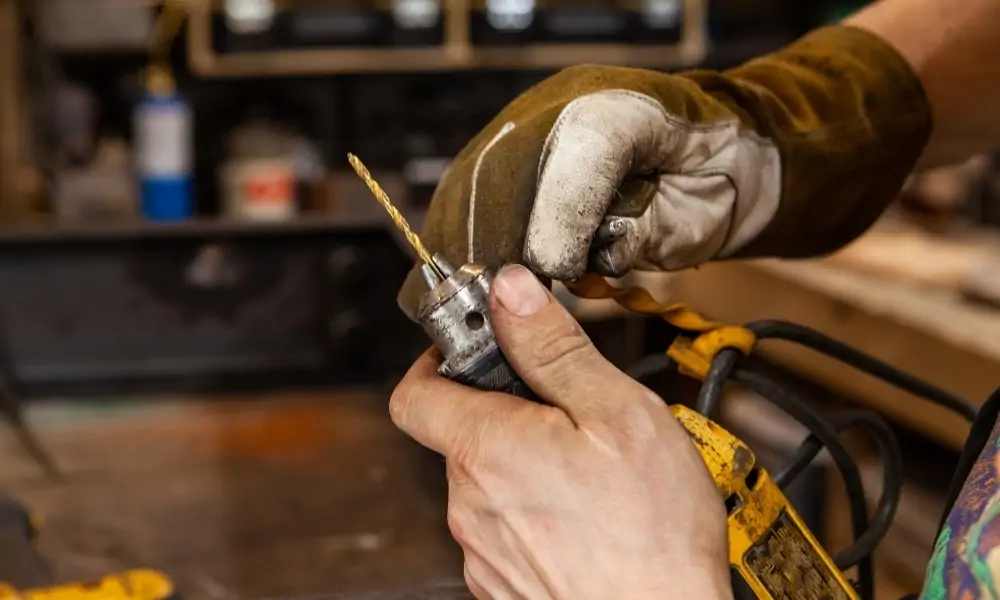
- Always loosen the chuck before changing bits. Never force remove one to avoid damage.
How to select the right settings before drilling?
Most drills have 3 speed settings: low, medium, high.
- Speed 1 – driving screws.
- Speed 2 – general drilling/driving.
- Speed 3 – drilling/driving of anchors or fasteners.
Speed and torque have an inverse relationship. Low speed is higher-torque and vice versa.
Adjust the clutch collar if you plan to drill for larger anchors. Higher torque settings mean larger fasteners.
How to drill holes on a workbench?
Workbenches can either be simple flat surfaces or complexly designed work areas that allow you to effectively and efficiently take on tasks of varying sizes and difficulty with comfort.
Professional woodworking workbenches typically include dog holes that help secure and hold workpieces in different orientations, otherwise, a bench vise or even just standard wood clamps can be used to secure your work before drilling holes.
And if you have no idea how to use a cordless drill, it works just like a corded one just without the hassle of a lead.
Tips:
- Measure and know the size of your workpiece. Pieces too large for a bench vise might need to be manually clamped to the table instead.
- Utilize vises and dog holes to your advantage.
- Use a packer or depth stop to set correct drilling depths and avoid drilling through your workbench, especially for projects that require vertical drilling.

How to drill a hole in a wall?
The key to drilling into walls is to know where exactly to drill [2] using a multi-scanner or stud finder to avoid pipes and wires and to locate studs. Also, make sure to use the right type of drill bit.
Wooden walls need wood drill bits, while concrete and tiled walls need masonry and carbide bits respectively. While you won’t really need jigs, you might need the help of tools like stud finders to help identify other possible obstructions behind the wall.
- Find/identify stud locations.
- Choose your starting point.
- Mark points you’ll be drilling.
- Use a depth stop or wrap a part of your bit in masking tape to get the correct depth.
- Line up the tip of the drill bit with the marks. Only lightly touch the surface.
- Slowly squeeze the trigger and bring the drill up to speed before pushing against the wall.
- Slowly apply pressure until you reach the desired depth. Use the hammer function if your drill has it, especially if working with concrete walls.
- Withdraw with the drill and the bit while it is still turning.

What type of drill can drill through concrete?
Basically, any drill with the correct masonry bit can drill through concrete. Ideally, you’d want to go with drills that have a hammering function or get a rotary hammer for large holes. These drills not only rotate a drill bit but give it extra penetrating power by simultaneously delivering concussive blows.
Dyna drills use a piston mechanism, making them superior to the hammer function for, especially larger tasks.
How to drill rivets in thin metal sheets?
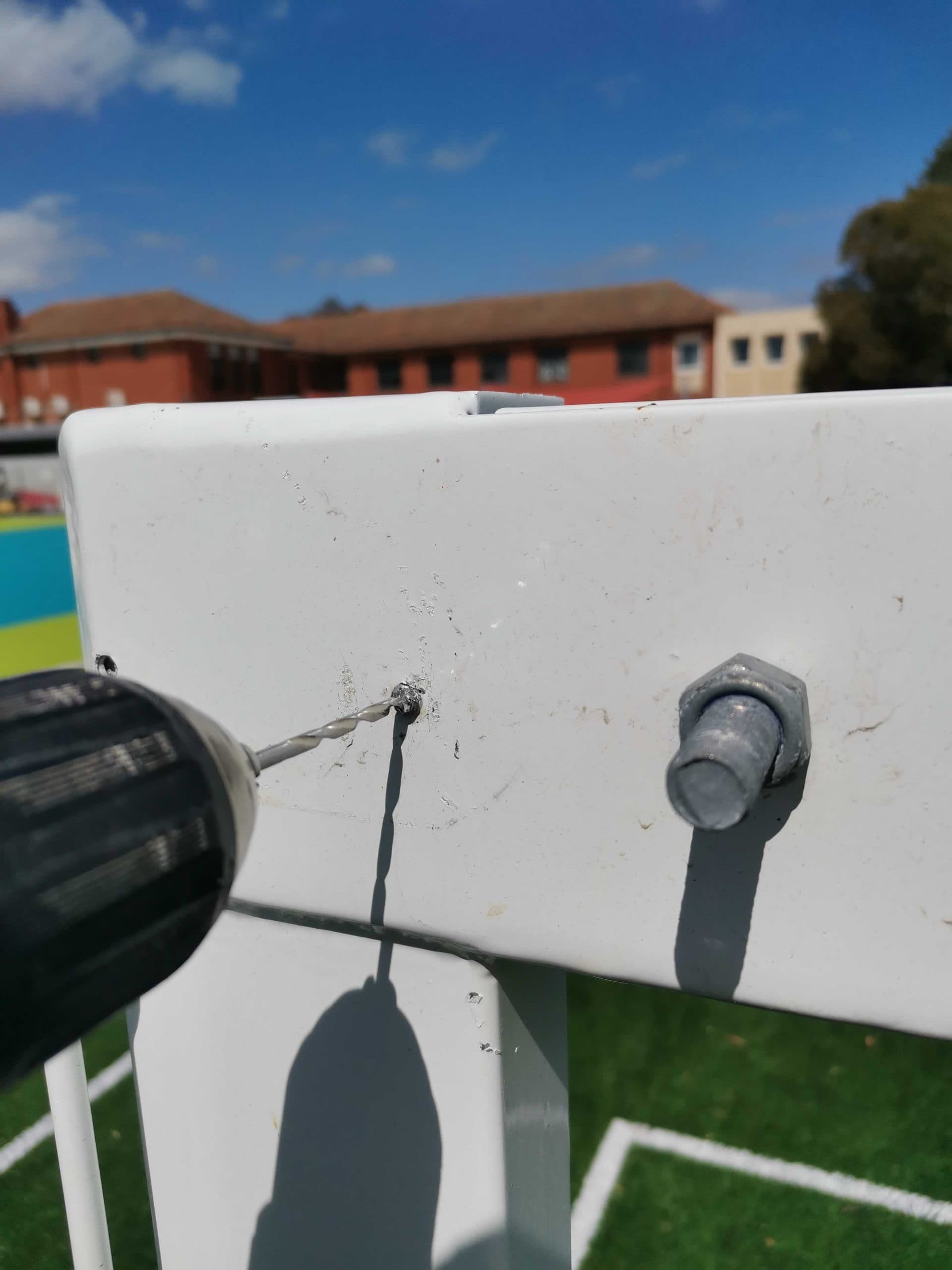
While you can go with an electric drill, a manual drill will also work, it can be easier and more efficient to use pop rivets with a rivet gun over screws. Pop rivets are used on adjoined workpieces where access to the backside isn’t required and a slimmer finish compared to screws is desired.
- Select the size of the pop rivet.
- Select the corresponding rivet adapter on the rivet gun.
- Measure the size of the rivet to determine drill size.
- Select the appropriate drill bit.
- Clampdown your workpiece/s and drill straight through.
- Load up the rivet gun and insert the rivet into the hole/s.
- Squeeze the handles all the way and be sure to pull them as far apart with each stroke.
- Repeat until the pop rivet feed breaks.
- Do this for all remaining rivet points.

How to use a drill to drive screws?
Most cordless drills nowadays are also called drill drivers due to the fact that, with the correctly shaped bit, they can be used to drive screws faster. To use your power drill as a motorized screwdriver, you just need to know what shape the screw head is.
Here’s how to use a power drill to drive screws.
- Select a drill bit compatible with the shape of the screw head (Phillips or hex head).
- Go for low-speed settings (1 to 2 only) for better control.
- Set the torque settings up to average. Avoid going with the higher options to avoid overturning the screws and burring the head.
- Once driving, keep pressure on the screw and let the torque setting guide you exactly when to stop.
- In the event that the bit starts to slip during driving, discontinue, pull it out, and start with a new fresh screw.
How to use a drill to make large holes?
Luckily, there are specialized bits for larger holes and using a drill as a saw. Spade bits, paddle bits, Forstner bits, and hole saws will make drilling large holes very easy and convenient.
- Select a drill bit that has favorable width. A Forstner bit is recommended since it’s relatively easy to control to make symmetrical holes with.
- Once you’ve identified where you want to drill, clamp some scrap material behind the workpiece to eliminate ‘blow-out’.
- Drill normally and apply pressure as you bore through. You can rock the drill slightly back and forth to apply pressure to different sides of the hole.

How to use a drill with a socket?
A drill socket or socket adapter is a tool that functions as an accessory and attaches just like a drill bit and turns your drill into an automated wrench.
Socket adapters come in different sizes and can take on a range of differently-sized socket bits, allowing you to work with various kinds of nuts and bolts.
Can you use router bits with a drill?
Using router bits in a drill is possible, but due to the differences in their design and functionality, it’s ill-advised to use a router bit with a drill.
Drills, unlike routers, are not really built to take on constant sideways pressure and are not up to par when it comes to cutting edges and grooves.

Can you use a drill as a lathe?
Yes. With enough creativity and ingenuity, it’s possible using a drill as a lathe. Though not as efficient as a regular lathe, it is, however, better if you set up an electric drill.
All you’d need is a custom jig to vertically hold your drill and a few fasteners to allow the chuck to support the workpiece.
You can DIY a lot of projects with a power drill.
Though they’re called power drills, they can actually do more than just drill. The ability of the chuck is to hold various kinds of bits and adapters making drills truly versatile and popular tools.
If you think about it, a drill with all the necessary components is enough to replace several other tools when it comes to construction and carpentry. So, the next time you need to bore some holes, you know the drill.

More information:
- Drill press: what is it and when to use it? an article published from https://www.familyhandyman.com/article/what-drill-press-when-to-use/
- Before drilling holes, read this, a guide published from https://www.realtor.com/advice/home-improvement/what-to-know-before-drilling-holes-in-your-walls/


