

Last updated on March 23, 2026 3:48 am
Need a metal-cutting tool with little-to-no sparks?
According to Aaron Barnett of BangingToolbox: Sparks do not only affect focus while working, but hot sparks can also be dangerous.
Whether you are a DIY enthusiast or a metal worker, you can have more options to cut metal without producing sparks if you do your research.
If you have no idea, let me share with you how to cut metal without sparks.
If you like to know how to read on.

Option 1. Use power tools that cut metal without sparks.
Here are the power tools that cut metal without producing sparks.
Bandsaw
A bandsaw is a cutting tool utilizing a long looped, fine-teethed blade mounted and stretched on two pulleys or wheels.
These pulleys continuously rotate in a single direction so that the blade can perform a steady cutting motion through almost any material that will fit onto the bench.
The machine uses a specialized blade that does not get hot enough to burn and produce sparks.
Instead of relying on the heat produced on saw blades to cut, a bandsaw blade utilizes removing hard filings before sparks are formed.
Additionally, some bandsaws can utilize a continuous coolant flow to keep the metal blade extra cool while cutting to also keep the blades sharp.
Here is one thing to remember when using bandsaws to cut metal.
Use blades with more teeth per inch (TPI) for thinner metals and less TPI for thicker metals.
Also, note that using any power-cutting tool will produce metal dust or filings that should be extracted away from you.

Angle grinder with non-spark wheels or cut-off disk
If you only have an angle grinder in your toolbox and got a cut-off disc, you can safely cut metal with this type of attachment to produce minimal-to-no sparks.
Although a non-spark angle grinder disk attachment can get brittle as the wheel becomes thinner, you can use a slower speed to help prevent early shattering.
The non-spark attachment is made of resin-bonded abrasives, including silicon carbide, aluminum oxide, or zirconia alumina, making the blade perfect for cutting softer metals.
Just a reminder not to use the cut-off wheel for harder metals.
If you still do not have an angle grinder in your toolbox, check the corded angle grinders for added power and cordless angle grinders for convenience in our lists.

Nibbler
A handheld power nibbler is all you need for cutting metal sheets without producing sparks.
You can cut metal sheets, sidings, or studs in a breeze.
Nibblers do not produce sparks because the tool does not use heat or grinding to perform the cuts.
Instead, the cutter chews and cuts the metal through with a punch-and-die mechanism.

Electric shears
An alternative to a nibbler is air or electric-powered shears used to cut metal sheets or roofing.
The tool uses two blades facing each other to enforce the cut – much like scissors but for metal.
Unlike other blades, this cutting action does not produce sparks as the process does not produce heat to separate metal through cutting and grinding.

Option 2. Use hand tools to avoid sparks.
Aviation and tin snips
If you need a cheaper alternative to cutting metal sheets, try aviation or tin snips.
Tin snips are like scissors but with longer handles and strong, firm blades for cutting metal without heat or sparks.
Aviation snips are a variation of tin snips that are often angled as either left or right-handed cuts, have two pivot points, and are installed with a spring-loaded mechanism to open the blade after each snip for stress-free cutting.
Tin snips do not produce heat while cutting but use blades that are facing each other.
However, you must apply extra force compared to electric shears or nibblers that are powered by electricity.

Bolt cutters
Bolt cutters are special cutting tools that have extremely long handles and snipers on the tip.
These long handles are the source of superior leverage that cuts through molded metals like rebars, wire, locks, wire mesh, chain links, wire mesh, and rods.
Manual handheld tools like these do not create sparks as two blades perform the cut.
These blades work by shearing the metal piece and using the leverage provided by long handles so as to not require any power.

Hacksaw
A hacksaw is a staple in many workstations and toolsheds.
Every DIYer we know or metalworker we have talked to has a hacksaw as their first metal-cutting tool.
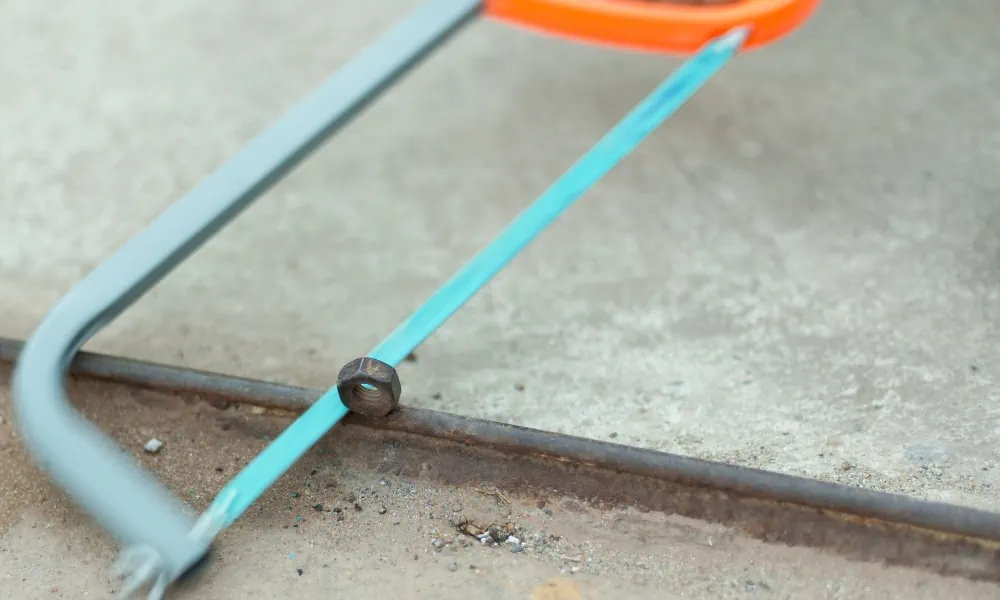
A hacksaw has a C-shaped frame with a pistol grip and a screwing mechanism to mount the fine-toothed blade.
The hacksaw uses a push-and-pull motion to create the cut while the metal is held on a bench vise or clamped on the table.
To summarize a hacksaw is like a hand saw, except the blade is replaceable and the teeth are finer for cutting metal.
Option 3. Use non-spark or spark-reduced metal blades.
Some blades for different metal cutting tools are spark-free, spark-reduced, or spark-proof.
Many companies are now creating non-sparking blades to help cut metals more safely.
These specialty blades do not have iron in their composition.
The materials commonly used in these blades are brass, bronze, copper-beryllium alloys, copper-aluminum alloys, or copper-nickel alloys.
All experts say to us when we visit our metalworking engineers that it is important to set your power tool to a slower speed to prevent blades from burning and blunting.
Slower speeds on angle grinders and bench grinders increase blade life and decrease any amount of sparks produced.
Metals with a higher tensile strength require sharper and stronger blades.
Note that these blades may create sparks too. Lower temp sparks are called cold sparks and won’t ignite flammable materials.
However, all flammable materials should never come into contact with any type of spark.
Although most of these blades are marketed as non-spark blades, they may produce a minimal amount of sparks from our findings. So the term non-sparks can be confusing and misleading.
To Wrap it up
Cutting metal can be safer if you intend to reduce the sparks and have a fire extinguisher nearby.
We have many options to help you cut metal sheets and stock that can help you stay away from the sparks made by power tools.
Now that you know what tools are great (Like nibblers), you’ll never have to be distracted by hot sparks that could become embedded in glass windows or, worse, your eyes.

More information:
- What is a non-sparking tool? A guide published at https://www.ccohs.ca/oshanswers/safety_haz/hand_tools/nonsparking.html


