Last updated on June 1, 2022 5:46 am
Are you spotting burnt grass in your lawn?
Aaron Barnett of BangingToolbox suggests: For proud lawn owners, the only thing worse than weed growth in the precious backyard would be seeing burnt grass. Burnt grass on an otherwise lush, and lively green landscape is like a bad rash on a baby’s skin – unsightly and unwelcome.
Green grass indicates a number of positives. For one, it means that your soil is rich and healthy.
Green grass also indicates that your lawn is receiving enough water, creating a self-sustaining micro-environment where small organisms like ants can interact. In other words, you’d want your yard to always be pristine-green.
The different burnt grass and how they look
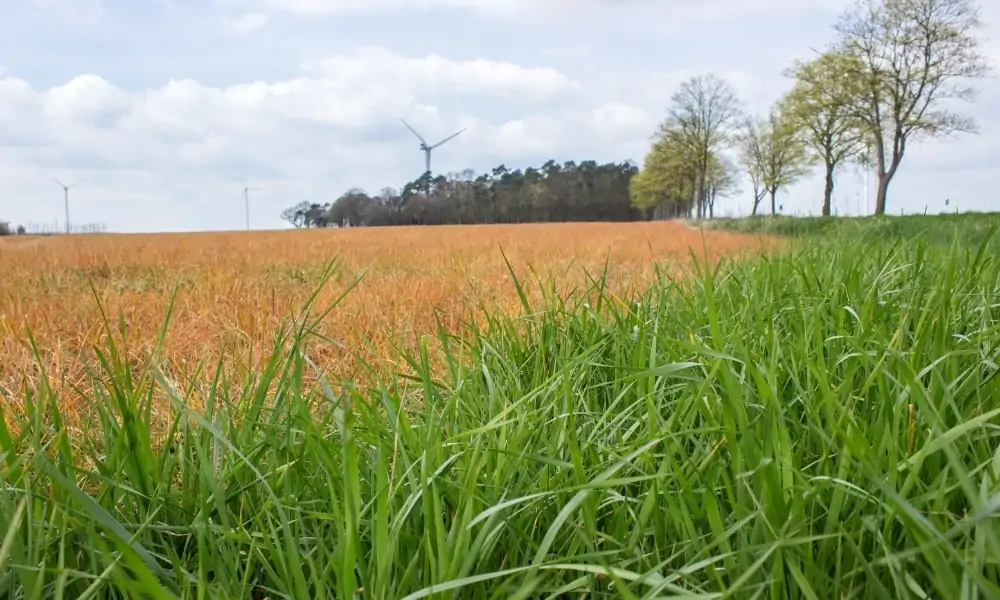
Note that when grass ‘burns’, it doesn’t mean that it actually burned. In most scenarios, grass burning means that there’s something affecting your lawn that gives the grass a scorched/seared look.
1. Brown tips
This type of ‘burning’ is characterized by discolored tips often caused by either a dull mower blade or by fungi known as Sclerotinia Homoeocarpa which can turn the grass tips white or straw-colored, giving it a burnt look.

2. Brown spots/ patches
This type of burning causes yellowish-brown patches to appear on your lawn.
Also known as “Brown Patch Disease”, the main culprit behind this is the fungus Rhizoctonia which kills grass faster during hot and humid weather [1] (hotter seasons).

3. Large patches of dormant grass
Not really a burn, but rather dormancy is grass’ natural ability and response to conserve water and nutrients.
Grass usually enters drought during both cold and warm seasons due to there being little moisture available.
When dormant, grass tends to develop a brownish-tan color, indicating reduced activity.
4. Strips and patches of brown
‘Stripe Smut’ is a perennial disease caused by the Ustilago Striiformis fungus. This kind of burn is characterized by thinned grass blades that often curl into dark brown strips.
Spores are carried by the wind and rain, and can even be transmitted via mowing. Younger lawns during cooler seasons are more susceptible to infection.
5. The entire lawn is brown
When your entire lawn is brown or looks burnt, it can either be a widespread fungal infection, over-mowing, over-fertilizing, accidentally spilling chemicals on your lawn or a combination of two or more of these. OR simply, not enough water.
The overall health of your lawn will determine the range and severity of burning.

Understanding the levels of damage
Earlier levels of damage can still be treated and reversed. Know the instances when does burnt grass grows back.
Early stages
Early levels of burning usually go unnoticed. This is because visible signs are very minute and indistinguishable.
Grass with early signs of damage appear perfectly fine, but therein lies the problem.
Though difficult to spot, if you look closely, certain parts of the grass begin developing a darker shade of green along with the blades.
Middle stages
When you actually start seeing noticeable and visible differences in grass’ appearance, then that indicates that damage has now reached the middle stage.
Though these usually manifest as burnt or browning tips, which make up only a small portion of the grass, this stage is the most crucial and would be the final point at which you can still reverse the effects and have a chance for burnt grass to grow back again.
Late stages
If most of or your entire lawn looks very under the weather despite good care and adequate conditions, then that only means that damage to the grass has reached the late stage.
This stage is often irreversible and requires complete removal and replacement.
The grass is practically dead at this point – dried up and fully brown or a very pale tan.

Reason why grass get burnt
1. Fertilizer burn
Contrary to popular belief, applying too much fertilizer can actually cause more harm than good to plants.
Too much plant food can cause fertilizer burn by building up too much salt in the soil, leading to a detrimental drying effect that turns grass yellowish-brown.
Lighter cases are usually just burnt tips, whereas more severe ones can wipe out an entire lawn.
2. Animal or pet urine
Nitrogen is actually an essential component of healthy soil.
However, urine contains high amounts of nitrogen which can end up damaging and even killing grass.
Depending on how many and how often your pets urinate on the lawn, burning can be as light as burnt tips, or as bad as entire brown or even bald patches of grass.
3. Too much heat
In warmer seasons, where temperatures can be higher than normal, and especially during sudden droughts, the excess heat easily dries up and burns grass.
Burning caused by too much heat is often major and results in brown-patched or even completely dried up lawns.

4. Stress from herbicides
Because herbicides are technically chemicals, they can cause serious damage to grass and even flat-out kill large swathes of newly planted grass.
Though herbicides can effectively deal with weeds, they cause grass a condition called chlorosis which can leave them yellowed or have areas with colorless stripes.
5. Blunt mower blades
A blunt mower blade results in how any blunt edge would perform – a poor cut.
Blunt mower blades end up tearing grass instead of fully cutting it, exposing the turf to various diseases and causing stored moisture to leak.
Check the blades and sharpen them if needed, if you notice patches of your lawn going brown after a trim.
6. Improper watering
Ask any plant and they’ll surely say why over and underwatering is never a first class thing for them.
To cut the long story short, not taking care of how much and how often you water your lawn with respect to the season and climate can cause the grass to have shallow roots. More details are below.
7. Shallow roots
When plants have shallow roots, they’re not as strong and healthy as they’re meant to be.
Grass with shallow roots is often thinner, resulting in lower resistances and tolerances.
Signs that your turf might have shallow roots are when they squish hours after a first class douse or when patches of grass seem to die after every quench.

8. Excessive thatch
Thatch is the build-up of old and dead grass material.
Too much thatch can cause spongy lawns which, in turn, will result in overall less healthy grass due to the thatch compromising the grass’ ability to take in air, water, and nutrients from the soil.
9. Fire
Whether natural, by accident, or on purpose, setting the grass on fire will definitely burn it, leaving behind only black, ashen remains.
Excessive thatch is usually treated with fire, while the spots with thatch will be completely burned, the surrounding soil is also greatly nourished.
How to get burnt grass green again?
1. Regular mowing
Regular mowing is knowing when it’s right to cut grass.
Unbeknownst to many, you actually have to let the grass grow to a certain height before cutting. This helps facilitate better growth and reduces the chance of harming juvenile lawns.
Always ensure that your blades are sharp. Aim to reduce grass height only by about a third.
Keep frequency in mind depending on the season – cut fortnightly in early spring and weekly in late spring and summer.
Maintain lawn grass height anywhere between 2.5 – 4cm and always mow on dry days when the grass is standing up straight.

2. Watering
Moisture is everything for plants.
The general rule to remember is to water more frequently during hot periods and less on colder ones and to only water once the surface is dry between waterings.
Apply an inch of water on your lawn once a week in the morning for burnt grass to grow back.
Avoid watering mid-day since 65% of the water would likely be lost due to evaporation.
Also, avoid watering at night since it’ll leave the soil wet for about 12hrs which is likely to develop harmful fungi.

3. Using sugar
Weed control is necessary to facilitate better, healthier lawn growth. Sugar is actually an organic substitute for commercial herbicide [2] and can prevent weed growth by creating a controlled low-nitrogen soil environment.
You can sprinkle powdered sugar on your lawn or use a solution molasses spray that’s 1 ¾(420ml) cups molasses mixed with about 10 gallons of water.
Lightly and evenly coat your lawn with the sugar treatment and continue regular watering. Recommended to sugar-treat your lawn in spring, before weeds start to seed
4. Plant new seeds
Rehabilitating patches or entire lawns from burns will require you to plant new grass seeds.
When it comes to planting new seeds, timing is the most important factor.
Depending on your lawn grass’ growth cycle and climate preference, it’d be best to align planting seeds with their respective period of active growth.
As a general rule, consider planting new seeds beginning fall for cool-season grasses. And starting spring for warm-season ones.
5. New sod
Depending on the severity of burns, grass can actually die back in places. If this is the case, then it’s time to consider installing new sod.
Fortunately, new sod isn’t that hard to get hold of, but what you have to bear in mind is the time of year.
Laying new sod in the fall will require regular watering and fertilization. Laying in winter requires reduced but regular watering. Expect dormancy.
Laying in fall has to be precise – ensure that there are no more opportunities for freezing before laying and keep the sod extra moist. Lay down a little fertilizer too for healthier root growth.
Lastly, laying in summer is difficult because the new sod will need to be regularly and consistently kept moist.
Fertilization and constant adjustments to watering cycles also make it a hands-on task that might be difficult for new lawn owners.
6. Fix the drainage system
First, pinpoint where the drainage problem lies. It could be a case of overwatering, so cut back and observe potential trouble spots to be able to rule this out.
If excess runoff from your gutter builds up too much water, then consider extending the downspout further away.
What a downspout extension can’t fix, a creek bed or swale probably can. If there’s too much water for a creek bed to handle, then you can construct a rain garden to make the most out of soggy patches of soil.
Lastly, you can consider installing a french or dry well to drain excess water from beneath the topsoil.
7. Using fertilizer
The nitrogen in fertilizer helps promote healthier soil, which in turn helps to grow healthier grass.
However, fertilizer also builds up salt in the soil, which can cause burning if applied in excessive amounts.
Keep in mind that it’s best to use fertilizer sparingly – 4 times a year for new lawns and 1 – 2 times for seasoned ones.
Make sure to apply feed evenly, walk back and forth in straight lines, and overlap layers in the middle.
Lastly, you can apply fertilizer in any season except for winter – the grass will likely be dormant and it’s better to feed seedlings during warmer seasons anyway.

How to quickly regrow your lawn?
How long for burnt grass to get green again? Whether it’s reviving large patches of dead grass or the entire lawn itself, below is a simple step-by-step that shows how you can restore your lawn to its pristine, sea of green state. Here’s how to turn burnt grass green quickly:
- Determine if the lawn is either dead or dormant. Remember that in cooler seasons, grass enters dormancy to survive – observe and rule out dormancy first as regrowing a dormant lawn out of panic will burn a lot of resources.
- Though you can pretty much restore at any time, the best period would be in early spring or fall.
- Start by getting rid of weeds that came in when your lawn was stressed and browning out. You can use sugar to impede new weed growth or herbicides to snuff out any that you missed but do plan ahead if you intend to go this path.
- Mow grass to about an inch tall and rake away any debris and dead grass.
- Plant new grass seeds in completely bald spots or lay down new sod. Make sure to water them down nicely a day or two before applying fertilizer. Apply soil enhancer and continue with regular watering.
- Maintain proper and consistent care until new sprouts reach about 3-4 inches in height for their first mowing.
- Follow through with regular care and maintenance, feed new grass and sod up to 4 times for a year then cut back to at most once a year to facilitate healthy growth.


Repairing the entire lawn
Repairing a lawn is actually a larger project than just reviving it. Lawn repair entails several attempts to restore, replace, and just outright fix any trouble spot/s. When a lawn becomes too unruly or barren, then it’s time for a repair. Below are some general steps you can take to start off any repair project, be it large or small.
Here’s how to make sunburnt grass green:
- Remove or vacuum gravel and pebbles. In part of the cleaning phase, small objects like these on the surface hinder grass growth and mess with soil texture and consistency.
- Get rid of any weeds, dead material, and even consider replacing the soil in very severe cases. And re-leveling the ground.
- Ensure that irrigation and drainage are optimal. If there were problem spots before, address them as needed and make sure that nothing contributes to the soil being drenched even amidst adverse weather conditions.
- Plant new grass seeds and lay down new sod in areas that have been heavily compromised. If uniformity will be a concern, then consider replanting or re-sodding the entire lawn. Get the right shovel type for this job.
- It pays to be precise. Make use of a spreader if possible and measure its “throw”. When fertilizing, space passes, and be sure that the coverage overlaps at least 6-8 inches.
- Add soil activator or booster to help with initial growth. Feed and regularly water restored portions. Mind the season and always be sure to consistently follow through.
- Avoid using chemicals early on for newly repaired lawns. Allow grass to grow to acceptable heights before cutting with a sharp mower.


Keep track of your lawn care!
Taking care of a lawn can be equally as tough as taking care of a child or pet. In some ways, lawn care can even be more challenging since grass is a lot more sensitive to weather than people or animals.
Burns are unsightly for any green pasture, but are sometimes unavoidable, especially if you’re not aware as to what can cause them.
Now that you’ve been informed, it’s time to get back out there and earn that fire-prevention scout badge for your garden!
More information:
- Turfgrass diseases: brown patch, an article from https://extension.psu.edu/turfgrass-diseases-brown-patch-causal-fungus-rhizoctonia-solani
- Sugar from cyanobacteria is a potent herbicide, an article from https://www.chemistryviews.org/details/ezine/11130562/Sugar_from_Cyanobacteria_Is_a_Potent_Herbicide.html