- Cutting wooden slabs by hand? With a chainsaw?
- What do you need?
- Step 1 Log preparation
- Step 2 Perform measurements.
- Step 3 Attach the rail to the log.
- Step 4 Prepare the chainsaw.
- Step 5 Attach the chainsaw to the chainsaw mill.
- Step 6 Position the chainsaw mill.
- Step 7 Push the chainsaw blade to make the cut.
- Step 8 Remove the rail and the first slab.
- Step 9. Reposition your chainsaw mill.
- Step 10 Edging
- Now you have a set of slabs
Last updated on March 23, 2026 10:46 pm
Cutting wooden slabs by hand? With a chainsaw?
The idea of owning a portable chainsaw mill for the first time might send overwhelming signals through your circuits with new DIY ideas that will flood your mind and home with wood-work.
When you have all the chances of utilizing fallen trees around your property, all the ideas and opportunities will come racing through your mind until you start slabbing.
Aaron Barnett of BangingToolbox suggests: But it’s not that easy for just anyone to do. Even a smaller portable sawmill without the bulky frames will take time to learn to operate.
Not everyone has the chainsaw milling skill at the beginning. But when you’ve made your first few slabs, you’d find it satisfying.
So if you are excited about it, go get your toolbox and prepare to slab a log with a portable chainsaw mill!

What do you need?
- Log support/ stand
- Power drill and drill bits
- Screws
- Spirit level or a laser level
- Chainsaw (With a long bar attachment)
- Portable chainsaw mill
- Ripping chain
- PPE (Helmet, earmuffs, safety shoes, safety gloves)
- Marker
- Tape measure or ruler
- Hammer and nails
- Paintbrush and end sealer (paraffin wax, latex paint, or polyurethane shellac)
- Chainsaw sharpener
Step 1 Log preparation
Choose a log that has the same width as your chainsaw bar. You can remove the bark before cutting or let it be.
Milling facilities would have log support. Meanwhile, you can do it yourself with pieces of old timber by joining them and bracing the feet.
If you already have a log stand, just place your log for slabbing. Invest in a forklift trolley if you will be milling more often.
Take your claw hammer, secure the log with wedges, blocks, or straps, and ensure that it does not move or roll from the set position.

Step 2 Perform measurements.
The next phase of log preparation is performing measurements. This measure ensures that you will cut slabs for an even surface, equal thickness or width.
Below are the necessary measurements needed to help you attach the rail later.
Rail placement
Rail placement provides you with a starting point to cut slabs. The rail placement is the distance from the end of the log to your desired starting point.
While the rail provides stability and support to the chainsaw mill, the rail placement will help you decide on your desired cutting dimension.
After deciding your desired cutting area, mark the starting point you want to make the first cut.
Use a ruler and pencil to mark the first slab. Use a spirit level to ensure the slab is flat and level.
In this mark, you will place wood blocks that will serve as brackets at both ends where you can safely secure the rail.
Some people directly attach the rails and proceed with the first slab. But if you care for accuracy, you need to set the rail placement.
You should use a dedicated aluminum straight edge on both the left and right sides of the chainsaw mill to ensure a straight and flat cut. You can even use an old rail ladder.

Rail width
The rail should support both ends of the chainsaw mill a center rail can hold the weight of the mill, but you will need more effort to keep the cut straight and square.
You can mark your desired timber width, including the additional measurement of the thickness of the rail guide.
Reference points
If you’re achieving certain dimensions and a number of slabs, mark the log with reference points. Mark it for equal thickness or widths on each slab so you can count how many slabs you will get from a log. Make sure to allow extra when thinking of the results of the finished product.
You will have wastage from the chainsaw cut and from what will be removed by a thickness planner after the slab is ruff sawn.
Some chainsaw mills feature measurements in inches and centimeters. But if not, a tape measure or ruler will do.
Draw a line on your reference points. These reference points will serve as your guide on where to start.


Step 3 Attach the rail to the log.
The rail will serve as your guide on the direction of the chainsaw mill while cutting. Referring to your mark, screw the wood brackets on both ends.
Check if they are level. After screwing the brackets, mount the rail and fasten them into the log. Check for levelness one more time.
Step 4 Prepare the chainsaw.
When slabbing a log with a chainsaw mill, you should replace the standard chain with a ripping chainsaw blade. Make sure you have a chainsaw that is powerful enough.
Untangle the chainsaw blades and place the new ripping chain on the chainsaw bar.
Keep the teeth cutter facing forward. You want the chainsaw ripping chains tight enough without being too loose.
Reassemble your chainsaw and top it with fuel. Inspect the bar oil. Make sure your chainsaw has enough bar chain oil. And remember to top it up between cuts.
TIP: Bar oil lubricates the chainsaw blade and stops the blade from overheating and snapping. If the blade starts smoking and not cutting well, the bar oil has run dry.

Step 5 Attach the chainsaw to the chainsaw mill.
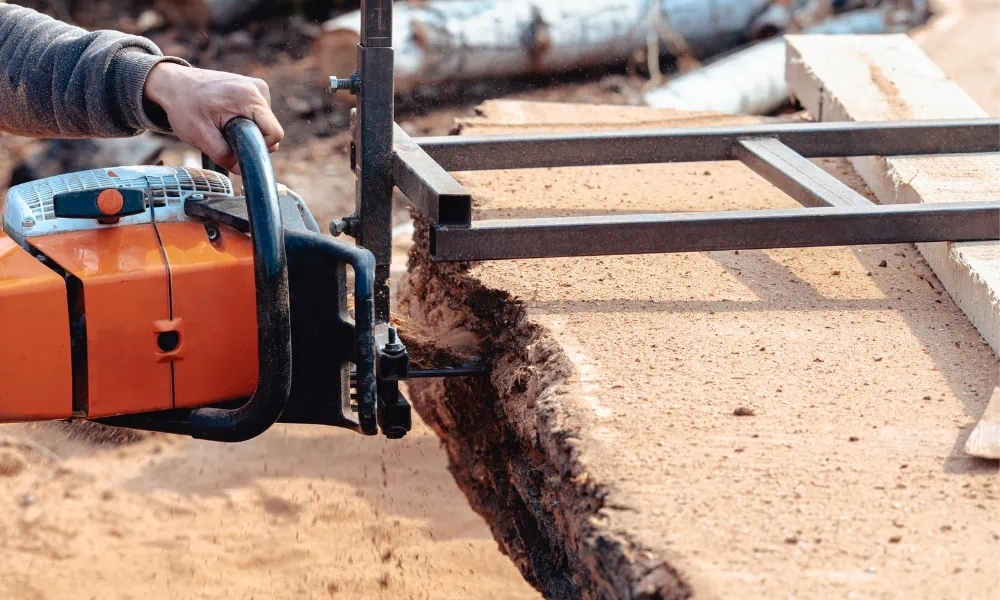
Slide down the chainsaw bar into the portable chainsaw mill’s mounting bracket. It should fit in securely without obstructing the chain while running.
Secure the chainsaw bar into the mill using the provided hardware, which could be bolts, nuts, and clamps.
Once attached, check the alignment with the mill. Make sure it is fit, straight, and level. For safety, test run your chainsaw while attached to the mill.
Step 6 Position the chainsaw mill.
Turn the chainsaw mill on. Place the chainsaw mill on the rail with the blade directly facing the cutting mark for the first slab.
With the rail you’ve set up, your chainsaw mill will follow the rail and will not be out of track.
Remember you and your helper need to wear all the appropriate PPE – Long trousers, ear protection, face and eye protection. I prefer not to wear gloves so I have a better grip.
When protection is there and you go slow, with a helper on the other side, it’s a pretty straightforward job. Just guide the machinery to make the cut, making sure to spend the effort and time on all of the preparation work.
Step 7 Push the chainsaw blade to make the cut.
Use both your hands to push the chainsaw mill. Use one hand on the chainsaw mill handle while the other one is on the chainsaw handle.
The milling process for the first slab will not be as smooth as you expected. But constant practice will help you handle the chainsaw mill better as you work on its weight and the vibrations by the chainsaw. When you cut the second slab, you will have a flatter surface to set your guides to.
Make use of a friend to hold the other end of the chainsaw mill for more controlled and safer cuts on bigger mills made for two people to operate.
Use timber or plastic wedges on the starting side of the cut to take some weight and to stop the top slab from binding down on the chainsaw blade.

Step 8 Remove the rail and the first slab.
Now that you have cut the first slab, the surface will be smooth enough to be your guide.
You can remove the rail first, then follow with the first slab. Depending on the thickness and weight, you can safely remove the slabs with a forklift. Or a makeshift crane.

Step 9. Reposition your chainsaw mill.
After removing the first slab, you can repeat the same process. However, you do not need to use the slab rails anymore. Clean the sawdust produced when cutting.
Place the chainsaw mill above the log. Go back to your cutting marks and face the chainsaw blade into your reference points.
Once the chainsaw mill is in its place, cut your second slab. Take it off and clear the surface. Repeat these steps for the next cuts.
One thing you should remember after one or two passes is to check on your chainsaw blade. Sharpen the chainsaw blade to avoid putting strain on the motor and keep the chain cutting smoothly with top-ups to the bar oil.

Step 10 Edging
If you want the ruff-sawn outside edge as a woodworking feature, keep it! However, if you are also looking to remove the outside edge for a milled timber surface, you can make use of an edging mill, like a chainsaw mill. You can instead cut verticle up and down cuts.
If you only have a bit to do, you can also use a corded circular saw with a straightedge guide. Or a track saw.
Now you have a set of slabs
Prepare your slabs for drying because you cannot use them right away.
Take a paintbrush and seal the ends of the freshly cut slabs. This measure prevents your slabs from cracking or splitting while drying.
Allot a drying area for your slabs, and make sure to use spacers when stacking them.
In the meantime, plan your next woodworking projects for your new slabs. There’s so much room for creativity and unique woodworking opportunities.
You can build tables, mill your own framing, build wooden slab staircases the list goes on. You cannot buy a product that you can make yourself here!
So if you’ve decided to utilize the abundance of trees on your property, invest in a chainsaw mill that you can take to places.