Last updated on May 29, 2024 9:42 pm
Quick questions

How much torque is needed to remove lug nuts?
You need 80 to 100 ft-lbs. You would need more if the lug nuts got stuck or already rusty.
Is tightening torque greater than the breakaway torque?
In normal circumstances where fasteners are not stuck or rusty, the breakaway torque needed may be less powerful than the tightening torque.
What factors to consider before getting an impact wrench?
When getting an impact wrench, consider your applications, the durability of the impact wrench, flexibility and design, and adjustable torque.
Measuring needed torque for your impact wrench job
Aaron Barnett of BangingToolbox recommends: There is a specific amount of torque needed for an impact wrench.
Being careless and not mindful of the torque could be damaging since, with too much torque, threads and bolts can crack or break.
And with not enough torque the fastening is not secure enough and can come undone.
In mechanics, over-torquing can damage bolts and threads.
And speed is a result of the amount of power and force delivered from your tools.

What affects finding the right torque setting
Here is what to think about when deciding what impact wrench to use:
The first function is the power of the impact wrench, which will determine the power of the torque that can be applied.
Second, the size of the fastener, screw, or bolt that you’re going to work with.
The bigger the object you’ll need to tighten or loosen, the more power or torque you’re going to need.
Third, application. Where will you use an impact wrench? For your car? Or for building and construction?
Lastly, the type of impact wrench you are using will determine if you have torque settings.
You need either an attachment for a cordless impact wrench or the right pneumatic air-powered wrench for exact torque application in sensitive areas. Of engineering.
You need to have a complete set of sockets when dealing with a range of different bolt sizes.

For pneumatic impact wrench
Other factors for getting the right torque for air impact wrenches are as follows.
First, understand the line pressure from where the force travels from the compressor to your tool.
Secondly, the tool pressure. Control the pressure from your impact wrench with the help of an air regulator attached to your compressor.
This way you can avoid the sudden blow of pressure from your tool and cause accidents or over-tightening and stripping of bolts.
This is generally everything you need to know before using or buying an impact wrench to work with.
So you can pick the right impact wrench for you and your projects and refrain from getting the wrong tool if you need exact torque control.

The implications of wrong amount of torque
An impact wrench harnesses an immense amount of torque from the hammering mechanism in the tool.
It will depend on the size of the fastener, if you have a large-sized lug nut then you will probably need an impact wrench that generates a high level of torque.
However, that won’t save you if you ever tighten a fastener too hard or too loose. Over-torquing the nuts or lug nuts may stretch or even strip the threads.
It may also result in the imbalance rotation of the nuts if it’s tightened too hard.
As for applying less torque than the minimum, this resolves to loose lug nuts [1] which may possibly fall out, and the nuts not being able to hold on as expected.
Know what fastener you are dealing with and the amount of torque that you need to avoid over or under-torquing.
How much torque do I need in an impact wrench?
Consider the applications
The amount of torque needed on an impact wrench depends on the task you would want to accomplish. Keep in mind there are different factors that can affect the torque needed in an impact wrench.
You cannot use the same amount of force for every particular task, torque strongly depends on the force of direction, magnitude, and point of application.

Torque for cars vs trucks
The torque needed for cars and trucks is different, despite both being automobiles.
Trucks need more torque than cars since the components are a lot heavier and are built to transport heavy loads, this principle applies to trailers and buses too.
Cars have less torque needed compared to heavy trucks.
General ranges of torque are needed for heavy to light automobiles, trucks, and cars.

Torque can be measured either ft-lbs (foot-pound) or Nm (Newton Metre)
The torque needed for impact wrenches working on lightweight trucks is around 125 – 400 ft-lbs.
The torque needed for an impact wrench working on medium to heavyweight trucks is 200 – 900 ft-lbs.
The torque needed for impact wrench working on cars is 70 – 145 ft-lbs. For this, I would have ready a set of 1/2 sockets in my trunk,
Considering the thread size
Before exerting the needed force for your truck or car, evaluate the thread size, rim, mounting, nut or stud type and the suggested torque specified by the manufacturer for each part.
The general thread Size for light trucks is 9/16 – 18 to M20 x 1.5.
General thread Size for medium to heavy trucks is 3/4 – 10 to 15/16 – 12.

For rail construction
Situations, where much more torque is needed due to bolt size and materials, are usually involved in heavier construction work.
So the torque rating impact wrench needed for drivetrain work is 700 ft-lbs or more, contrasting to bolt sizes.
By bolts and nuts
Different bolts and nuts also have their own amount of torque.
How much torque do you need in an impact wrench for lug nuts?
- 80 – 100 ft-lbs
How much torque do you need in an impact wrench for an axle nut?
- 15 – 20 ft-lbs
Lug bolts are threaded stems that are attached to the tapered head [2], while lug nuts are bolt threads are found to be fixed into the hub. Axle nuts are used to secure an axle to each wheel.
For carpentry
Torque is also widely used in carpentry impact wrench applications and some professional mechanical jobs.
Carpenters take into consideration the surfaces wherein the bolts go, which could be wood, metal, rubber glass, etc.
Some would also use impact wrench drivers and pneumatic wrenches whichever fits and does the job easily and properly.
For this job, most carpenters would have 1/2 inch sockets in their toolbox as well as a 3/8 inch socket set for smaller jobs. Wherever torque is applied with too much or too little force, this can be unsafe and pose a hazard.

What can you do to get the right torque for an impact wrench?
There is no standard torque for an impact wrench, although using too much or too little torque could result in a project mistake and even a threat to people’s safety.
To be able to tell how much torque you need to know everything about the particular task, bolt size, and type of impact wrench.
And only then apply an impact wrench to attain the exact torque needed.

When choosing an impact wrench
Here is what to consider when using an impact wrench;
Bolt sizes, the application, and adjustable torque.
An impact wrench is a powerful tool commonly used in automotive applications and, construction projects, including on scaffolding.
The tool is used to tighten or remove bolts, screws, and fasteners.
Air (a pneumatic impact wrench) or electricity (with an electric impact wrench) are the most common sources of power for impact wrenches.
So pick and use the right kind of impact wrench needed for the job since both types have different power sources.
Consider the connectivity of the specific impact wrench tool. And remember to keep your sockets neat and tidy.
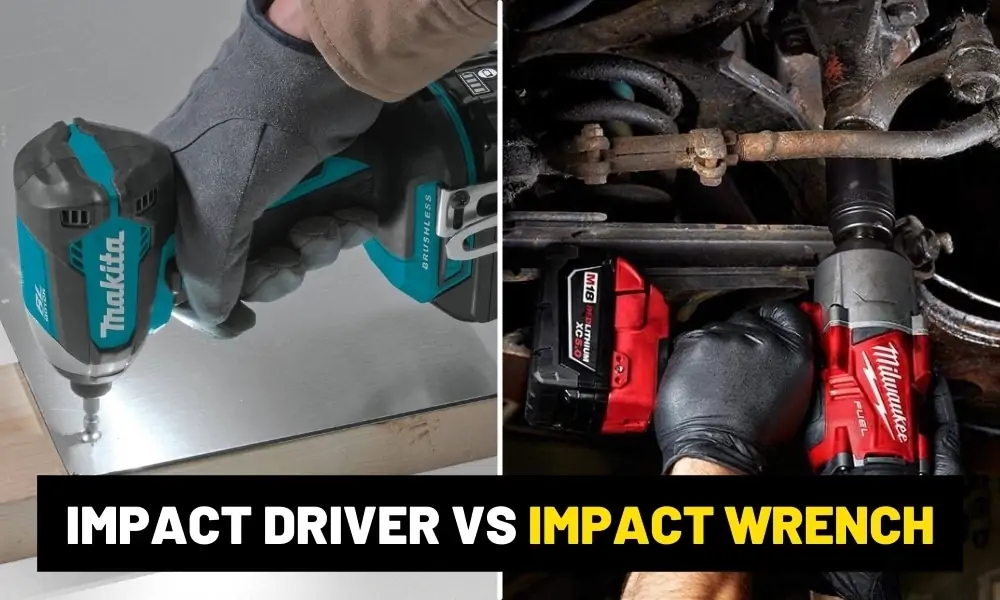
Cordless is also a kicker. Do not mistake an impact wrench for an impact driver though that can also work for small 3/8 bits and jobs with an attachment.


A few more reminders
Exact torque settings and reading is required for mechanics and engineering on vehicles.
But for building and construction and attaching fasteners to concrete or wood: as long as each fastener is fully down and tight the fastener is secure.
The chippy or DIYer can feel tightness when operating an impact wrench when tightening to wood or concrete.
Concrete and wood are hard to strip out from over-tightening making overtightening rare.
If over-tightening happens you will feel the bolt spin lose.
You can then remove the fastener and install the bolt in a new location.
With mechanics, you have to be more careful and avoid damaging the thread on expensive mechanical parts by using specific torque settings found with pneumatic tools and a compressor.

More information:
- The dangers of too much, too little torque, a blog from https://www.tirebusiness.com/shop-floor-wheel-torque/danger-too-much-too-little-torque
- Lug bolts vs lug nuts, an article from https://knowhow.napaonline.com/lug-bolts-vs-lug-nuts-whats-the-difference/