
Last updated on March 19, 2026 1:24 am
Is your chisel worn out or blunten?
According to Aaron Barnett of BangingToolbox: Nothing is worse than hitting a blunt chisel on your woodwork. Hitting your chisel harder with a hammer or a mallet, will put more pressure on a superior quality wooden-handled chisel and can damage a quality handle quickly while resulting in a poor rugged cut on your work and timber.
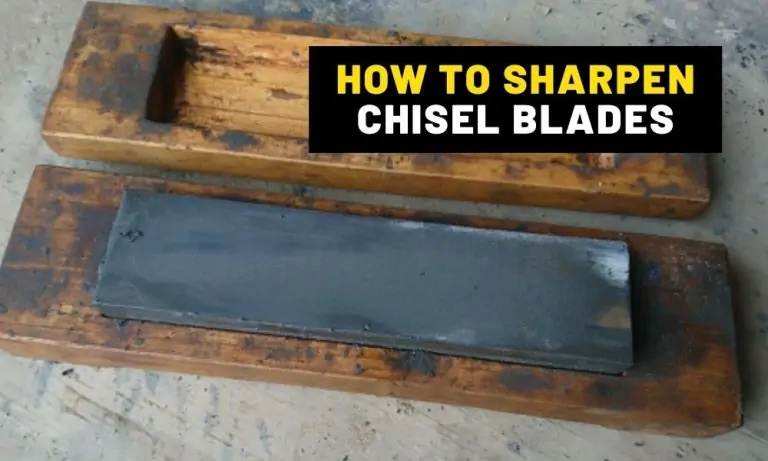
Instead, make sure to always have a sharp chisel and follow this guide on how to sharpen a chisel blade by using a bench grinder or a sharpening stone.
Tools you need to sharpen a chisel blade
- A bench grinder.
- A cup of cold water.
- A sharpening stone.
- A strap of leather.
- Safety glasses.
- Ear protection.
For noticeable dents or the need to hone a steeper angle on a blade, using a bench grinder should be your first step with a cup of cold water nearby to dip the chisel in periodically to stop the metal from overheating and burning.
When your chisel is as close to sharp as possible with a bench grinder, you want to do the final hone using a sharpening stone, also known as whetstones.
They come with two different grits on each side starting off with the more coarse grit and finishing with the finer grit at the end.
And you need basic PPE like glasses and ear muffs for when you use the grinder and sparks are flying around with the nice that comes with it.

1. Bench grinder
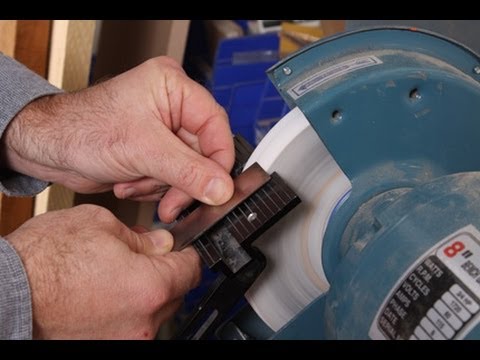
A Dewalt 8 inch bench grinder mounted down to a stable workbench is useful for grinding any metal including tools that are in the need of sharpening.
Any blade that has hit a nail and has a big chip will need a bench grinder to quickly grind it out.
Read here to find out what is better a 6 or an 8 inch bench grinder.

Pros
- The fastest way to remove metal for a clean fresh blade edge.
- Easy to control as you only need to guide the tool you are sharpening.
- Pretty safe as long as you take care and use the correct PPE.
Cons
- Can’t get full sharpness with a bench grinder alone.
2. Sharpening stone
A wood chisel sharpening stone is pretty handy to have as they are universally useful for sharpening any kind of blade, from woodworking chisels, carving chisels, knives, and even hand or electric planer blades.
Sharpening stones do last a long time they still do wear-out on the most used face of the stone, therefore you want to develop a sharpening technique, to wear the stone out evenly.

Pros
- Can get a chisel or any tool blade as sharp as you want.
- A sharpening stone is cheap and easy to buy.
- It will last a long time (even longer with a technique discussed below).
Cons
- Cannot remove chips or hone a new angle to a blade that has been sharpened already to many times without the assistance of a bench grinder.
1. How to use a bench grinder to sharpen a tool blade?
Here are the steps for sharpening your chisel with a grinder.
- Hold the right angle – Hold the chisel against the grinding wheel with both hands on the correct angle specified in the instructions that come with your sharpening stone.
- Swipe the blade – Move the chisel or blade you are sharpening from left to right as to take off an even amount on each swipe.
- Stops the blade from overheating – Every 2 – 4 swipes you should remove the blade from the friction and dip it in some cold water to avoid overheating. If you do overheat the blade it will burn and turn black letting this happen can degrade the strength of the metal and cause future chips more easily it can also help to use a slow speed or a variable speed bench grinder.
- Be satisfied with the finish – After you have removed any chips and achieved the cutting angle you want you can move to the sharpening stone steps.
Safety tips
- Never use a grinder close to a flammable source [1].
- Don’t use a grinder near a glass window, as hot metal sparks can embed into the glass and damage it.
- Sparks don’t burn your skin burn but be very careful with your eyes and wear safety glasses.
- Make sure you have a firm grip of the chisel and the bench grinder is bolted down securely so that it doesn’t move during operation.
2. How to sharpen a chisel blade using a sharpening stone
Most sharpening can be done from the beginning if there are no dents with a sharpening stone, the sharpening stone is also needed to get the final razor-sharp hone.
- Choose the low grit side – Choose the low grit side of the sharpening stone first that will more quickly sharpen a chisel.
- Lubricate the stone – Use some sharpening stone oil, or just any general oil to lubricate the stone.
- Use a figure 8 motion – When you start to slide the chisel up and down the stone decide to use a figure 8 motion at the angles specified by your chisel manufacture. A figure 8 will avoid un-equal wear and tear on your stone and help it last longer.
- Choose the high grit side – Once it’s sharp and the angles are smooth flip the stone to now hone with the higher grit side of the sharpening stone.
- Remove any burrs – Once you think it is sharp, you need to remove the burred edge to do this scrape the blade backward on some leather, like some leather work boots.
- Tet the blade for sharpness – Test the blade’s sharpness by taking a slice out of some wood, if the chisel is not easily and smoothly shaving wood, repeat the above steps again this can take 2 attempts.
- Add corrosion-resistant oil – After you are satisfied with the sharpening apply some lubricating oil to prevent rust build-up like silicone spray.
Get your blunten chisels ready.
There you have it, the two best tools to sharpen your chisels are a bench grinder and a sharpening stone. Quickly remove any dents and hone your angle with a power tool, then get your blade perfectly sharp using a sharpening stone.
If it’s time to upgrade to a better chisel set read my chisel recommendations here.
More information:
- Know what is a flammable source for safer grinding, https://www.ccohs.ca/oshanswers/chemicals/combustible_dust.html


